


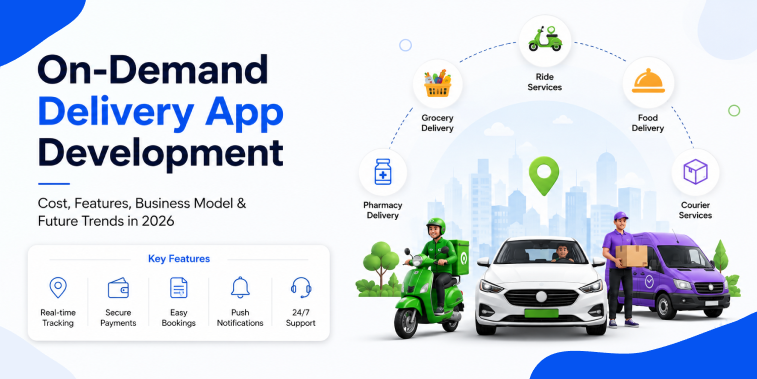
The on-demand economy has transformed how people purchase products and access services. From food and groceries to medicines and parcels, customers now expect fast deliveries directly to their doorstep. Businesses that fail to meet these expectations risk losing customers to competitors that offer convenient digital solutions. This growing demand has made on-demand delivery app development one of the most profitable investments for startups and enterprises in 2026. By leveraging advanced technologies such as artificial intelligence, real-time tracking, and automated logistics, businesses can improve customer satisfaction while creating new revenue opportunities.
What Is an On-Demand Delivery App?
An on-demand delivery app is a digital platform that allows customers to order products or services and receive them quickly through a network of delivery agents. The application connects customers, businesses, vendors, and drivers in a single ecosystem. Whether it is a food delivery app, grocery delivery platform, courier service, or medicine delivery solution, the primary goal is to provide a seamless ordering and delivery experience. These apps have become increasingly popular because they save time, improve convenience, and offer real-time visibility into the delivery process.
Why On-Demand Delivery Apps Are Growing Rapidly
The popularity of on-demand delivery applications continues to rise because consumer behavior is changing. People prefer ordering products online rather than visiting physical stores. The widespread adoption of smartphones, digital payments, and high-speed internet has further accelerated this trend. Businesses are also recognizing the advantages of delivery apps, including improved operational efficiency, wider market reach, and increased customer loyalty. As customer expectations continue to evolve, delivery applications are becoming a necessity rather than an option.
Essential Features of an On-Demand Delivery App
A successful delivery application requires a combination of customer-focused and business-oriented features. Customers expect an intuitive interface that allows them to register quickly, browse products, place orders, make secure payments, and track deliveries in real time. Push notifications keep users updated on order status, while ratings and reviews help maintain service quality.
For delivery personnel, features such as route optimization, navigation support, delivery request management, and earnings tracking are essential. Business owners benefit from an advanced admin panel that provides order monitoring, customer management, performance analytics, commission settings, and marketing tools. Together, these features create a complete ecosystem that supports efficient operations and excellent customer experiences.
Advanced Features Shaping Delivery Apps in 2026
Technology is rapidly changing the delivery industry, and businesses are increasingly adopting advanced features to stay competitive. Artificial intelligence helps optimize delivery routes, predict demand, and automate customer support through chatbots. Machine learning algorithms personalize user experiences by recommending products based on purchasing behavior. Voice ordering is gaining popularity as smart assistants become more integrated into everyday life.
Additionally, contactless delivery options, blockchain-based transaction security, predictive delivery estimates, and automated dispatch systems are becoming standard features. Companies that invest in these innovations can enhance efficiency while improving customer satisfaction.
Business Models for On-Demand Delivery Apps
Choosing the right business model is critical for long-term profitability. One of the most common approaches is the aggregator model, where the platform connects customers with multiple vendors and earns a commission on every transaction. Another popular option is the inventory-based model, where the company manages its own inventory and handles deliveries directly.
Subscription-based models generate recurring revenue by offering benefits such as free delivery and exclusive discounts. Hyperlocal delivery models focus on delivering products from nearby stores within a limited geographic area, ensuring faster service. Many businesses are also adopting the super app model, which combines multiple services such as food delivery, grocery delivery, medicine delivery, and ride-hailing into a single application.
Cost of On-Demand Delivery App Development in 2026
The cost of developing an on-demand delivery app depends on several factors, including app complexity, feature requirements, design quality, and technology stack. A basic delivery application with essential functionality may cost between $10,000 and $25,000. Medium-complexity applications that include real-time tracking, payment integration, and customer reviews generally range from $25,000 to $60,000.
Advanced enterprise-level solutions featuring artificial intelligence, multi-vendor support, predictive analytics, and custom integrations can cost anywhere from $60,000 to $150,000 or more. Businesses should also consider ongoing maintenance, cloud hosting, security updates, and feature enhancements when planning their budget.
Factors That Affect Development Costs
Several variables influence the overall development cost of a delivery application. Platform selection plays a significant role, as developing separate Android and iOS applications requires additional resources. The complexity of the design, the number of integrations, and the implementation of advanced technologies such as AI and machine learning can also increase costs.
Third-party services such as payment gateways, GPS tracking systems, and communication APIs contribute to development expenses. Furthermore, businesses that require custom branding, enterprise-level security, and scalable infrastructure should expect higher investment requirements.
Benefits of Investing in an On-Demand Delivery App
An on-demand delivery app offers numerous advantages for businesses. It enhances customer convenience by enabling quick and reliable deliveries. Businesses can expand their reach beyond physical locations and serve a larger audience. Automated workflows reduce manual effort and improve operational efficiency, while data analytics provide valuable insights into customer behavior and purchasing trends.
Additionally, delivery apps create multiple revenue streams through delivery fees, commissions, subscriptions, and premium services. These benefits make delivery applications a powerful tool for sustainable business growth.
Future Trends in On-Demand Delivery App Development
The future of delivery apps will be shaped by innovation and automation. Artificial intelligence will continue improving logistics management and route optimization. Sustainable delivery methods, including electric vehicles and eco-friendly packaging, will become increasingly important as businesses focus on environmental responsibility.
Drone deliveries and autonomous vehicles are expected to revolutionize last-mile logistics by reducing delivery times and operational costs. Hyper-personalized user experiences powered by AI will help businesses increase customer engagement and retention. The rise of super apps will also continue as consumers seek all-in-one platforms that offer multiple services through a single application.
How to Choose the Right Development Partner
Selecting the right app development company is one of the most important decisions for a successful project. Businesses should evaluate potential partners based on their industry experience, portfolio, technical expertise, development process, and post-launch support capabilities. A reliable development team can help create a scalable, secure, and user-friendly application that aligns with business goals and market demands.
Industries Using On-Demand Delivery Apps
On-demand delivery applications are no longer limited to food delivery businesses. Today, various industries use delivery apps to enhance customer convenience and streamline operations. Grocery stores use delivery platforms to provide same-day deliveries, pharmacies offer medicine delivery services, retailers use apps for local product distribution, and logistics companies manage courier services through dedicated delivery applications. Even florists, pet stores, and electronics retailers are adopting delivery apps to meet customer expectations and increase sales.
Technology Stack for On-Demand Delivery App Development
Choosing the right technology stack is crucial for building a secure and scalable delivery application. Frontend development often uses Flutter or React Native for cross-platform compatibility, while backend development may rely on Node.js, Laravel, Python, or .NET. Cloud platforms such as AWS and Google Cloud help ensure scalability and performance. Integration with APIs for GPS tracking, payment gateways, push notifications, and analytics creates a seamless user experience.
Monetization Strategies for Delivery Apps
A successful on-demand delivery app should include multiple revenue streams. Businesses can generate income through delivery fees, vendor commissions, subscription plans, surge pricing during peak hours, featured vendor listings, and in-app advertising. Diversifying revenue sources helps improve profitability while reducing dependence on a single income stream.
Challenges in On-Demand Delivery App Development
Although delivery apps offer significant business opportunities, developers and business owners face several challenges. Managing real-time logistics, ensuring timely deliveries, handling peak-hour demand, maintaining data security, and optimizing delivery routes require advanced technology solutions. Addressing these challenges through automation and AI-powered systems can improve operational efficiency and customer satisfaction.
Importance of Real-Time Analytics
Real-time analytics plays a critical role in the success of delivery applications. Businesses can track customer behavior, monitor delivery performance, identify popular products, and analyze revenue trends. These insights help companies make informed decisions, optimize marketing campaigns, and improve overall business performance. Advanced analytics also enables predictive forecasting for future demand.
Security Measures for Delivery Applications
Security is one of the most important aspects of app development in 2026. Delivery apps must protect customer data, payment information, and business operations from cyber threats. Implementing end-to-end encryption, secure payment gateways, multi-factor authentication, and regular security audits helps ensure a safe user experience. Strong security practices also build customer trust and improve brand reputation.
Why Startups Should Invest in On-Demand Delivery Apps
For startups, on-demand delivery applications offer a scalable business model with significant growth potential. Consumer demand for convenience continues to rise, creating opportunities across multiple industries. A well-designed delivery platform allows startups to reach customers quickly, automate operations, and compete with larger businesses. With the integration of AI, automation, and cloud technology, startups can launch cost-effective solutions that support long-term growth and profitability.
Role of Artificial Intelligence in Delivery Apps
Artificial Intelligence (AI) is revolutionizing the on-demand delivery industry by improving efficiency and reducing operational costs. AI-powered algorithms can predict customer demand, optimize delivery routes, automate order assignments, and provide personalized recommendations. Businesses that integrate AI into their delivery applications can improve delivery accuracy, enhance customer satisfaction, and maximize profitability while reducing manual intervention.
Benefits of Cross-Platform App Development
Many businesses prefer cross-platform app development because it allows them to launch applications on both Android and iOS using a single codebase. Frameworks such as Flutter and React Native reduce development costs, shorten time-to-market, and simplify maintenance. This approach helps startups and enterprises reach a wider audience without investing in separate development projects for different platforms.
Customer Retention Strategies for Delivery Apps
Acquiring users is important, but retaining them is essential for long-term success. Delivery apps can improve customer retention through loyalty programs, reward points, personalized offers, referral bonuses, and subscription memberships. Regular engagement through push notifications and exclusive discounts encourages repeat purchases and strengthens customer relationships, resulting in higher lifetime value.
Importance of Scalability in Delivery App Development
As a delivery business grows, its application must be able to handle increasing numbers of users, orders, and transactions. Scalability ensures that the platform maintains high performance during peak demand periods without affecting user experience. Cloud-based infrastructure, microservices architecture, and load-balancing technologies help businesses build scalable delivery applications that support future growth and expansion.
How On-Demand Delivery Apps Improve Customer Experience
Customer experience is a major factor in the success of any delivery platform. Features such as real-time order tracking, instant notifications, secure payments, fast deliveries, and easy order management create a seamless user journey. A positive customer experience increases trust, encourages repeat business, and generates positive reviews, helping companies build a strong reputation in the competitive on-demand market.
Conclusion
On-demand delivery app development remains a highly profitable opportunity for businesses in 2026. With increasing consumer demand for convenience and fast service, delivery applications are becoming an essential component of modern business strategies. By incorporating advanced technologies, choosing the right business model, and focusing on customer experience, companies can build successful delivery platforms that generate long-term revenue and sustainable growth. As innovations such as AI, drone deliveries, and super apps continue to evolve, businesses that invest in delivery technology today will be better positioned for future success.
FAQs
How much does an on-demand delivery app cost to develop?
Development costs typically range from $10,000 for basic apps to over $150,000 for advanced enterprise solutions.
What are the key features of a delivery app?
Important features include real-time tracking, secure payments, push notifications, route optimization, ratings and reviews, and analytics dashboards.
Which businesses can benefit from delivery apps?
Food delivery, grocery stores, pharmacies, courier services, retail businesses, and e-commerce companies can all benefit from delivery applications.
How do delivery apps generate revenue?
Delivery apps earn money through commissions, delivery fees, subscriptions, advertisements, and premium services.
What is the future of on-demand delivery apps?
The future includes AI-powered logistics, autonomous vehicles, drone deliveries, predictive analytics, sustainable delivery methods, and multi-service super apps.
What Is the Best Technology Stack for Delivery Apps?
The best technology stack for an on-demand delivery app depends on the project’s requirements, scalability needs, and budget. For frontend development, Flutter and React Native are popular choices because they allow businesses to build Android and iOS apps from a single codebase. On the backend, technologies such as Node.js, Laravel, Python, and .NET provide robust performance and scalability. Databases like PostgreSQL and MongoDB are commonly used to manage user and order data. Cloud platforms such as AWS, Google Cloud, and Microsoft Azure help ensure high availability, security, and seamless scaling as the business grows.
How Can AI Improve Delivery Operations?
Artificial Intelligence (AI) can significantly improve delivery operations by automating tasks and optimizing logistics. AI-powered algorithms analyze traffic conditions, delivery routes, and customer demand to reduce delivery times and operational costs. Machine learning can predict peak order periods, helping businesses allocate resources more effectively. AI chatbots enhance customer support by providing instant responses, while predictive analytics improve inventory management and demand forecasting. These capabilities enable delivery businesses to increase efficiency, accuracy, and customer satisfaction.
Is Flutter Good for Delivery App Development?
Yes, Flutter is one of the best frameworks for delivering app development in 2026. It allows developers to create high-performance applications for both Android and iOS using a single codebase, reducing development time and costs. Flutter offers a rich set of customizable UI components, fast rendering performance, and seamless integration with APIs for GPS tracking, payment gateways, and push notifications. Its flexibility and scalability make it an ideal choice for startups and enterprises looking to launch delivery applications quickly without compromising quality.
What Are the Maintenance Costs of a Delivery App?
The maintenance cost of an on-demand delivery app typically ranges between 15% and 25% of the initial development cost annually. Maintenance expenses include server hosting, cloud infrastructure, bug fixes, security updates, feature enhancements, API upgrades, and technical support. Businesses should also budget for performance monitoring, user feedback implementation, and compatibility updates for new operating system versions. Regular maintenance ensures the application remains secure, stable, and competitive in a rapidly evolving market.
How Do Delivery Apps Ensure Security?
Delivery apps implement multiple security measures to protect customer data, payment information, and business operations. Common security practices include end-to-end encryption, secure payment gateway integration, multi-factor authentication (MFA), role-based access controls, and regular security audits. Data is stored securely on encrypted cloud servers, while compliance with regulations such as GDPR and PCI DSS helps ensure safe transactions. By prioritizing cybersecurity, delivery apps build customer trust, prevent data breaches, and maintain a reliable platform for users and businesses alike.

Parth Kulkarni
Managing Director
Parth Kulkarni is the Managing Director with strong expertise in IT and on-demand app solutions, focused on empowering startups and enterprises with scalable digital products. His strategic leadership and business insight drive innovation, ensuring consistent client success and long-term growth.
