

Introduction
The way people and businesses transport goods is changing rapidly. Traditional transportation methods often depend on phone calls, manual driver coordination, uncertain pricing, and limited visibility during a delivery. As customers increasingly expect faster and more convenient services, digital goods transportation platforms are becoming an important part of the on-demand economy.
From moving small packages across a city to transporting commercial inventory between businesses, customers want a simple way to book the right vehicle, know the expected fare, track their delivery, and receive confirmation when their goods arrive. Businesses also need technology that can help them manage drivers, vehicles, bookings, payments, and delivery operations from a centralized system.
This shift has created new opportunities for logistics startups, transportation companies, retailers, entrepreneurs, and enterprises. A Porter Clone App provides a way to enter this market with a ready-made, customizable transportation platform instead of developing every feature from scratch.
A modern goods transportation platform can support different vehicle categories, local deliveries, commercial transportation, last-mile logistics, and business-to-business transportation. With features such as GPS tracking, automated driver assignment, fare estimation, digital payments, and real-time notifications, businesses can create a more organized transportation experience for customers and delivery partners.
In 2026, the opportunity is expanding beyond simple vehicle booking. Businesses can combine on-demand transportation with B2B logistics, scheduled deliveries, commercial goods movement, and last-mile delivery to build a scalable logistics ecosystem.
This complete guide explains what a Porter Clone App is, how it works, the services it can support, and why it is becoming a valuable solution for businesses entering the goods transportation and delivery market.
What Is a Porter Clone App?
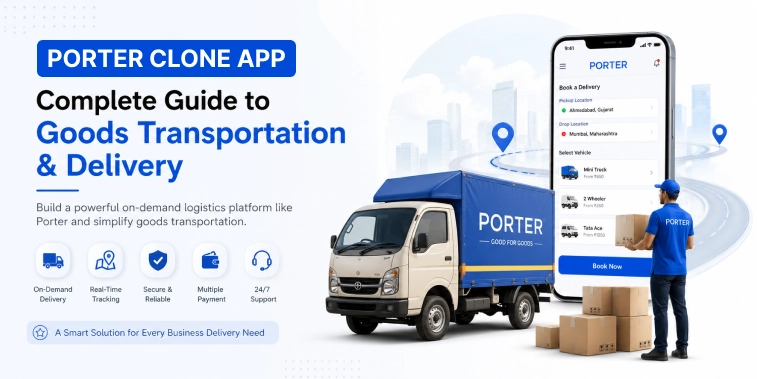
A Porter Clone App is a white-label goods transportation and delivery platform inspired by the business model of Porter. It enables entrepreneurs, logistics companies, transportation businesses, and startups to launch their own branded application for connecting customers with drivers and suitable vehicles.
Instead of developing a transportation platform completely from the beginning, businesses can start with pre-built functionality and customize it according to their market requirements. Branding, service categories, pricing, payment methods, delivery zones, vehicle types, and operational rules can be adjusted to create a platform suited to a particular business.
The main purpose of a Porter Clone App is to simplify the process of booking and managing goods transportation. A customer can enter pickup and drop locations, select a suitable vehicle, provide details about the goods, view an estimated fare, confirm the booking, and track the transportation journey.
The platform can also serve businesses that regularly need transportation. Retail stores can use it to move inventory, e-commerce businesses can manage local deliveries, and companies can arrange transportation between warehouses, offices, stores, and customers.
A complete platform generally includes several connected components.
Customer App
The Customer App allows users to register, select a transportation service, enter pickup and drop locations, select a vehicle, provide goods details, view estimated pricing, book a trip, make payments, track the driver, and review completed transportation requests.
Driver App
The Driver App allows transportation partners to register, submit verification documents, manage their availability, receive booking requests, accept trips, navigate to pickup locations, update transportation status, and monitor their earnings.
Admin Dashboard
The Admin Dashboard gives business owners centralized control over customers, drivers, vehicles, bookings, pricing, commissions, payments, service areas, complaints, and analytics.
Business or Enterprise Panel
For organizations that require frequent transportation, a business panel can provide tools for bulk bookings, recurring deliveries, centralized billing, invoices, and transportation monitoring.
Together, these components create a connected transportation ecosystem that can manage the journey from booking to delivery.
Types of Goods Transportation Services
One of the main advantages of a Porter Clone App is that businesses can customize the services according to their target customers and available vehicle network.
Two-Wheeler Goods Delivery
Two-wheelers can be used for lightweight packages, documents, small parcels, and quick local deliveries. They can be particularly useful in busy urban areas where smaller vehicles can navigate congested roads more easily.
Three-Wheeler and Tempo Transportation
Three-wheelers and tempos can handle larger loads than two-wheelers. They can be suitable for local commercial deliveries, retail transportation, and moving goods between nearby locations.
Mini-Truck Transportation
Mini trucks can transport heavier or larger goods that cannot be handled by smaller vehicles. Customers can choose an appropriate vehicle based on the quantity and size of their goods.
Commercial Goods Transportation
Businesses can use the platform to transport inventory, equipment, supplies, and other commercial goods between warehouses, stores, offices, suppliers, and customers.
Parcel and Last-Mile Delivery
A transportation platform can also support last-mile delivery by connecting businesses with nearby drivers who transport packages from a distribution point to the final customer.
Household Goods Transportation
Businesses can add household transportation services for customers moving furniture, appliances, boxes, and other personal belongings between locations.
The exact vehicle categories and transportation services can be customized according to local demand, operating areas, and business objectives.
How Does a Porter Clone App Work?
A Porter Clone App connects customers, drivers, vehicles, and administrators through a single digital workflow. The process begins when a customer requests transportation and continues until the goods are delivered.
1. Customer Registration
Customers create an account using their mobile number, email address, or other supported login methods. They can then manage their profile, save addresses, review previous bookings, and manage payment information.
2. Select a Transportation Service
Customers choose the type of transportation they require, such as two-wheeler delivery, tempo transportation, mini-truck booking, commercial goods transportation, or another service offered by the business.
3. Enter Pickup and Drop Locations
The customer enters the pickup and destination addresses. GPS-based location detection can make this process easier, while manual address selection can be provided when required.
The platform can calculate the distance between locations and use it as one factor in determining the estimated transportation charge.
4. Add Multiple Stops
Some customers need to deliver goods to several locations. A multi-stop feature allows users to add additional destinations to the same booking.
This can be particularly useful for retailers, distributors, and businesses handling multiple local deliveries.
5. Select a Vehicle
Customers select a vehicle based on their goods and transportation requirements. Available options can include two-wheelers, three-wheelers, tempos, mini trucks, and other commercial vehicles.
6. Add Goods Details
Customers provide information about the goods, such as type, quantity, approximate weight, dimensions, and special instructions. This helps ensure that the selected vehicle is appropriate.
7. View Estimated Fare
The application calculates an estimated transportation price based on factors such as distance, vehicle category, number of stops, and the pricing rules configured by the business.
Displaying the estimated fare before confirmation improves transparency and helps customers make informed decisions.
8. Confirm the Booking
After reviewing the transportation details, vehicle, locations, goods information, and estimated price, the customer confirms the booking.
The request then becomes available for assignment to an appropriate driver.
9. Driver Assignment
The platform identifies available drivers based on location, vehicle type, availability, and booking requirements. A suitable driver receives the request through the Driver App.
10. Pickup, Tracking & Delivery
After accepting the booking, the driver travels to the pickup location, collects the goods, and begins the journey toward the destination. Customers can track the transportation status using GPS.
After reaching the destination, the driver updates the delivery status. The platform can support digital confirmation such as OTP verification, timestamps, or other proof-of-delivery methods.
Must-Have Features of a Porter Clone App
A successful Porter Clone App needs more than basic vehicle booking. It should provide an efficient experience for customers, drivers, businesses, and administrators while giving the platform owner complete control over transportation operations.
Customer App Features
Easy Registration & Profile Management
Customers should be able to register quickly using a mobile number, email address, or supported login method. They can manage their profiles, save multiple addresses, review previous bookings, and access invoices and payment information.
Vehicle Selection
Customers can select the vehicle that best matches their transportation requirements. The platform can offer two-wheelers, three-wheelers, tempos, mini trucks, or other commercial vehicles depending on the business model.
Goods Details
Users can provide information about the goods they want to transport, including type, quantity, approximate weight, dimensions, and special handling instructions.
Multi-Stop Booking
A multi-stop feature allows customers to add several pickup or delivery points to a single transportation request. This can be especially valuable for retailers, distributors, and businesses making multiple deliveries.
Fare Estimation
Customers can view an estimated transportation cost before confirming a booking. Pricing can consider distance, vehicle category, number of stops, service type, and other business-defined rules.
Real-Time GPS Tracking
Live tracking allows customers to monitor their driver’s location and transportation progress. Estimated arrival information and status updates can provide greater transparency during the delivery journey.
Secure Online Payments
The platform can support multiple payment options, including cards, digital wallets, online banking, and other payment methods suitable for the target market.
Booking History
Customers can access completed, active, cancelled, and scheduled transportation requests. Previous booking information makes it easier to review trips and repeat regular transportation services.
Notifications
Push notifications can keep customers informed about booking confirmation, driver assignment, driver arrival, pickup, transportation progress, delivery completion, and payment status.
Ratings & Reviews
After completing a trip, customers can rate the driver and share feedback. This helps businesses monitor service quality and identify areas that require improvement.
Driver App Features
The Driver App helps transportation partners manage their work efficiently from a smartphone.
Driver Registration & Verification
Drivers can create profiles and submit required documents for verification. Administrators can review driver information before activating an account.
Online & Offline Status
Drivers can control their availability. The platform can use their status to identify suitable drivers when new transportation requests are created.
Booking Requests
Drivers receive available transportation requests with details such as pickup location, destination, vehicle requirements, and other relevant information.
Accept or Reject Requests
Drivers can review requests and accept suitable bookings. This gives them greater control over their transportation activity.
GPS Navigation
Integrated navigation helps drivers reach pickup and delivery locations efficiently and can provide route guidance throughout the trip.
Trip Status Updates
Drivers can update the booking status as the trip progresses, including accepted, arriving, goods picked up, in transit, and delivered.
Earnings Dashboard
Drivers can view completed trips, earnings, commissions, incentives, and payment history through their dashboard.
Trip History
Drivers can review their completed and cancelled transportation requests and monitor their overall activity.
Admin Dashboard Features
The Admin Dashboard gives business owners centralized control over the entire transportation network.
Customer Management
Administrators can manage customer profiles, bookings, account activity, and support requests.
Driver Management
The dashboard can be used to approve drivers, verify documents, monitor driver activity, and review performance.
Vehicle Management
Business owners can create vehicle categories, configure vehicle-specific pricing, and manage the transportation fleet available through the platform.
Booking Management
Administrators can monitor active, completed, scheduled, and cancelled bookings from one interface.
Pricing & Commission Management
Businesses can configure base fares, distance charges, vehicle-specific pricing, additional stop charges, commissions, and other applicable fees.
Service Area Management
Administrators can define cities, zones, or locations where transportation services are available. This allows the business to expand gradually into new markets.
Payment Management
The platform can provide tools for monitoring customer payments, driver payouts, commissions, refunds, invoices, and transaction records.
Reports & Analytics
Analytics can provide insights into booking volume, revenue, driver performance, vehicle utilization, customer activity, cancellation rates, and popular service areas.
Support & Complaint Management
A dedicated support module can help administrators handle customer complaints, driver issues, delivery problems, refunds, and other service requests.
Benefits of Developing a Porter Clone App
Faster Market Entry
A white-label Porter Clone App provides pre-built transportation functionality, allowing businesses to launch faster than building every feature from scratch. Entrepreneurs can focus more on customer acquisition, operations, and market expansion.
Better Transportation Management
The platform connects customers, drivers, vehicles, and administrators within one ecosystem. Automated booking and driver assignment can reduce manual coordination and make daily transportation operations easier to manage.
Improved Customer Experience
Features such as vehicle selection, fare estimation, live GPS tracking, digital payments, notifications, and delivery confirmation give customers greater convenience and visibility.
Multiple Transportation Services
Businesses can offer different transportation categories through one application. Depending on market requirements, these may include two-wheeler delivery, tempo transportation, mini-truck booking, commercial goods movement, parcel delivery, and last-mile transportation.
Scalable Operations
As demand grows, businesses can add drivers, vehicles, service categories, and new geographic areas. This allows the transportation network to expand according to customer demand.
Better Driver & Vehicle Utilization
Real-time booking information and automated driver assignment can help businesses make better use of available drivers and vehicles. Operational data can also reveal areas where additional transportation capacity may be needed.
Data-Driven Business Decisions
Analytics can help owners understand booking patterns, revenue, demand by location, driver performance, vehicle utilization, and customer activity. These insights can support decisions about pricing, expansion, and resource allocation.
B2B Logistics Opportunities
A Porter Clone App can also be customized for businesses that require regular transportation. Features such as bulk bookings, recurring deliveries, centralized billing, invoices, and delivery monitoring can help businesses manage their logistics requirements.
Business Model of a Porter Clone App
A goods transportation platform can generate revenue through multiple channels.
Transportation Commission
The platform can charge a commission or service fee on completed transportation bookings. Rates can vary according to vehicle type, service category, distance, or business agreements.
Delivery & Transportation Charges
Customers can pay transportation fees based on distance, vehicle type, number of stops, goods requirements, and selected service.
Dynamic Pricing
During high-demand periods, businesses can use dynamic pricing based on demand, driver availability, traffic conditions, or operating periods, provided the pricing is transparent to customers.
Enterprise Plans
Businesses with frequent transportation requirements can be offered customized pricing or recurring plans. This can create longer-term relationships with commercial customers.
Premium Services
Additional revenue can come from priority transportation, scheduled bookings, specialized vehicles, or other premium options that the business chooses to offer.
Advertising & Featured Listings
Relevant businesses can promote their products or services through sponsored placements, featured listings, and promotional campaigns within the platform.
Future Trends in Goods Transportation & Delivery in 2026
AI-Powered Driver Assignment
AI can analyze driver location, availability, vehicle type, and transportation requirements to identify suitable drivers for incoming requests. This can improve assignment efficiency and reduce manual coordination.
Intelligent Route Optimization
Advanced route planning can analyze distance, traffic conditions, and multiple destinations to help drivers select more efficient routes. Better routing can improve delivery times and reduce unnecessary travel.
Electric Commercial Vehicles
Electric two-wheelers, three-wheelers, and commercial vehicles are becoming increasingly relevant to urban transportation. Businesses can gradually integrate suitable EVs into their networks as infrastructure and market demand develop.
Real-Time Logistics Analytics
Advanced analytics can help businesses monitor important metrics such as
- Booking volume
- Revenue
- Delivery time
- Driver utilization
- Vehicle utilization
- Cancellation rate
- Customer retention
- Service-area demand
These insights can help transportation companies improve their operations and identify growth opportunities.
Digital Proof of Delivery
OTP verification, digital confirmations, timestamps, and location information can provide stronger evidence that goods have reached their destination. This is particularly useful for B2B transportation and commercial deliveries.
B2B Logistics Integration
Goods transportation platforms are increasingly positioned to serve businesses, not only individual customers. A flexible platform can support recurring transportation, inventory movement, distribution, and last-mile logistics.
Conclusion
The increasing demand for convenient, transparent, and technology-driven transportation has created strong opportunities for entrepreneurs and logistics businesses. A Porter Clone App provides a customizable foundation for launching a branded goods transportation and delivery platform that connects customers, drivers, vehicles, and administrators through one digital ecosystem.
From two-wheeler deliveries and tempo transportation to mini-truck bookings, commercial goods movement, and last-mile logistics, businesses can configure services according to their target market.
Features such as vehicle selection, pickup and drop locations, fare estimation, multi-stop booking, GPS tracking, digital payments, driver management, and centralized analytics can create a smoother transportation experience while improving operational visibility.
The platform can also support multiple revenue streams through transportation commissions, delivery charges, enterprise plans, premium services, and advertising. Looking toward 2026 and beyond, AI-powered driver assignment, intelligent route optimization, electric vehicles, real-time analytics, digital proof of delivery, and B2B logistics integration can further strengthen the platform.
For businesses planning to enter the goods transportation market, a customized Porter Clone App can provide the technology foundation needed to build, operate, and scale a modern transportation business.
Frequently Asked Questions
1. What is a Porter Clone App?
A Porter Clone App is a white-label goods transportation platform that allows businesses to launch their own branded application for connecting customers with drivers and suitable vehicles for goods transportation and delivery.
2. What services can a Porter Clone App support?
It can support two-wheeler delivery, three-wheeler and tempo transportation, mini-truck booking, commercial goods transportation, parcel delivery, last-mile delivery, and household goods transportation, depending on the business model.
3. What features should a Porter Clone App include?
Important features include vehicle selection, goods details, pickup and drop locations, multi-stop booking, fare estimation, driver assignment, GPS tracking, digital payments, notifications, ratings, driver management, vehicle management, pricing controls, and analytics.
4. How does a Porter Clone App generate revenue?
Revenue can come from transportation commissions, delivery charges, dynamic pricing, enterprise plans, premium transportation services, and sponsored or featured listings.
5. Can a Porter Clone App support B2B logistics?
Yes. It can be customized for bulk bookings, recurring deliveries, inventory movement, last-mile logistics, centralized billing, digital invoices, and transportation monitoring for business customers.

Parth Kulkarni
Managing Director
Parth Kulkarni is the Managing Director with strong expertise in IT and on-demand app solutions, focused on empowering startups and enterprises with scalable digital products. His strategic leadership and business insight drive innovation, ensuring consistent client success and long-term growth.