

Introduction
Urban transportation is changing rapidly as customers increasingly expect convenient, affordable, and technology-driven ways to move around cities. Mobile applications have transformed traditional transportation by allowing users to enter a destination, select a vehicle, request a ride, view fare information, and track the trip from a smartphone.
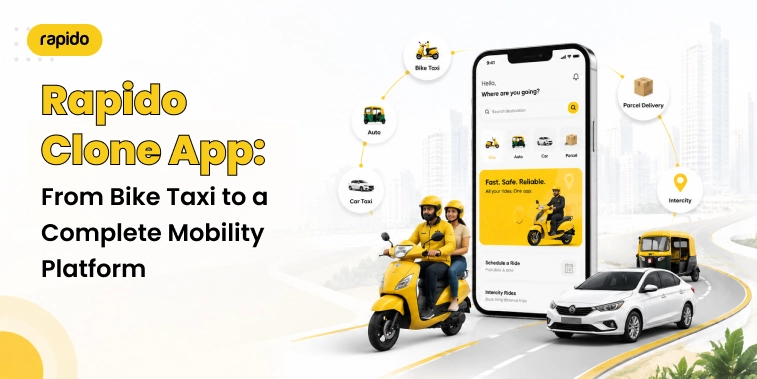
A Rapido Clone App is a customizable mobility platform that can help businesses launch their own ride-booking and transportation service. While a bike taxi can be the starting point, a modern mobility platform can expand beyond two-wheelers to include auto rides, cab services, parcel transportation, and other on-demand mobility solutions.
Rapido’s current platform supports bike transportation and also provides functionality around auto and cab services. Its customer terms also describe package services that facilitate pickup and drop-off through third-party drivers or vehicle operators.
This evolution makes the Rapido Clone App relevant for entrepreneurs who want to build a broader mobility business rather than a platform limited to one transportation category.
In this guide, we explore what a Rapido Clone App is, how it works, why businesses may consider developing one in 2026, its major components, and the features needed to create a complete mobility platform.
What Is a Rapido Clone App?
A Rapido Clone App is a customizable ride-hailing and mobility application inspired by the core functionality of modern transportation platforms.
The platform connects customers with drivers or transportation partners through a digital booking system. Customers can request a ride by entering their pickup and destination locations, selecting an available transportation option, reviewing fare information, and confirming the trip.
A basic platform can start with bike taxi booking, while a more advanced mobility platform can support additional services such as:
- Bike taxi
- Auto booking
- Cab booking
- Parcel delivery
- Local transportation
- Business transportation
- Last-mile delivery
The exact services offered can be customized according to the target market, local regulations, business model, and available transportation partners.
Rapido’s current customer-facing information describes bike, auto, and cab ride options, while its platform terms also cover package services.
A complete clone-style solution can therefore contain multiple connected interfaces:
- Customer App
- Captain/Driver App
- Admin Dashboard
- Business or Enterprise Panel
Each component has a different purpose, but all work together to manage transportation requests.
From Bike Taxi to a Complete Mobility Platform
The most important idea behind this title is the evolution of a mobility platform.
A business does not necessarily need to remain limited to bike taxi bookings. It can build a transportation ecosystem in which customers can select different services according to their needs.
Stage 1: Bike Taxi
Bike taxi can serve as the foundation of the platform.
Customers can book a nearby two-wheeler for short-distance urban transportation. This can be particularly useful when customers want a quick option for navigating busy city roads.
Rapido describes its bike taxi service as a solution for intra-city commuting and highlights its ability to navigate traffic efficiently.
Stage 2: Auto Rides
The platform can expand by adding three-wheeler transportation.
Auto rides can provide another option for customers who need more space or prefer a different type of city transportation.
Stage 3: Cab Booking
Four-wheeler cab services can extend the platform to customers looking for additional comfort, capacity, or different travel requirements.
Rapido’s current platform provides bike, auto, and cab options in supported locations.
Stage 4: Parcel Delivery
A mobility platform can also use its transportation network for local package delivery.
Customers or businesses can request pickup and drop-off services for eligible parcels. Rapido’s terms currently describe a package service in which customers can send packages from one location to another through Captains.
Stage 5: Business Mobility
The platform can further expand toward business and enterprise transportation.
Companies can use mobility services for employee transportation, local deliveries, business trips, and other transportation requirements.
Why Build a Rapido Clone App in 2026?
The mobility industry continues to move toward digital booking, real-time tracking, cashless payments, and connected transportation services.
A customizable platform can help businesses create a mobility service according to their specific market.
Growing Demand for On-Demand Transportation
Customers increasingly expect transportation to be available through mobile applications.
Instead of calling a transportation provider, users can request a ride digitally and receive booking information through the application.
Multiple Transportation Options
A platform can provide several transportation choices within one application.
Customers may be able to select:
- Bike
- Auto
- Cab
This allows the platform to serve different transportation needs.
Faster Booking
A digital booking workflow can reduce manual communication.
The customer can enter the route, select a service, review the available information, and confirm the request through the app.
Better Trip Visibility
GPS tracking allows customers to receive information about their driver and trip progress.
Rapido’s route pages currently describe pickup and destination selection, ride options, estimated fares, and real-time ride tracking.
Delivery Expansion
The same technology infrastructure used for transportation can also support package and last-mile delivery services.
This can allow businesses to serve both passengers and delivery customers through one platform.
Business Scalability
A customizable platform can begin with one transportation service and expand gradually.
For example:
Bike Taxi → Auto → Cab → Parcel → Enterprise Mobility
This approach can allow businesses to develop their mobility ecosystem according to customer demand and operational capacity.
How Does a Rapido Clone App Work?
A typical ride-booking workflow can be divided into several stages.
Step 1: Customer Registration
The customer creates an account through the mobile application.
The platform can support suitable authentication methods such as phone verification, OTP, or other login options.
Step 2: Select Pickup and Destination
The customer enters the pickup location and destination.
Map integration can help users select locations and calculate the route.
Step 3: Select Transportation Type
The customer can select the available transportation option.
Depending on the platform, this may include:
- Bike
- Auto
- Cab
Step 4: View Fare Information
The platform can display an estimated fare before the customer confirms the booking.
Fare calculation can consider factors such as:
- Distance
- Estimated travel time
- Vehicle type
- Location
- Applicable pricing rules
Rapido’s current customer information states that estimated fares can consider distance, time, and the selected ride option.
Step 5: Confirm the Booking
The customer confirms the ride after reviewing the trip information.
Step 6: Driver Matching
The system identifies an available driver or Captain according to the selected transportation type and configured matching rules.
Step 7: Driver Reaches Pickup Location
The driver receives the pickup information and navigates to the customer.
Step 8: Ride Begins
After the customer enters the vehicle, the trip begins and the platform can update the ride status.
Step 9: Real-Time Tracking
The customer can monitor the ride’s progress through the application where tracking is enabled.
Step 10: Trip Completion
After reaching the destination, the driver completes the trip and the booking is added to the relevant history.
This workflow can also be adapted for parcel transportation, where the customer requests a pickup and delivery instead of passenger transportation.
Main Components of a Rapido Clone App
A complete mobility platform generally requires multiple applications and management interfaces.
Customer App
The customer application is the main interface for users who want to book transportation services.
Important features can include:
- Registration and login
- Pickup and destination selection
- Vehicle selection
- Fare estimation
- Ride booking
- Scheduled rides
- Real-time tracking
- Digital payments
- Ride history
- Notifications
- Ratings and reviews
- Customer support
The application should provide a simple booking process so that users can request transportation with minimal effort.
Captain or Driver App
The driver application connects transportation partners with customer requests.
Drivers can use the application to:
- Register as a transportation partner
- Submit required information
- Manage availability
- Receive ride requests
- Accept or reject requests
- View customer pickup locations
- Navigate using maps
- Update trip status
- View completed rides
- Monitor relevant earnings information
The driver application is essential because the mobility platform depends on a reliable connection between transportation demand and available partners.
Rapido’s own platform distinguishes between its customer and Captain applications.
Admin Dashboard
The admin panel provides centralized management for the platform.
Administrators can manage:
- Customers
- Drivers
- Vehicles
- Ride bookings
- Service categories
- Pricing
- Payments
- Promotions
- Notifications
- Support requests
- Reports
The dashboard can also provide visibility into active rides, completed trips, driver activity, and other operational information.
Business or Enterprise Panel
A business-focused panel can help organizations manage transportation and delivery requirements.
Possible features include:
- Business account management
- Multiple employees or users
- Ride booking
- Delivery requests
- Trip history
- Payment records
- Reports
- Transportation monitoring
This component can help extend a consumer-focused ride-hailing application into a broader mobility platform.
Key Bike Taxi and Ride-Hailing Features
Easy Ride Booking
The platform should allow customers to request a ride through a short and understandable booking process.
Bike Taxi Booking
Bike booking can be the core transportation service, allowing customers to request two-wheeler transportation for suitable routes.
Auto Booking
Auto services can provide an additional transportation option for customers who prefer a three-wheeler.
Cab Booking
Cab functionality can support customers who require four-wheeler transportation.
Fare Estimation
Customers can view an estimated fare before confirming a trip.
Driver Matching
The system can identify suitable nearby drivers according to availability, location, and selected vehicle type.
Live Location Tracking
GPS tracking can allow customers to monitor the driver’s location and trip progress.
Ride Scheduling
Customers can schedule transportation in advance where the business supports scheduled bookings.
Digital Payments
The platform can integrate supported payment methods to simplify ride payments.
Ratings and Reviews
Customers can rate their transportation experience after completing a trip.
Notifications
Push notifications can provide updates about booking confirmation, driver assignment, driver arrival, trip progress, and completion.
Multi-Service Mobility Features
A complete mobility platform can go beyond passenger transportation.
Parcel Delivery
Customers can request pickup and delivery of eligible packages.
Local Business Delivery
Businesses can use the platform for local delivery requirements.
Last-Mile Logistics
The transportation network can support short-distance delivery operations.
Business Transportation
Companies can use the platform for recurring transportation needs.
Multiple Service Categories
The admin can configure transportation and delivery categories according to the platform’s target market.
Rapido’s current Captain terms identify package services including food delivery, grocery delivery, and Rapido Parcel, demonstrating how a transportation network can also support delivery-related services.
This creates an opportunity for businesses to build a connected mobility ecosystem rather than operating only a bike taxi service.
Parcel and Last-Mile Delivery Functionality
A mobility platform can expand beyond passenger transportation by using its driver network for local goods and parcel delivery.
A Rapido Clone App can include a dedicated parcel-booking workflow where customers enter pickup and drop locations, provide package information, and request a suitable delivery partner.
Possible parcel features include:
- Pickup and drop-off locations
- Package details
- Delivery instructions
- Estimated delivery charges
- Driver assignment
- Real-time tracking
- Delivery status updates
- Digital payments
- Delivery history
- Notifications
This functionality can help businesses serve customers who need convenient local delivery in addition to passenger transportation.
For example, a retailer could use the platform to send a package to a nearby customer, while an individual could use it for a local pickup and drop-off request.
Auto and Cab Booking
Starting with bike taxis does not mean a mobility platform needs to remain limited to two-wheelers.
Adding auto and cab booking can help the platform serve different customer requirements.
Auto Booking
Auto rides can provide an alternative for customers who need additional passenger or luggage capacity compared with a bike.
The booking workflow can include:
Pickup → Destination → Auto Selection → Fare Estimate → Driver Assignment → Trip Tracking → Completion
Cab Booking
Cab services can extend the platform to customers who prefer four-wheel transportation.
Depending on the business model, different cab categories can be configured, such as standard, premium, or other locally relevant categories.
Multi-Mode Transportation
Offering bikes, autos, and cabs within one application can give customers more choice.
For example:
- Bike: Suitable for quick individual travel
- Auto: Suitable for short trips with additional space
- Cab: Suitable for customers who prefer four-wheel transportation
The exact services should be configured according to the target market and applicable local requirements.
Driver and Vehicle Management
A successful mobility platform depends on the availability and management of transportation partners.
Driver Registration
Drivers can register through the partner application and submit required information for verification.
Depending on the operating market, the platform may collect:
- Personal details
- Contact information
- Vehicle details
- Required identification
- Driving-related documents
- Bank or payout information
The admin team can review and approve driver accounts before they become active.
Vehicle Management
Administrators can maintain records for each vehicle connected to the platform.
Information can include:
- Vehicle type
- Vehicle model
- Registration information
- Assigned driver
- Service category
- Availability status
This allows the platform to organize different transportation options.
Driver Availability
Drivers can switch their availability status through the partner app.
The system can use this information when searching for drivers for new ride requests.
Driver-Ride Matching
The platform can match a ride request with an appropriate driver based on factors such as:
- Distance
- Current location
- Vehicle category
- Availability
- Service area
An efficient matching system can reduce customer waiting time and improve driver utilization.
Driver Trip Management
Drivers can manage active rides from their applications.
They can:
- View booking information
- Navigate to pickup
- Start the trip
- Update ride status
- Complete the trip
- View previous rides
Real-Time Tracking and Route Management
Real-time location functionality is an important part of modern mobility applications.
GPS Tracking
The driver application can transmit location information during an active trip.
Customers can use this information to understand where their driver is and follow the journey.
Route Navigation
Map integration can help drivers navigate to pickup and destination locations.
The platform can also use route information for fare estimation and trip-related calculations.
Estimated Arrival
The platform can provide estimated arrival information using available route and location data.
This can help customers plan their time and reduce uncertainty.
Multiple Stops
For selected services, the platform can support multiple destinations or stops.
This can be useful for business transportation and certain delivery workflows.
Payments, Notifications and Customer Support
A complete mobility platform needs more than ride booking. It also requires systems for payments, communication, and customer assistance.
Digital Payments
The platform can integrate payment methods suitable for the target market.
Possible options include:
- Credit and debit cards
- UPI
- Digital wallets
- Online banking
- Cash payments
The available payment methods should depend on the business’s location and payment-provider support.
Fare and Payment Records
Customers can view relevant fare and transaction information after completing a ride.
Businesses can also maintain payment records for their transportation activities.
Push Notifications
Notifications can inform customers and drivers about important events.
Examples include:
- Booking confirmation
- Driver assigned
- Driver arriving
- Ride started
- Ride completed
- Payment confirmation
- Delivery updates
Customer Support
The application can provide a support system for handling common issues.
Support functionality may include:
- Help center
- FAQ section
- In-app support
- Booking-related complaints
- Payment assistance
- Lost-item reporting
- Delivery-related support
A well-organized support system can improve customer confidence and help resolve issues more efficiently.
Mobility App Trends
The mobility industry is moving toward more connected and intelligent transportation experiences.
AI-Powered Driver Matching
AI-assisted systems can analyze factors such as location, availability, vehicle category, and demand to improve driver matching.
Intelligent Route Optimization
Advanced routing can help identify efficient routes and improve trip coordination.
Personalized Transportation
Mobility platforms can use customer preferences and previous activity to provide more relevant service suggestions.
AI-Based Customer Support
AI-powered assistants can handle common questions about bookings, payments, cancellations, and trip information.
Real-Time Analytics
Businesses can use live data to monitor ride demand, driver activity, delivery performance, and service utilization.
Multi-Service Mobility
The trend toward combining multiple transportation and delivery services into one application can help businesses build broader mobility ecosystems.
A platform can evolve from:
Bike Taxi → Auto → Cab → Parcel Delivery → Business Mobility
This approach allows the application to address multiple transportation needs while maintaining a unified customer experience.
Conclusion
A Rapido Clone App can start with the core concept of bike taxi booking and gradually evolve into a complete mobility platform.
The foundation includes customer ride booking, driver matching, vehicle management, fare estimation, GPS tracking, payments, notifications, and trip management. Businesses can then expand the platform by adding auto booking, cab services, parcel delivery, last-mile transportation, and enterprise mobility features.
This broader approach can help businesses address multiple transportation needs through one connected application.
For customers, the benefit is convenience: they can access different mobility services from one platform. For drivers, the platform can provide a digital system for receiving and managing transportation requests. For businesses, it can create a centralized way to manage rides, deliveries, and transportation operations.
As mobility technology continues to develop in 2026, AI-assisted matching, intelligent route optimization, real-time analytics, automated support, digital payments, and multi-service transportation can become increasingly important.
A carefully planned and customizable Rapido Clone App can therefore provide more than a bike taxi solution—it can serve as a foundation for building a complete, scalable mobility ecosystem.
Frequently Asked Questions
1. What is a Rapido Clone App?
A Rapido Clone App is a customizable mobility platform inspired by ride-booking applications. It can allow customers to book bike taxis, autos, cabs, and other transportation or delivery services through one application.
2. Can a Rapido Clone App support more than bike taxis?
Yes. A customizable platform can be expanded with auto booking, cab booking, parcel delivery, last-mile logistics, and business transportation services according to the business model and market requirements.
3. What are the key features of a Rapido Clone App?
Important features can include ride booking, vehicle selection, fare estimation, driver matching, GPS tracking, digital payments, notifications, ride history, ratings, customer support, and an admin dashboard.
4. Can businesses add parcel delivery to a Rapido Clone App?
Yes. Parcel and local delivery functionality can be added so customers and businesses can request pickup and drop-off services through the same mobility platform.
5. Can a Rapido Clone App be customized?
Yes. Businesses can customize the platform with their own branding, service categories, operating locations, vehicle types, pricing rules, payment methods, integrations, and workflows.

Parth Kulkarni
Managing Director
Parth Kulkarni is the Managing Director with strong expertise in IT and on-demand app solutions, focused on empowering startups and enterprises with scalable digital products. His strategic leadership and business insight drive innovation, ensuring consistent client success and long-term growth.