


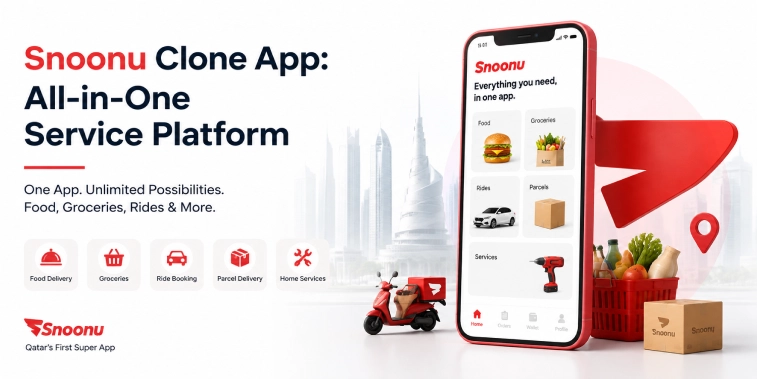
Introduction
Consumers increasingly expect convenience from digital platforms. Instead of using separate applications for food, groceries, retail products, courier services, pharmacy items, and other everyday needs, users are looking for platforms that bring multiple services together.
This is where an all-in-one service platform can create a strong digital business opportunity.
A Snoonu Clone App is a customizable multi-service application concept that can help businesses launch a platform where users can discover services, place orders or bookings, make payments, track fulfillment, and manage their activities from a single application.
Rather than building several independent applications for different services, businesses can create one interconnected ecosystem with multiple service categories. The platform can be customized according to the target market, operational requirements, service providers, and business model.
In 2026, technologies such as AI-powered recommendations, intelligent search, automated customer support, personalization, real-time analytics, and smart delivery management can make all-in-one platforms more efficient and convenient.
This guide explores what a Snoonu Clone App is, how it works, its core components, key features, AI opportunities, revenue models, technology requirements, security considerations, and future potential.
What Is a Snoonu Clone App?
A Snoonu Clone App is a customizable multi-service platform inspired by the concept of bringing different on-demand services into one digital ecosystem.
The platform can allow users to access multiple categories through a single application rather than switching between separate services.
Depending on the business strategy, a customized platform may support categories such as:
- Food delivery
- Grocery delivery
- Retail shopping
- Pharmacy delivery
- Courier services
- Local services
- Other on-demand services
The exact categories should be selected according to the business’s target market and operational capabilities.
A typical platform can include separate interfaces for customers, service providers or merchants, delivery partners, and administrators.
The purpose of a clone solution is not to duplicate another company’s branding or proprietary implementation. Instead, it provides a customizable starting point for developing a similar type of multi-service business platform with unique branding, features, workflows, and business rules.
How Does an All-in-One Service Platform Work?
An all-in-one platform connects customers with different service providers through one centralized application.
A typical workflow can be:
User Registration → Service Discovery → Product/Service Selection → Order or Booking → Payment → Fulfillment → Tracking → Completion
For example, a customer may open the application and select grocery delivery. Another customer may choose food delivery or a courier service.
The platform then routes the request to the appropriate merchant, service provider, or delivery partner.
The basic process involves several connected systems:
- Customer application
- Merchant or provider interface
- Delivery or service-provider application
- Admin dashboard
- Order and booking management
- Payment processing
- Location services
- Notification systems
- Analytics and reporting
This interconnected architecture allows the business to manage multiple services through one digital ecosystem.
Why Build an All-in-One Service Platform in 2026?
Growing Demand for Digital Convenience
Consumers increasingly use mobile applications for everyday activities. A platform that combines multiple services can reduce the need to manage several applications.
Multiple Revenue Opportunities
A multi-service platform can support different revenue streams across multiple categories.
Larger Customer Ecosystem
Adding multiple services can give users more reasons to return to the same application.
Cross-Service Opportunities
A customer who initially uses one service may later discover another category available on the platform.
Personalized Experiences
AI and analytics can help businesses provide more relevant recommendations based on user activity.
Scalable Business Model
A modular platform can allow businesses to introduce additional services gradually instead of launching every category at once.
Core Components of a Snoonu Clone App
A successful all-in-one service platform requires more than a customer-facing mobile application.
User App
The user application provides access to available services and allows customers to:
- Register
- Browse categories
- Search
- Place orders
- Make bookings
- Pay online
- Track orders
- Manage profiles
- Review services
Merchant or Service Provider App
Merchants and providers can use their interface to manage:
- Profiles
- Products or services
- Prices
- Availability
- Orders
- Bookings
- Promotions
- Earnings
Delivery Partner App
For services involving physical delivery, delivery partners can receive assignments, manage delivery status, navigate to locations, and review completed tasks.
Admin Dashboard
The administrator manages the complete ecosystem.
Admin functionality can include:
- User management
- Provider management
- Category management
- Order management
- Booking management
- Delivery management
- Payments
- Promotions
- Reviews
- Analytics
- Reports
Key Features of a Snoonu Clone App
User Registration and Profiles
Customers can create accounts and manage their personal information.
Profile functionality may include:
- Name
- Contact information
- Saved addresses
- Payment preferences
- Order history
- Booking history
- Favorite services
- Notification settings
Authentication should be designed with appropriate security measures.
Multi-Service Discovery
A major feature of an all-in-one platform is the ability to discover different services from one application.
The home screen can organize services into categories such as:
Food | Grocery | Pharmacy | Retail | Courier | Local Services
Businesses can add or remove categories according to their operating model.
Search and Filters
A powerful search system can help users find products, merchants, services, and providers.
Filters may include:
- Category
- Location
- Price
- Availability
- Rating
- Delivery options
- Service type
Good search functionality is particularly important when a platform contains a large number of products and service providers.
Product and Service Listings
Merchants or service providers can create detailed listings.
A listing can contain:
- Name
- Images
- Description
- Price
- Availability
- Category
- Options or variations
- Applicable service information
The presentation should remain clear and easy to understand.
Cart and Checkout
For shopping-related services, customers can add products to a cart before confirming an order.
The checkout process can include:
- Order summary
- Delivery address
- Payment method
- Applicable fees
- Discounts
- Final total
- Order confirmation
For service-based bookings, the same platform can use a booking flow rather than a traditional shopping cart.
Order and Booking Management
An all-in-one platform may support both transactions and appointments.
Customers can view:
- Current orders
- Upcoming bookings
- Completed orders
- Cancelled transactions
- Booking history
This creates a centralized account experience.
Real-Time Order Tracking
For delivery services, tracking can provide customers with updates about their orders.
The system can display information such as:
- Order confirmed
- Being prepared
- Assigned for delivery
- On the way
- Delivered
The exact status sequence can be customized according to the service category.
Multiple Payment Options
Payment integration can support different methods depending on the target market.
Potential options include:
- Credit cards
- Debit cards
- Digital wallets
- Online banking
- Other locally supported payment methods
The platform should clearly display applicable fees, discounts, taxes, and refund policies.
Notifications
Notifications can keep customers, merchants, providers, and delivery partners informed.
Examples include:
- Order confirmation
- Booking confirmation
- Status updates
- Delivery updates
- Cancellation notices
- Promotional notifications
Users should have appropriate control over marketing notifications.
Ratings and Reviews
Customers can provide feedback after eligible orders or services.
Ratings and reviews can help users compare providers while giving businesses valuable feedback.
A platform should include suitable moderation and reporting mechanisms.
Offers and Promotions
Businesses can use promotional tools to attract customers.
Potential features include:
- Discount codes
- Category offers
- First-order promotions
- Limited-time offers
- Merchant promotions
- Loyalty rewards
Promotions should be transparent about eligibility and expiration.
AI Features for an All-in-One Service Platform
AI can make a multi-service platform more intelligent when implemented around genuine user and business needs.
AI-Powered Recommendations
AI can analyze permitted user activity and preferences to provide potentially relevant product or service recommendations.
For example, customers who frequently use a particular category may receive suggestions related to that category.
Recommendations should remain transparent and respect applicable privacy requirements.
Smart Search
AI-assisted search can help users find products and services even when they do not use exact catalog terminology.
For example, a user might describe what they need rather than entering a precise product name.
The system can then identify relevant categories or listings.
AI Customer Support
An AI assistant can handle common questions related to:
- Orders
- Payments
- Delivery
- Booking procedures
- Cancellation policies
- Platform features
More complex issues can be transferred to human support.
Personalized Home Screen
AI can help personalize the application interface according to customer activity.
Instead of showing every category equally, the platform could prioritize relevant services based on user preferences and permitted behavioral signals.
Demand Forecasting
Businesses can use machine learning to analyze demand patterns.
This can support:
- Inventory planning
- Staffing
- Provider availability
- Delivery capacity
- Promotional planning
Forecasting should be treated as decision support rather than an infallible prediction.
Intelligent Delivery Optimization
For delivery-based services, algorithms can help with:
- Delivery assignment
- Route planning
- Estimated arrival calculations
- Operational forecasting
The effectiveness depends on accurate location, order, traffic, and availability data.
Multi-Service Categories
The biggest advantage of an all-in-one platform is its ability to support multiple service verticals.
Food Delivery
Customers can discover restaurants, browse menus, place orders, and track eligible deliveries.
Grocery Delivery
Users can purchase everyday grocery products and receive them through local fulfillment or participating merchants.
Pharmacy Delivery
A platform may support eligible pharmacy products subject to applicable laws, regulations, and prescription requirements.
Retail Shopping
Businesses can add local retail categories for products such as electronics, fashion, beauty, household items, and other merchandise.
Courier Services
Customers can request local delivery or courier services where the business model supports them.
Local On-Demand Services
Depending on the market, the platform can be extended to selected local service categories.
The important strategy is to avoid launching too many categories without sufficient supply, operational capacity, and customer demand.
Business Model and Revenue Opportunities
A multi-service platform can use multiple monetization strategies.
Commission Model
The platform can charge merchants or service providers a percentage of eligible transactions.
Delivery Fees
Customers may pay applicable delivery charges depending on order type, distance, service, and business rules.
Subscription Model
A subscription can provide benefits such as reduced fees, exclusive promotions, or other premium features.
Advertising
Merchants and brands may pay for promotional placements within the platform.
Featured Listings
Businesses can pay for enhanced visibility where appropriate.
Service Fees
The platform can apply service-related fees according to its business model and local requirements.
Using several revenue sources can reduce reliance on one income stream, but pricing should remain competitive and transparent.
Technology and Third-Party Integrations
Technology infrastructure is an important part of a scalable all-in-one platform.
Payment Gateways
Payment integrations can process eligible digital transactions securely.
Maps and Location Services
Maps can support:
- Address selection
- Distance calculations
- Delivery tracking
- Navigation
- Service-area management
Push Notifications
Push notification services can deliver real-time updates.
SMS and Email
Communication integrations can support authentication, transactional notifications, and customer communication.
Analytics
Analytics can help businesses understand:
- Orders
- Bookings
- Revenue
- Customer activity
- Service performance
- Retention
AI Services
AI APIs or models can support recommendation systems, conversational assistance, search, and forecasting.
Third-party integrations should be evaluated based on reliability, security, cost, scalability, and privacy requirements.
Security and Data Protection
An all-in-one platform can handle account information, addresses, transactions, orders, bookings, and potentially other personal information.
Security should therefore be considered from the beginning of development.
Important measures can include:
- Secure authentication
- Role-based access controls
- Encryption
- Secure payment processing
- Data protection
- Account recovery
- Monitoring
- Appropriate backups
Businesses should follow applicable privacy and data-protection regulations in the markets they serve.
If certain service categories involve regulated or sensitive information, additional compliance requirements may apply.
How to Choose the Right Snoonu Clone App Solution
Businesses should evaluate a clone solution based on their actual operating requirements.
Customization
The platform should allow businesses to customize:
- Branding
- Service categories
- User workflows
- Fees
- Business rules
- Notifications
Multi-Service Architecture
The architecture should support multiple service categories without making the application unnecessarily complicated.
Scalability
The platform should be capable of supporting additional users, merchants, providers, locations, and transactions.
AI Capabilities
AI should solve genuine business or customer problems rather than being included only as a marketing label.
Integrations
Check whether the platform can integrate with the payment, map, communication, analytics, and other services required for the target market.
Admin Controls
A strong administrative dashboard is important for managing the entire ecosystem.
Security
Review authentication, data protection, access controls, payment security, and privacy practices.
Maintenance and Support
Businesses should also consider ongoing maintenance, updates, technical support, infrastructure management, and future customization.
Future of All-in-One Service Platforms in 2026
All-in-one platforms are likely to become more sophisticated as AI, automation, analytics, and digital commerce continue developing.
Potential trends include:
AI-Powered Personalization
Platforms can become better at presenting relevant products and services.
Conversational Shopping
Users may increasingly interact with applications using natural-language requests.
Smarter Operations
AI-assisted forecasting and optimization can help businesses manage demand and fulfillment.
Unified Digital Ecosystems
Customers may prefer platforms that allow them to access multiple everyday services through one account.
Better Loyalty Programs
Businesses can use personalized rewards and membership programs to encourage repeat usage.
More Intelligent Delivery Networks
Data-driven logistics can help improve delivery planning and resource allocation.
The strongest platforms will need to balance technological innovation with reliability, affordability, privacy, and customer experience.
Conclusion
A Snoonu Clone App can serve as a foundation for building an all-in-one service platform that connects customers with multiple digital services through one application.
The concept can support categories such as food delivery, groceries, retail, pharmacy, courier services, and other on-demand offerings, depending on the business strategy and applicable regulations.
A strong platform should combine multi-service discovery, search, ordering, booking, payments, tracking, notifications, reviews, merchant management, delivery management, and analytics.
AI can further enhance the experience through intelligent search, personalized recommendations, customer support, demand forecasting, and operational optimization.
However, technology alone does not guarantee the success of a multi-service business. Businesses also need reliable service providers, efficient fulfillment, transparent pricing, strong customer support, appropriate compliance, and a clear market strategy.
In 2026, the opportunity is to create a platform that does more than simply combine several services. The stronger approach is to build an interconnected digital ecosystem where customers can easily discover relevant services while businesses gain efficient tools for managing orders, providers, payments, and customer relationships.
With the right combination of scalable technology, practical AI, multi-service functionality, secure infrastructure, and a customer-focused experience, a Snoonu Clone App can provide a strong foundation for launching a modern all-in-one service platform.
Frequently Asked Questions (FAQs)
1. What is a Snoonu Clone App?
A Snoonu Clone App is a customizable multi-service application designed to bring different on-demand services into one digital platform. It can support services such as food, grocery, retail, pharmacy, courier, and other categories depending on the business model.
2. What features should an all-in-one service platform include?
Important features can include user registration, multi-service discovery, search, product and service listings, ordering, booking, payments, tracking, notifications, reviews, merchant management, delivery management, analytics, and an admin dashboard.
3. Can AI be integrated into a Snoonu Clone App?
Yes. AI can support personalized recommendations, intelligent search, customer assistance, demand forecasting, and operational optimization. AI should be implemented around practical use cases and applicable privacy requirements.
4. How does an all-in-one service platform make money?
Potential revenue models include commissions, delivery or service fees, subscriptions, advertising, featured listings, and other premium services. The best combination depends on the target market and business strategy.
5. Can a Snoonu Clone App support multiple service categories?
Yes. A customized platform can be designed with multiple service categories such as food delivery, grocery, retail, pharmacy, courier, and other eligible services. Businesses can select categories based on local demand, provider availability, operational capacity, and applicable regulations.

Parth Kulkarni
Managing Director
Parth Kulkarni is the Managing Director with strong expertise in IT and on-demand app solutions, focused on empowering startups and enterprises with scalable digital products. His strategic leadership and business insight drive innovation, ensuring consistent client success and long-term growth.
