


Introduction
Healthcare has moved from occasional clinic visits to always available digital access. Patients now expect to search for doctors, book appointments, consult specialists online, order medicines, review lab reports, and manage health records from one application. This shift has created strong demand for multi-service healthcare platforms inspired by successful apps such as MFine.
MFine clone app development refers to creating a customized healthcare application with a similar service model and user experience to MFine. It does not mean copying the original brand, source code, visual identity, or protected content. Instead, it involves building an original telemedicine and healthcare marketplace that includes comparable features, customized workflows, and a business model suited to a specific market.
This guide explains the main features, technology choices, development stages, costs, revenue models, compliance considerations, and growth strategies involved in building an MFine inspired healthcare app.
What Is an MFine Clone App?
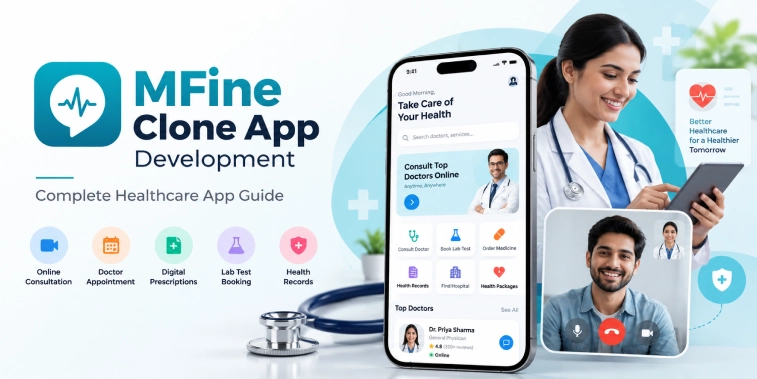
An MFine clone app is a healthcare platform that connects patients with doctors, diagnostic laboratories, pharmacies, and other health service providers through one digital ecosystem. Depending on the business plan, users may be able to schedule in person consultations, start video or audio appointments, chat with doctors, upload prescriptions, book diagnostic tests, purchase medicines, and access digital health records.
The platform generally includes separate interfaces for patients, doctors, pharmacies, laboratories, delivery staff, and administrators. Each interface has different permissions and workflows. For example, patients need simple search and booking tools, while doctors need appointment calendars, consultation tools, patient history, prescription management, and earnings information.
A customized solution can focus on a specific region, medical specialty, customer group, or service category. A startup might launch with online doctor consultations and expand later into medicine delivery, home sample collection, wellness programs, and insurance services. This phased approach can reduce the initial investment while allowing the business to validate demand.
Why Build an MFine Inspired Healthcare App?
The healthcare market is becoming more convenient, connected, and technology-driven. Patients value quick access to qualified professionals, especially when travel, distance, mobility issues, or long waiting times make traditional care difficult. A well-designed app can reduce friction in the patient journey and help healthcare providers serve more people efficiently.
Digital healthcare platforms also create opportunities for businesses to build recurring revenue. Consultation fees, platform commissions, subscription plans, medicine orders, diagnostic bookings, corporate wellness programs, and provider promotions can all contribute to income. However, revenue should support patient trust rather than compromise clinical quality or transparency.
An original app also gives the business more control than relying on a third party marketplace. The owner can define provider onboarding rules, pricing, branding, data policies, customer support standards, and expansion plans. Custom development makes it easier to add integrations and workflows that are specific to the target audience.
Essential Features for an MFine Clone App
A successful healthcare application needs features for every participant in the service ecosystem. The first priority is a smooth patient experience. Users should be able to register with a phone number, email address, or supported social login, complete a basic health profile, search providers, compare services, and book an appointment without unnecessary steps.
Important patient features include:
– Doctor search by specialty, experience, location, language, consultation fee, and availability
– Online appointment booking with calendar-based time slots
– Audio, video, and text consultations
– Secure payment through cards, bank transfers, wallets, and local payment methods
– Digital prescriptions and treatment instructions
– Medicine ordering and delivery tracking
– Diagnostic test booking and home sample collection
– Health records, invoices, reports, and appointment history
– Push notifications for bookings, reminders, reports, and follow-ups
– Ratings, reviews, help center access, and customer support
The doctor application should help medical professionals deliver care without creating administrative complexity. Doctors need profile management, document verification, availability settings, appointment controls, consultation notes, electronic prescriptions, patient history, and payment tracking. They should also be able to mark appointments as completed, reschedule sessions, manage follow-ups, and communicate with support staff.
A pharmacy and laboratory interface can support product or service catalogs, inventory updates, order processing, pricing, delivery coordination, and report uploads. The administrator dashboard should provide centralized control over users, providers, bookings, payments, commissions, refunds, complaints, content, analytics, and system settings. Role-based access is important because different employees should only see information necessary for their responsibilities.
Advanced Features That Improve Engagement
Once the minimum viable product is stable, advanced features can improve convenience and retention. An intelligent symptom assessment tool can ask structured questions and guide users toward suitable care options. It must be clearly presented as an informational support feature, not a replacement for professional diagnosis. Emergency warnings should direct users to urgent medical services when appropriate.
Personalized recommendations can help users discover relevant doctors, health packages, reminders, or preventive services. These recommendations should be based on consent and responsible data practices. A health reminder engine can support medication schedules, follow up appointments, vaccination dates, recurring tests, and wellness goals.
Other valuable additions include family accounts, multilingual support, wearable device integrations, corporate healthcare dashboards, health package subscriptions, video consultation recording controls, and automated support chat. Artificial intelligence can assist with appointment routing, frequently asked questions, document categorization, and operational analytics. Any AI feature handling medical information should include human oversight, clear limitations, and appropriate privacy safeguards.
Healthcare App Development Process
The development process begins with market and user research. The business should identify its target geography, user groups, key health services, provider acquisition strategy, payment preferences, and major competitors. Interviews with patients, doctors, pharmacies, and diagnostic centers can reveal practical requirements that are not visible from competitor research alone.
The next stage is feature planning and product definition. Features should be divided into launch requirements and later enhancements. A typical minimum viable product may include patient registration, provider profiles, doctor discovery, appointment booking, video consultation, payments, prescriptions, notifications, and an admin panel. Defining the first release carefully prevents excessive complexity and helps the team launch faster.
User experience design follows product planning. Healthcare interfaces should use clear language, readable typography, logical navigation, visible pricing, and reassuring status messages. Booking, payment, consent, cancellation, and report access flows should be tested with real users. Accessibility should be considered from the beginning, especially for older adults and users with visual, hearing, or mobility limitations.
Development then proceeds through frontend, backend, database, integration, and security work. Teams typically build mobile apps for Android and iOS, along with a web-based administration panel. Agile development allows features to be delivered in manageable cycles. Quality assurance should test functionality, performance, security, device compatibility, payment behavior, video quality, and failure recovery before launch.
After deployment, the product needs monitoring and continuous improvement. Analytics can show where users abandon registration, searches, bookings, or payments. Customer feedback can identify confusing screens and missing services. Regular updates should improve stability, security, performance, and compliance rather than adding features without a clear purpose.
Recommended Technology Stack
The technology stack depends on budget, scale, team expertise, and launch timeline. Native Android and iOS development can provide strong device integration and performance, while cross-platform frameworks can reduce duplicated development work. A suitable choice should support video calls, notifications, secure authentication, accessibility, and long-term maintenance.
The backend may use technologies such as Node.js, Python, Java, or a comparable enterprise framework. A relational database can manage structured information such as users, appointments, invoices, and provider schedules. Additional storage and search tools may be used for medical documents, catalogs, logs, and provider discovery. Cloud infrastructure can provide scalable hosting, backups, monitoring, and disaster recovery.
Third-party services are often required for video consultations, SMS verification, email, maps, payments, push notifications, identity checks, analytics, and medicine or laboratory integrations. Each provider should be evaluated for availability, pricing, security standards, regional support, and data processing terms. Relying on external services reduces development time, but the application should be designed so that critical integrations can be replaced if needed.
Security and Compliance Requirements
Healthcare applications process sensitive personal and medical information, so security cannot be treated as a later enhancement. The app should use encryption in transit and at rest, strong authentication, secure session management, access controls, audit logs, secure backups, vulnerability testing, and careful handling of passwords and tokens.
Compliance requirements vary by location and service type. The business may need to follow applicable health data, privacy, telemedicine, electronic transaction, consumer protection, and medical advertising regulations. Provider licenses and credentials should be verified before activation. The platform should also explain consultation limitations, consent requirements, cancellation rules, refund policies, and data retention practices in language users can understand.
Privacy by design is particularly important. The application should collect only necessary information, request clear consent, provide account and data controls where legally required, and limit internal access to sensitive records. Security policies should cover employees, providers, vendors, devices, logs, support conversations, and incident response. A legal and compliance review should be completed before operating in each new market.
MFine Clone App Development Cost
The cost of development depends on the number of platforms, feature depth, design quality, integrations, development location, compliance scope, and post launch support. A basic healthcare consultation app with patient and doctor modules will cost less than a full platform containing pharmacy operations, laboratory bookings, logistics, family accounts, subscriptions, and advanced analytics.
A practical budget normally includes discovery, UI and UX design, mobile and backend development, admin tools, integrations, quality assurance, security testing, deployment, and maintenance. Ongoing expenses may include cloud hosting, video and messaging services, payment processing, technical support, compliance audits, provider onboarding, and marketing.
Businesses can control costs by launching a focused minimum viable product, using reusable components, selecting essential integrations, and prioritizing one region or service category. However, reducing cost through poor security, unstable video infrastructure, weak testing, or unclear medical workflows can create higher expenses later. The goal should be dependable value at launch, followed by measured expansion.
Revenue Models for the App
A healthcare app can combine several revenue streams. The platform may charge a commission on doctor consultations, medicine orders, diagnostic bookings, or home healthcare services. It may also offer subscription plans that provide discounted consultations, priority booking, health reminders, or family account benefits.
Other options include provider listing fees, sponsored visibility with clear labeling, corporate wellness contracts, paid health packages, delivery charges, and software subscriptions for clinics or laboratories. Revenue models should remain transparent. Patients should see the consultation price, platform fee, taxes, delivery charge, refund terms, and total payable amount before confirming a transaction.
The best model depends on customer purchasing behavior and provider economics. Excessive commissions may discourage high quality providers, while aggressive advertising can reduce patient trust. Sustainable pricing should support clinical quality, customer support, technology maintenance, and regulatory obligations.
How to Choose a Development Partner
A development partner should demonstrate experience with healthcare workflows, secure payment systems, telemedicine features, scalable backend architecture, and privacy focused product design. Review previous work carefully, ask how patient data was protected, and confirm whether the team can support audits, integrations, testing, and post launch maintenance.
The project agreement should define ownership of source code, design assets, databases, documentation, cloud accounts, and intellectual property. It should also specify milestones, acceptance criteria, testing responsibilities, warranties, response times, maintenance terms, and procedures for handling third party services. Avoid partners who promise a complete healthcare platform without discussing compliance, provider verification, or operational support.
A strong partner will help narrow the first release, identify technical risks, prepare an implementation roadmap, and explain tradeoffs in plain language. Communication, documentation, and accountability are as important as coding ability because healthcare products require coordination across technology, clinical operations, legal requirements, and customer service.
Launch and Growth Strategy
Launching in one focused market is usually more effective than trying to serve every patient and provider immediately. Start by selecting a clear audience, such as urban families, chronic care patients, women seeking specialist consultations, corporate employees, or users in areas with limited specialist access. Recruit credible providers and make onboarding quality a central priority.
Before launch, conduct pilot testing with real users and providers. Measure booking completion, consultation attendance, payment success, report delivery, support response time, refunds, and satisfaction. Fix operational weaknesses before investing heavily in advertising. Marketing can then combine search content, local partnerships, provider referrals, social media, educational campaigns, and targeted performance advertising.
Long term growth should be guided by measurable outcomes rather than downloads alone. Important indicators include active users, completed consultations, repeat bookings, customer acquisition cost, provider utilization, cancellation rate, average order value, support resolution time, and retention. Trust, reliable service, and clinical quality will usually create stronger growth than promotional discounts by themselves.
Conclusion
MFine clone app development offers a practical path for entrepreneurs and healthcare organizations that want to create a connected digital care platform. The strongest solutions do more than reproduce familiar screens. They adapt the core marketplace and telemedicine model to a defined audience, provide reliable patient and provider workflows, protect sensitive data, and create a sustainable operating model.
Start with focused research, a carefully scoped minimum viable product, secure architecture, verified healthcare professionals, and clear compliance processes. After launch, use real user feedback and operational data to improve the experience and add services such as diagnostics, pharmacy delivery, subscriptions, and preventive care. With the right strategy and development partner, an original MFine inspired app can make healthcare more accessible while creating a scalable digital business.
Frequently Asked Questions (FAQs)
1. What Is an MFine Clone App?
An MFine clone app is a healthcare application inspired by digital health platforms like MFine. It allows businesses to build an online healthcare solution with features such as doctor consultations, appointment booking, digital prescriptions, and health record management.
2. What Are the Key Features of an MFine Clone App?
Key features of an MFine clone app include online doctor consultations, appointment scheduling, doctor profiles, digital prescriptions, secure payments, patient health records, notifications, and an admin dashboard. Depending on the business model, it may also support lab test bookings and health monitoring tools.
3. How Much Does MFine Clone App Development Cost?
The cost of MFine clone app development depends on the app’s features, UI/UX design, platform compatibility, technology stack, integrations, security requirements, and customization. A basic healthcare app generally costs less than a feature-rich platform with telemedicine, electronic health records, and advanced integrations. A detailed project assessment is needed for an accurate estimate.
4. How Does an MFine Clone App Generate Revenue?
An MFine clone app can generate revenue through doctor consultation commissions, subscription plans, appointment booking fees, diagnostic test booking commissions, and partnerships with healthcare providers. The most suitable revenue model depends on the target audience, healthcare services, and local regulations.
5. How Can Businesses Launch an MFine Clone App Successfully?
Businesses can launch an MFine clone app by identifying their target audience, selecting essential healthcare features, choosing a suitable development approach, integrating secure payment and consultation systems, and ensuring compliance with applicable healthcare and data protection regulations. Testing the app and partnering with qualified healthcare professionals can also support a reliable launch.

Parth Kulkarni
Managing Director
Parth Kulkarni is the Managing Director with strong expertise in IT and on-demand app solutions, focused on empowering startups and enterprises with scalable digital products. His strategic leadership and business insight drive innovation, ensuring consistent client success and long-term growth.
