


Introduction
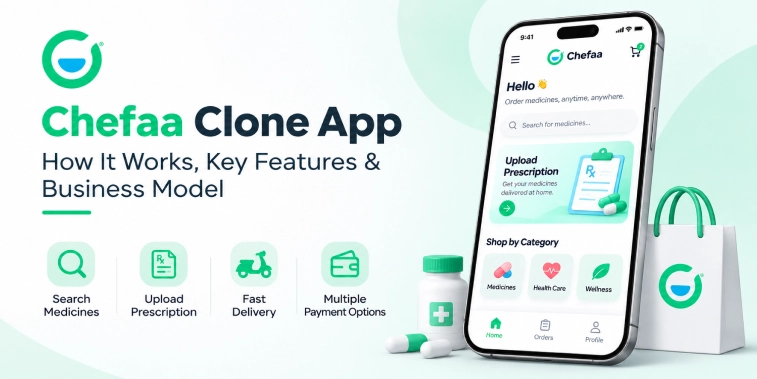
A Chefaa clone app is a digital healthcare marketplace modeled around the core functions of pharmacy delivery platforms such as Chefaa. It connects customers with pharmacies, enables online medicine ordering, supports prescription uploads, and coordinates delivery to the customer’s preferred location. The concept combines e-commerce convenience with the operational requirements of healthcare, including prescription validation, product availability, pharmacist communication, and secure handling of health information.
The demand for pharmacy delivery applications has grown because customers increasingly expect essential healthcare products to be accessible through their smartphones. People may need recurring medicines, over-the-counter products, wellness items, baby care products, or urgent prescriptions without visiting several pharmacies. A well-designed clone app gives entrepreneurs a structured starting point while allowing them to customize the product for a particular market, audience, or business model.
However, a clone app should not be treated as a simple copy of another platform. The strongest solutions study the original service model, identify the features that create value, and then adapt the experience to local pharmacy regulations, delivery networks, payment preferences, and customer expectations. The objective is to build a reliable healthcare commerce platform with its own brand identity and competitive advantages.
How a Chefaa Clone App Works
The app typically operates as a multi-sided platform with separate experiences for customers, pharmacies, delivery partners, pharmacists, and administrators. Customers use the mobile app or web application to search for products, upload prescriptions, request medicine, compare options, and complete purchases. Pharmacies receive order information through a pharmacy dashboard, confirm stock, verify prescriptions when required, prepare the order, and hand it to a delivery partner.
When a customer searches for a medicine, the platform can show available products from participating pharmacies. The customer may add eligible items to a cart, submit a prescription for restricted medicines, select a delivery address, and choose a payment method. If the requested product is unavailable, the pharmacy or pharmacist can suggest a suitable alternative, subject to applicable rules and customer approval.
After checkout, the order moves through a series of status updates. These may include order received, prescription under review, pharmacy confirmation, preparation in progress, ready for pickup, out for delivery, and delivered. Automated notifications keep customers informed and reduce the need for support calls. The platform may also allow customers to contact a pharmacist or support agent through in-app messaging.
Behind the user interface, the system coordinates inventory, prescription review, payments, order routing, delivery assignment, refunds, and reporting. An administrator can monitor activity across the marketplace, approve pharmacy partners, manage product categories, configure commissions, review disputes, and track business performance.
Main User Roles in the Platform
Customers
The customer app should make healthcare shopping simple without removing important safety steps. Users can create profiles, save delivery addresses, manage family members, browse product categories, upload prescriptions, place orders, and review previous purchases. A customer profile may also include medicine reminders, refill preferences, and records of frequently ordered products, provided that these functions comply with privacy and healthcare regulations.
Search and navigation are especially important. Customers should be able to find products using brand names, generic names, categories, symptoms where legally appropriate, or pharmacist assistance. Product pages should display clear descriptions, dosage information where permitted, packaging details, prices, availability, and warnings. The interface should never encourage self-diagnosis or make unsupported medical claims.
Pharmacies and pharmacists
Pharmacy partners need tools for receiving and processing orders efficiently. Their dashboard can show incoming requests, prescription files, customer notes, inventory status, expected preparation times, and payment information. Pharmacists should be able to approve a valid prescription, reject an unsuitable request, ask for clarification, or propose an approved alternative.
Pharmacy onboarding should include business verification, license documentation, operating hours, service areas, bank details, and staff information where required. A strong platform also supports inventory synchronization, either through an existing pharmacy system or through manual stock management. Accurate availability reduces cancellations and improves customer trust.
Delivery partners
The delivery application should present assigned orders, pickup details, customer addresses, navigation support, delivery instructions, and proof of delivery options. Partners may update their availability, accept or decline tasks, and view earnings. Location tracking can help customers follow an order, but the platform should collect and share location data only when necessary and with suitable consent.
Administrators
The admin panel is the control center for the marketplace. Administrators can manage users, pharmacies, pharmacists, delivery partners, orders, payments, categories, promotions, complaints, and content. They can also configure service fees, delivery zones, commission rules, prescription workflows, and role-based permissions.
Key Features of a Chefaa Clone App
Medicine and healthcare product search
A searchable catalog is one of the app’s most important components. It should support filters for category, price, brand, active ingredient, availability, and pharmacy location. Product data needs to be organized carefully because inconsistent names, duplicate listings, and missing information can make healthcare shopping confusing.
The catalog can include prescription medicines, over-the-counter products, vitamins, personal care items, medical devices, baby products, and wellness goods. Each market has different requirements regarding what can be displayed, sold, or delivered online. The platform should therefore include configurable product rules rather than relying on a single universal catalog structure.
Prescription upload and verification
Prescription handling is a defining feature of a pharmacy delivery application. Customers should be able to upload an image or document from their device, attach it to an order, and receive a clear status update during review. The app may support camera capture, file validation, secure storage, expiration checks, and pharmacist comments.
Prescription verification should remain under the control of authorized pharmacy professionals. Optical character recognition can help extract basic information, but automated tools should not replace professional review when regulations require human validation. The system should also restrict unauthorized access, create audit logs, and define retention policies for prescription files.
Pharmacist consultation
In-app consultation can improve customer confidence and help pharmacies provide professional service. Depending on local rules, customers may communicate with pharmacists through text chat, voice calls, or video consultations. The experience can support questions about product use, availability, refills, and general guidance within the pharmacist’s legal scope.
The platform should show pharmacist availability, expected response times, and consultation status. It should also provide disclaimers and escalation options for urgent or serious medical concerns. A healthcare marketplace must make it clear that online support is not a replacement for emergency care.
Order management and live tracking
Customers should be able to see each order’s current status from payment through delivery. Pharmacies need a workflow that prevents orders from being lost between approval, preparation, and dispatch. Delivery partners require accurate pickup information and a simple method for confirming handover.
Live tracking can use location services and map integrations to show an estimated arrival time. Since delivery estimates can change due to traffic, pharmacy preparation, or product substitutions, the platform should communicate updates honestly. Notifications through push messages, email, or SMS can keep customers informed without requiring them to repeatedly open the app.
Digital payments and refunds
A Chefaa clone app can support cards, mobile wallets, bank transfers, cash on delivery where appropriate, and other locally popular payment methods. Payment processing should use a trusted gateway and follow relevant security requirements. Sensitive card information should not be stored directly by the application unless the necessary compliance controls are in place.
The payment system should handle partial refunds, canceled orders, failed transactions, delivery charges, pharmacy commissions, and promotional discounts. Clear receipts should explain the product subtotal, taxes, delivery fee, platform fee, discounts, and total amount. Transparent billing helps reduce disputes and support costs.
Refills and medicine reminders
Recurring orders can create significant value for customers managing long-term treatments. Users may set refill reminders, save a previous order, request approval for a new refill, or choose a recurring delivery schedule. The app should not automatically reorder restricted medicines without the required prescription and pharmacist review.
Reminder features should be customizable and privacy-conscious. Customers may choose notification channels, reminder times, and the products included in a reminder. These tools can increase retention while also supporting better adherence, but they should be presented as convenience features rather than medical advice.
Reviews, support, and loyalty
Ratings and reviews can help customers evaluate pharmacy service, delivery speed, packaging, and order accuracy. Review moderation is important because healthcare platforms must prevent misleading claims, abusive content, and disclosure of private medical information. Customers should have access to a simple process for reporting an issue.
Customer support can include FAQs, chat, ticket management, phone support, and order-specific assistance. Loyalty programs may offer points, discounts, subscription benefits, or referral rewards. Promotions should be reviewed carefully because advertising rules for medicines and healthcare services can be strict in many jurisdictions.
Business Model of a Chefaa Clone App
The business model determines how the platform earns revenue while delivering value to customers and pharmacy partners. The most common approach is a commission on orders completed through the marketplace. The platform receives a percentage or fixed fee from the pharmacy, while the customer pays the product and delivery charges according to the configured pricing structure.
Another option is a delivery fee. Customers may pay a standard charge, a distance-based price, or a variable fee linked to delivery speed. The platform can also offer free delivery above a minimum basket value or provide discounted delivery through a membership plan. Pricing should balance convenience for customers with fair compensation for delivery partners.
Subscription plans can create recurring revenue and improve customer retention. A paid membership might include free delivery, exclusive discounts, priority support, refill reminders, or access to selected wellness services. The benefits should be financially sustainable and easy for customers to understand.
Pharmacy partners may pay a software subscription for advanced dashboard features, inventory integration, analytics, promotional placement, or customer relationship tools. This model is useful when the platform serves pharmacies that want digital infrastructure in addition to marketplace access. In some markets, the business may also earn revenue from private-label wellness products, compliant advertising, or corporate healthcare programs.
Revenue diversification should not compromise customer trust. The platform must clearly distinguish paid promotions from organic search results and avoid allowing commercial incentives to influence professional prescription decisions. Long-term success depends on reliability, safety, and transparent relationships with all participants.
How to Build a Chefaa Clone App
The development process should begin with market research and regulatory analysis. The business team needs to identify target cities, pharmacy types, customer segments, delivery expectations, payment methods, and legal requirements. It should also determine whether the platform will serve only over-the-counter products, support prescription medicines, or include consultations and recurring care programs.
The next step is to define a minimum viable product. A practical first version may include customer registration, pharmacy onboarding, product browsing, prescription upload, cart and checkout, order tracking, delivery management, payments, notifications, and an admin panel. Advanced functions such as artificial intelligence recommendations, wearable integrations, complex subscriptions, or multi-country support can be introduced after the core workflow is stable.
The user experience should be designed around clarity and safety. Customers need to understand which products require prescriptions, when a pharmacist must review an order, how substitutions work, and what happens if an item is unavailable. Pharmacies need fast order processing tools, while delivery partners need a low-friction workflow that works reliably on mobile networks.
The technology stack may include native or cross-platform mobile applications, a responsive web portal, cloud infrastructure, a secure API layer, a relational database, payment gateway integrations, map services, push notification tools, and analytics systems. The exact stack depends on the expected scale, development team, compliance requirements, and integration landscape.
Testing should cover functional workflows, payment failures, prescription privacy, role permissions, delivery edge cases, accessibility, performance, and security. Pilot testing with a limited group of pharmacies and customers can reveal operational problems before a wider launch. The team should also establish processes for incident response, data deletion requests, customer complaints, and regulatory audits.
Challenges and Compliance Considerations
Healthcare commerce requires stronger controls than ordinary retail. Prescription documents, medicine details, addresses, payment data, and consultation messages may be sensitive. The app should use encryption in transit and at rest, secure authentication, least-privilege access, audit trails, regular security testing, and documented data retention policies.
Regulations differ by country and may govern online pharmacy licenses, pharmacist involvement, prescription validity, medicine advertising, delivery restrictions, data protection, and payment processing. A business should consult qualified legal and healthcare compliance professionals before launch. Copying a familiar interface does not guarantee that the operation is lawful in a new market.
Operational reliability is another major challenge. Inventory information may be outdated, prescriptions may be unclear, customers may enter incomplete addresses, and delivery delays may affect temperature-sensitive or time-critical products. The platform needs defined procedures for substitutions, cancellations, returns, damaged packages, failed deliveries, and urgent support requests.
Trust is built through accurate information and consistent service. The app should avoid exaggerated health claims, clearly display pharmacy credentials where appropriate, provide accessible support, and explain how customer data is used. These practices protect users and strengthen the brand’s reputation.
Benefits of Launching a Chefaa Clone App
For customers, the main benefit is convenient access to medicines and healthcare products from home. Search, digital prescriptions, online payment, delivery tracking, and refill tools reduce friction in the purchasing process. Customers can also compare availability and receive support without contacting several pharmacies individually.
Pharmacies gain a digital sales channel, broader local reach, structured order management, and opportunities to serve customers beyond their physical location. A marketplace can help independent pharmacies compete with larger chains when it provides useful technology, fair pricing, and dependable delivery operations.
Entrepreneurs benefit from a proven category with multiple possible revenue streams. They can begin in one city or niche, measure demand, and expand by adding pharmacies, product categories, delivery zones, and healthcare services. The model can also support partnerships with employers, insurers, clinics, and chronic care programs.
The strongest advantage comes from combining convenience with professional oversight. A successful clone app is not simply a shopping application. It is a healthcare service platform that must make every transaction understandable, secure, and operationally dependable.
Conclusion
A Chefaa clone app provides a practical framework for building an online pharmacy and healthcare delivery marketplace. Its core workflow connects customers with verified pharmacies, supports prescription review, manages payments and orders, and coordinates reliable delivery. Features such as product search, pharmacist consultation, live tracking, digital payments, refills, reminders, and support can create a complete user experience.
The business model may combine pharmacy commissions, delivery charges, subscriptions, software fees, and compliant promotional services. However, revenue should always be balanced with patient safety, privacy, regulatory compliance, and transparent healthcare practices.
For entrepreneurs, the best approach is to validate the market, launch a focused minimum viable product, work with qualified pharmacy partners, and improve the platform using real customer and operational data. With the right technology, compliance framework, and service quality, a Chefaa-inspired platform can become a valuable digital channel for pharmacies and a convenient resource for customers.
Frequently Asked Questions (FAQs)
1. What is a Chefaa clone app?
A Chefaa clone app is an online pharmacy delivery application inspired by Chefaa’s business model. It connects customers with pharmacies and allows users to search for medicines, upload prescriptions, order healthcare products, and receive deliveries.
2. How does a Chefaa clone app work?
The application connects customers, pharmacies, delivery partners, and administrators. Customers search for medicines or upload prescriptions, pharmacies review and prepare eligible orders, and delivery partners transport the packages to customers.
3. What are the essential features of a Chefaa clone app?
Important features include medicine search, prescription uploads, product catalogs, shopping carts, payment integration, order tracking, medication reminders, scheduled refills, pharmacy management, delivery assignment, and an admin dashboard.
4. How does a Chefaa clone app generate revenue?
A Chefaa clone app can generate revenue through pharmacy commissions, pharmacy subscriptions, optional customer subscriptions, delivery charges, featured pharmacy listings, and B2B pharmaceutical services.
5. Can a Chefaa clone app be customized for a specific business?
Yes. Businesses can customize the application according to their branding, target market, payment requirements, pharmacy workflows, delivery operations, and additional features. Customization should also address local pharmaceutical regulations, prescription verification, and data security requirements.

Parth Kulkarni
Managing Director
Parth Kulkarni is the Managing Director with strong expertise in IT and on-demand app solutions, focused on empowering startups and enterprises with scalable digital products. His strategic leadership and business insight drive innovation, ensuring consistent client success and long-term growth.
