

Introduction
Online grocery shopping has changed how customers purchase fresh produce, packaged food, household essentials, and everyday products. Instead of visiting multiple supermarkets, customers can browse products, place orders, and arrange home delivery through a mobile application. This convenience has encouraged retailers and entrepreneurs to explore digital grocery delivery platforms.
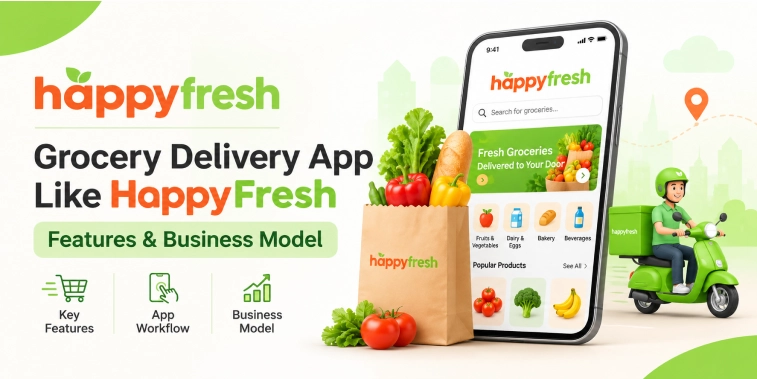
HappyFresh is an example of a grocery delivery platform that connects customers with supermarket partners through an online shopping experience. Its model combines digital product catalogues, personal shoppers, order management, and delivery services. Customers can choose products from participating stores, while shoppers help select items and coordinate fulfillment.
A grocery delivery app like HappyFresh provides an opportunity for businesses to bring traditional grocery shopping online. Entrepreneurs can develop a platform that connects customers, supermarkets, personal shoppers, delivery partners, and administrators in one system.
This guide explains the concept, essential features, business model, development process, and cost factors involved in building a grocery delivery platform.
What Is a Grocery Delivery App Like HappyFresh?
A grocery delivery app like HappyFresh is a digital platform that allows customers to order groceries from supermarkets and local retailers through a website or mobile application. It connects shoppers with participating stores and coordinates product selection, payment, order preparation, and delivery.
Rather than operating only as an online supermarket, this type of platform can work as a multi-store marketplace. Customers can browse products from available retailers, add items to their cart, select a delivery option, and receive their orders at home.
HappyFresh’s partnership model demonstrates how supermarkets can make their products available online without independently building an entire digital shopping and delivery system. Its partnership information describes product digitisation, personal shoppers, payment processing, and delivery coordination as part of the service.
An independent grocery delivery platform can adopt a similar concept while choosing its own operating model. It may work with existing supermarkets, manage its own inventory, operate fulfilment locations, or combine these approaches.
The platform generally includes four main participants:
- Customers: Browse grocery products, place orders, make payments, and track deliveries.
- Retailers: Provide product listings, pricing, inventory information, and order fulfillment support.
- Personal shoppers: Select products, follow customer instructions, and manage substitutions when items are unavailable.
- Delivery partners: Collect prepared orders and transport them to customers.
An administrator manages the overall platform, including users, retailer accounts, transactions, service areas, and operational reports.
Key Features of a Grocery Delivery App Like HappyFresh
A successful grocery delivery platform needs features that make product discovery, ordering, shopping, and delivery convenient. The following functionality can be included in a grocery app inspired by the HappyFresh business model.
1. Customer Registration and Profile Management
Customers should be able to create accounts using their email addresses or supported sign-in methods. Their profiles can store contact details, saved delivery addresses, order history, and preferences.
A well-organized profile helps customers manage their grocery shopping without entering the same information every time they place an order.
2. Supermarket and Store Listings
The application should display participating supermarkets and grocery retailers based on customer location and service availability.
Each store listing can include its name, location, product categories, delivery options, and operating hours. Customers can select a preferred retailer before exploring its catalogue.
This feature gives the platform a multi-store marketplace structure and helps partner businesses reach customers through a shared digital channel.
3. Digital Product Catalogue
A detailed product catalogue is essential for grocery shopping. Retailers should be able to list products with names, images, descriptions, prices, brands, sizes, and availability information.
Products can be organized into categories such as
- Fruits and vegetables
- Dairy and bakery
- Meat and seafood
- Packaged foods
- Beverages
- Snacks and confectionery
- Household essentials
- Personal care products
Search and filtering tools help customers find specific products without browsing the entire catalogue.
4. Smart Search and Product Filters
A search feature allows customers to locate products by name, brand, category, or relevant keyword. Filters can help narrow results according to price, product type, availability, or retailer.
A well-designed search experience reduces browsing time and makes it easier to complete grocery orders.
5. Shopping Cart and Order Management
Customers should be able to add products to a cart, adjust quantities, remove unwanted items, and review their selections before checkout.
The cart should display product prices, quantities, applicable fees, discounts, and the estimated order total. Customers should also be able to review their selected store and delivery details before confirming an order.
6. Personal Shopper Assignment
Personal shoppers are an important part of a grocery platform that offers handpicked products. The system can assign an available shopper to an order based on store location, workload, and operational requirements.
The shopper dashboard should display assigned orders, shopping lists, customer instructions, and order status. This helps shoppers understand what needs to be selected and prepared.
7. Product Substitution and Customer Instructions
Some products may be unavailable when a shopper visits a store. The platform should provide a substitution process that allows customers to select their preferences.
Possible options include:
- Allowing the shopper to suggest a similar product.
- Asking the customer to approve a replacement.
- Providing specific instructions for individual items.
- Requesting that unavailable products be excluded from the order.
These options help reduce confusion and give customers more control over their purchases.
8. Delivery Scheduling and Address Management
Customers should be able to save multiple delivery addresses and select an available delivery option during checkout.
Depending on the business model, the platform may support express delivery, same-day delivery, or scheduled delivery slots. Delivery availability should depend on store preparation capacity, shopper availability, and delivery coverage.
9. Secure Online Payments
A grocery delivery app can support payment methods such as cards, digital wallets, and other locally available payment options.
The checkout process should clearly display the order amount, delivery charges, discounts, and applicable taxes. Customers should receive an order confirmation and digital payment record after completing a transaction.
10. Live Order Tracking
Order tracking helps customers understand the progress of their purchases. The application can display stages such as order confirmed, shopping in progress, items packed, picked up, and out for delivery.
Where location tracking is supported, customers can also view the delivery partner’s location during the final delivery stage.
11. Ratings and Customer Feedback
Customers should be able to provide feedback about their shopping and delivery experience. Ratings can cover product selection, order accuracy, communication, and delivery service.
Feedback helps administrators identify service problems and gives retailers and delivery teams useful information for improving operations.
12. Offers, Discounts, and Loyalty Rewards
Promotional tools can help grocery businesses attract new customers and encourage repeat purchases. Administrators can create discount campaigns, store-specific offers, referral promotions, and loyalty programs.
The platform can display eligible promotions during browsing and checkout. Terms and conditions should be clear so customers understand how each offer applies.
13. Notifications and Order Updates
Push notifications, email alerts, or supported messaging notifications can inform customers about order confirmation, shopper progress, substitutions, payment updates, and delivery status.
Retailers and shoppers can also receive alerts about new orders, assignment changes, and important customer instructions.
14. Retailer Dashboard
Retailers need a dedicated dashboard to manage their participation in the platform. It can provide tools for product listings, pricing, inventory updates, order acceptance, and sales reports.
A retailer dashboard helps supermarket partners maintain their digital catalogue and coordinate incoming orders.
15. Admin Dashboard
The admin dashboard provides central control over the grocery delivery platform. Administrators can manage customer accounts, retailers, shoppers, delivery partners, product categories, payments, promotions, and service areas.
Reports can help monitor order volume, cancellations, revenue, delivery performance, and customer feedback. These insights support better operational decisions.
Business Model of a Grocery Delivery App Like HappyFresh
A grocery delivery platform can generate revenue through several channels. The right combination depends on its relationship with supermarkets, the delivery structure, operating expenses, and customer demand.
1. Commission From Retailer Partners
The platform can charge participating supermarkets a commission on completed orders. The commission may be calculated as a percentage of the eligible order value or according to an agreed commercial arrangement.
This model allows the platform to earn revenue from grocery transactions while helping retailers reach customers through an online channel.
2. Customer Delivery Fees
Customers may pay a delivery fee when placing an order. The amount can depend on delivery distance, order size, selected delivery speed, location, or time slot.
Some platforms may offer free delivery when customers meet a minimum order value or subscribe to an eligible plan.
3. Service and Convenience Fees
A platform may charge a separate service fee to cover certain order-processing and operational services. The fee structure should be transparent and displayed before checkout.
Businesses should ensure that charges are reasonable and clearly explained to customers.
4. Personal Shopping Fees
When customers use a personal shopping service, the platform may apply a shopping fee for product selection and order preparation.
This revenue stream is particularly relevant to platforms where shoppers visit partner supermarkets and handpick items according to customer preferences.
5. Subscription Plans
A grocery delivery business can introduce subscription plans for frequent customers. Depending on the plan, subscribers may receive benefits such as reduced delivery fees, selected offers, or access to eligible delivery options.
Subscription pricing should reflect actual service costs and provide clear value to customers.
6. Featured Product and Retailer Promotions
Retailers and brands may pay to promote selected products or special offers within the application.
Sponsored placements can create additional revenue, provided promotional listings are clearly identified and do not mislead customers.
7. Corporate Grocery Services
The platform can also serve offices, small businesses, and other organisations that regularly purchase groceries or pantry supplies.
Businesses may receive dedicated ordering arrangements, consolidated billing, and recurring order options. This creates an additional business-to-business revenue opportunity.
How to Develop a Grocery Delivery App Like HappyFresh
Developing a grocery delivery platform requires planning across customer experience, retailer management, shopping operations, and delivery coordination. A structured development process helps businesses define the product before investing in implementation.
Step 1: Research the Market and Define the Business Model
Begin by identifying the target market, customer requirements, supermarket partners, and local competitors.
Decide whether the platform will operate as a retailer marketplace, inventory-owning grocery service, personal shopper platform, or hybrid model. The business model will influence the features, partnerships, and operational requirements.
Step 2: Identify Essential User Roles and Features
Define the main user groups, including customers, retailers, personal shoppers, delivery partners, and administrators.
Prepare a feature list for each role. Prioritise essential functions such as product browsing, checkout, order assignment, substitutions, payment processing, and delivery tracking.
Step 3: Design the User Experience
Create wireframes and interface designs for the customer application and operational dashboards.
The customer journey should make it easy to find a store, browse products, add items to a cart, choose delivery options, and complete checkout. Retailer and shopper interfaces should focus on clear order information and straightforward task management.
Step 4: Choose the Technology and Integrations
Select technologies that support mobile applications, web dashboards, databases, notifications, payment processing, and location services.
The platform may also need integrations with retailer inventory systems, payment providers, mapping services, and delivery management tools. The final technology choices should reflect the project’s scale, budget, and technical requirements.
Step 5: Develop and Test the Platform
Build the customer application, retailer dashboard, shopper interface, delivery partner functionality, and admin panel.
Test important workflows, including product availability, order calculations, payment confirmation, substitutions, refunds, notifications, and delivery status updates.
Testing should also cover usability, performance, security, and different device sizes before launch.
Step 6: Launch and Improve the Service
Start with a defined service area and a manageable group of retail partners. Monitor customer feedback, order completion, product availability, delivery performance, and support requests.
Use operational data to identify problems and prioritise improvements. Additional stores, service areas, and features can be introduced as the platform becomes more established.
Cost Factors in Grocery Delivery App Development
The cost of developing a grocery delivery app like HappyFresh depends on the platform’s functionality, technical complexity, integrations, and operating requirements. A basic grocery ordering application will generally require fewer resources than a multi-store platform with personal shopper assignment and advanced delivery management.
Important cost factors include:
- Number of applications: Separate customer, retailer, shopper, and delivery interfaces increase development work.
- Feature complexity: Live tracking, substitutions, advanced search, loyalty programmes, and reporting require additional implementation.
- UI/UX design: Custom interfaces and user testing influence design costs.
- Third-party integrations: Payment gateways, maps, notifications, and retailer systems may involve setup or recurring fees.
- Backend infrastructure: Hosting, databases, security, and system maintenance affect ongoing expenses.
- Testing and quality assurance: Testing across devices and operational workflows requires time and resources.
- Maintenance and updates: Bug fixes, compatibility updates, performance improvements, and new features create continuing costs.
A business should define its minimum viable product before estimating the budget. Launching with essential features and expanding after evaluating real customer demand can help manage initial development investment.
Conclusion
A grocery delivery app like HappyFresh brings customers, supermarkets, personal shoppers, and delivery partners together through a digital shopping platform. Its core functionality includes store listings, product catalogues, shopping carts, order management, product substitutions, payments, and delivery coordination.
For entrepreneurs, this model offers different opportunities to work with existing retailers, provide personal shopping services, and develop additional revenue streams through commissions, delivery fees, subscriptions, and promotional partnerships.
A successful platform needs more than a customer-facing shopping application. Retailer tools, shopper workflows, delivery management, and reliable administration are equally important. With a clear business model, practical feature selection, and a customer-focused development strategy, businesses can create a grocery delivery solution suited to their target market.
Frequently Asked Questions (FAQs)
1. What is a grocery delivery app like HappyFresh?
It is an online platform that connects customers with supermarkets and grocery retailers. Customers can browse products, place orders, and arrange delivery through a website or mobile application.
2. What are the key features of a HappyFresh-like grocery app?
Important features include store listings, product catalogues, search filters, shopping carts, personal shopper assignment, product substitutions, online payments, order tracking, retailer dashboards, and admin management.
3. How does a grocery delivery app like HappyFresh make money?
It can generate revenue through retailer commissions, customer delivery fees, service charges, personal shopping fees, subscription plans, promotional placements, and corporate grocery services.
4. Can a grocery delivery app support multiple supermarkets?
Yes. A multi-store grocery platform can onboard different supermarkets and retailers, allowing customers to browse products from participating stores. Each retailer can manage its own catalogue, pricing, and order information.
5. What affects the cost of developing a grocery delivery app?
Development cost depends on the number of user applications, feature complexity, design requirements, third-party integrations, backend infrastructure, testing, and ongoing maintenance.

Parth Kulkarni
Managing Director
Parth Kulkarni is the Managing Director with strong expertise in IT and on-demand app solutions, focused on empowering startups and enterprises with scalable digital products. His strategic leadership and business insight drive innovation, ensuring consistent client success and long-term growth.