

Introduction
Online food delivery has become an important part of everyday life. Customers want convenient ways to discover restaurants, compare meals, place orders, make digital payments, and receive food at their preferred location. At the same time, restaurants and food businesses need digital platforms that can help them reach customers and manage orders efficiently.
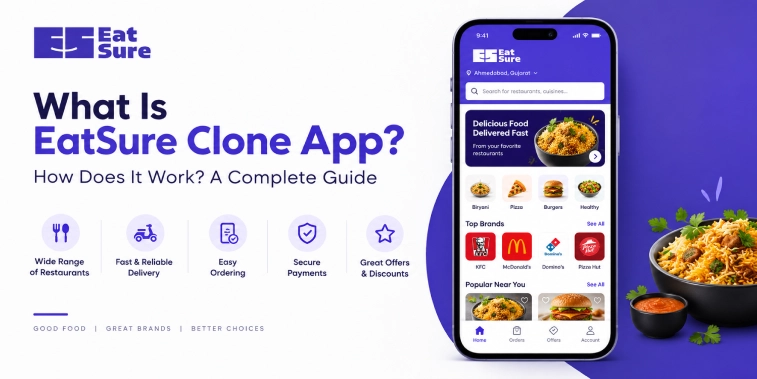
An EatSure Clone App is a customizable food delivery platform inspired by the multi-restaurant and food-ordering concept associated with EatSure. It can provide businesses with a foundation for launching their own branded food delivery marketplace.
The platform can connect customers, restaurants, delivery partners, and administrators through dedicated interfaces. Customers can browse restaurants and food items, place orders, make payments, receive notifications, and track deliveries. Restaurants can manage menus, orders, availability, and business information, while delivery partners can manage assigned deliveries and navigation.
This guide explains what an EatSure Clone App is, how it works, its major features, AI-powered functionality, business model, technology integrations, security requirements, and important factors to consider when launching a food delivery platform.
What Is an EatSure Clone App?
An EatSure Clone App is a ready-to-customize food delivery solution designed to provide functionality similar to a modern online food ordering platform.
The word “clone” does not necessarily mean an exact copy. A properly customized clone solution can use a familiar business concept while allowing a company to create its own branding, user experience, features, pricing model, restaurant network, and operating strategy.
A typical EatSure-style platform can connect four major participants:
- Customers
- Restaurants and food partners
- Delivery partners
- Platform administrators
The customer application focuses on food discovery and ordering. The restaurant interface helps food businesses manage menus and incoming orders. The delivery application supports delivery operations, while the admin panel provides centralized control over the entire marketplace.
Businesses can also customize the platform according to their target market. For example, a platform could focus on a particular city, cuisine category, restaurant segment, or food delivery model.
How Does an EatSure Clone App Work?
An EatSure Clone App generally works as a connected marketplace where customers can discover food, restaurants can receive orders, delivery partners can complete deliveries, and administrators can manage the overall ecosystem.
A typical customer journey can include the following steps:
1. User Registration
Customers create an account using supported registration methods such as a phone number, email address, or social login.
2. Location Selection
The application identifies or receives the customer’s delivery location so that it can show relevant restaurants and delivery options.
3. Restaurant and Food Discovery
Customers can browse restaurants, cuisines, categories, dishes, offers, and recommendations.
4. Search and Filtering
Users can search for a specific restaurant, dish, cuisine, or food category and apply relevant filters.
5. Food Selection
Customers select dishes, customize available options, specify quantities, and add items to their cart.
6. Checkout
The customer reviews the order, confirms the delivery address, applies an eligible offer, and selects a payment method.
7. Order Confirmation
The restaurant receives the order and confirms or processes it according to the platform workflow.
8. Delivery Assignment
A delivery partner can be assigned according to availability, location, or the platform’s dispatch logic.
9. Order Tracking
Customers can receive relevant updates about their order and delivery.
10. Delivery and Feedback
After the order is completed, customers can rate their experience and provide feedback where supported.
This connected workflow allows the platform to coordinate multiple parties through a single digital ecosystem.
Key Features of an EatSure Clone App
The features of a food delivery platform should address the needs of customers, restaurants, delivery partners, and administrators.
Customer Registration and Profile
Customers should have a convenient way to create and manage their accounts.
A profile can include:
- Name and contact details
- Saved addresses
- Order history
- Favorite restaurants
- Favorite dishes
- Payment preferences
- Saved offers
- Notification preferences
A centralized profile makes repeat ordering easier.
Restaurant Discovery
Restaurant discovery is one of the core functions of a food delivery application.
Users can explore restaurants according to:
- Cuisine
- Location
- Price range
- Ratings
- Availability
- Delivery options
- Offers
- Dietary preferences where supported
A well-organized discovery experience helps customers find suitable options quickly.
Search and Filters
A strong search system can significantly improve the ordering experience.
Customers can search by:
- Restaurant name
- Dish name
- Cuisine
- Food category
- Dietary preference
- Location
Filters can help narrow results based on price, rating, delivery availability, and other relevant factors.
Digital Menu
Restaurants can display their menus digitally.
Menu information can include:
- Food name
- Description
- Price
- Images
- Ingredients
- Add-ons
- Customization options
- Availability
Restaurants should be able to update menu information through their dashboard.
Cart Management
Customers can add multiple items to their cart, adjust quantities, remove products, and review the order before checkout.
A clear cart experience can reduce ordering errors.
Online Ordering and Checkout
The checkout system can allow users to:
- Confirm their address
- Review food items
- Apply eligible coupons
- View applicable fees
- Select payment methods
- Confirm the order
The final amount should be presented clearly before the customer completes the transaction.
Multiple Payment Options
A food delivery platform can integrate supported payment methods based on the target market.
These may include:
- Credit and debit cards
- Digital wallets
- Bank-based payment methods
- Other supported online payment options
- Cash payment where applicable
Payment processing should use appropriate security practices and compliant payment providers.
Order Tracking
Customers can receive updates about their orders.
Depending on the platform design, tracking can provide information about order confirmation, preparation, dispatch, and delivery progress.
Ratings and Reviews
Customers can rate restaurants, food, and delivery experiences where applicable.
Reviews can help customers make decisions while giving restaurants useful feedback.
Favorites and Reordering
Customers can save favorite restaurants or dishes and reorder previous meals more easily.
This can be especially useful for users who regularly order from the same restaurants.
Notifications
The platform can send relevant notifications about:
- Order confirmations
- Order updates
- Delivery information
- Promotional offers
- Payment notifications
- Refund updates
- Account activity
Notifications should be useful and appropriately controlled.
Restaurant and Food Partner Features
Restaurants need a dedicated interface for managing their operations on the platform.
Restaurant Profile Management
Restaurants can manage information such as:
- Business name
- Address
- Contact details
- Operating hours
- Cuisine
- Images
- Description
- Delivery availability
Menu Management
Restaurant owners can add, edit, remove, and organize food items.
They can also update prices, descriptions, images, availability, and customization options.
Order Management
Restaurants can receive and manage customer orders through their dashboard.
They may be able to:
- Accept orders
- Review order details
- Update preparation status
- Mark items unavailable
- Manage order history
Availability Management
Restaurants can control whether specific dishes or menu categories are currently available.
This helps prevent customers from ordering unavailable items.
Restaurant Analytics
Restaurant dashboards can provide useful information about:
- Orders
- Revenue
- Popular dishes
- Customer activity
- Ratings
- Order trends
These insights can help restaurants understand their platform performance.
Delivery Partner Features
Delivery partners play an important role in food delivery operations.
A dedicated delivery application can provide features such as:
Registration and Verification
Delivery partners can submit required information during onboarding.
Availability Control
Partners can indicate when they are available to receive delivery requests.
Delivery Requests
Available delivery partners can receive relevant delivery assignments.
Navigation
Map and navigation integrations can help delivery partners reach restaurants and customers.
Earnings Management
Partners can view completed deliveries and relevant earnings information.
Delivery History
The application can maintain a record of completed deliveries.
Notifications
Delivery partners can receive alerts about new requests, changes, and other operational information.
Admin Dashboard
The admin panel provides centralized management for the entire food delivery ecosystem.
Administrators can manage:
- Customers
- Restaurants
- Delivery partners
- Orders
- Payments
- Promotions
- Categories
- Reviews
- Content
- Reports
Customer Management
Admins can manage customer accounts and address support-related issues.
Restaurant Management
The platform can support restaurant onboarding, verification, category management, and account administration.
Delivery Management
Administrators can monitor delivery operations and manage delivery-partner-related settings.
Order Management
A centralized order dashboard can provide visibility into platform transactions.
Commission Management
The platform can define commission structures for participating restaurants according to its business model.
Promotional Management
Admins can create and manage promotional campaigns, coupons, banners, and offers.
Analytics and Reporting
Reports can provide insights into orders, revenue, customer activity, restaurant performance, and other operational metrics.
AI Features for an EatSure-Style Food Delivery Platform
AI can make a food delivery platform more personalized and efficient when implemented around genuine customer and operational needs.
AI-Powered Food Recommendations
AI can analyze relevant user activity, preferences, and ordering patterns to provide personalized food recommendations.
For example, the application may highlight dishes or restaurants that are relevant to a customer’s previous interests.
Intelligent Food Search
AI-powered search can understand conversational or less precise queries.
Instead of requiring users to enter an exact dish name, an intelligent search system can interpret broader food preferences and return relevant results.
Personalized Offers
AI can help businesses present more relevant promotions to different customer segments.
For example, a customer frequently ordering vegetarian meals may see relevant offers instead of unrelated promotions.
AI Customer Support
An AI assistant can answer common questions related to:
- Orders
- Payments
- Delivery
- Refunds
- Restaurant information
- Account issues
More complex cases can be transferred to human support.
Demand Forecasting
AI-based forecasting can help restaurants and platform operators identify demand patterns.
This can support inventory planning, staffing, preparation planning, and delivery capacity management.
Fraud and Anomaly Detection
AI systems can assist with identifying unusual transaction patterns or suspicious activity.
Such systems should complement appropriate security controls and human review.
Business Model and Revenue Opportunities
An EatSure Clone App can support multiple monetization strategies depending on the platform’s operating model.
Restaurant Commission
The platform can charge participating restaurants a commission on eligible orders.
Delivery Fees
Customers may pay delivery fees depending on factors such as location, order value, service conditions, or promotional rules.
Advertising and Sponsored Listings
Restaurants can pay for eligible promotional placements within the platform.
Subscription or Membership Plans
A platform can introduce membership programs that provide eligible benefits to customers for a recurring fee.
Promotional Partnerships
Food brands and restaurants may participate in promotional campaigns designed to increase visibility and customer engagement.
Service Fees
Additional platform or service fees may be applied where appropriate and clearly disclosed.
A combination of revenue streams can create a broader business model than relying entirely on restaurant commissions.
Technology and Third-Party Integrations
A reliable food delivery platform requires multiple technologies and third-party services.
Payment Gateway Integration
Payment gateways allow customers to complete digital transactions securely.
Maps and Location APIs
Maps can support restaurant discovery, address selection, delivery tracking, and navigation.
Push Notification Services
Push notifications can provide timely order and delivery updates.
SMS and Email Services
These services can support OTP verification, transactional communication, reminders, and customer notifications.
Analytics Tools
Analytics systems can help businesses understand customer behavior, ordering patterns, conversion activity, and operational performance.
AI Services
AI services can support recommendations, intelligent search, customer support, forecasting, and personalization.
Cloud Infrastructure
Cloud technology can support application hosting, databases, storage, monitoring, scalability, and backups.
Security and Privacy
Food delivery platforms handle customer information, payment-related information, addresses, restaurant information, and operational data.
Security should therefore be included throughout the platform architecture.
Important measures can include:
- Secure authentication
- Encryption
- Role-based access
- Secure APIs
- Payment security
- Data access controls
- Monitoring
- Backup and recovery
- Regular security testing
Businesses should also follow applicable privacy and data protection requirements in their target markets.
Benefits of an EatSure Clone App
A customizable food delivery platform can provide several potential benefits for businesses.
Faster Platform Launch
A ready-made foundation can reduce the amount of time required to establish common food delivery functionality compared with developing every component from scratch.
Custom Branding
Businesses can create their own brand identity through logos, colors, design, service categories, and other configurable elements.
Multiple Revenue Opportunities
The platform can support commissions, delivery fees, memberships, promotions, and other revenue models.
Scalable Marketplace
Businesses can onboard additional restaurants and delivery partners as their operations expand.
Better Customer Engagement
Personalized recommendations, loyalty programs, notifications, offers, and reordering features can encourage repeat usage.
Centralized Management
Customers, restaurants, delivery partners, and administrators can operate through connected digital interfaces.
How to Make an EatSure Clone App Stand Out
The food delivery market can be competitive, so businesses need to provide a clear reason for customers and restaurant partners to use their platform.
Focus on a Specific Market
A platform can initially focus on a city, region, cuisine category, dietary segment, or particular customer group.
Improve Food Discovery
Personalized recommendations, intelligent search, useful categories, and accurate restaurant information can simplify discovery.
Build a Reliable Ordering Experience
Customers should be able to move from discovery to checkout without unnecessary complexity.
Strengthen Restaurant Partnerships
Restaurants are essential to the marketplace. Transparent commercial terms, useful analytics, promotional tools, and operational support can help attract and retain restaurant partners.
Use Data Responsibly
Analytics and AI can support personalization and operational improvements, but customer data should be handled responsibly.
Prioritize Delivery Reliability
Clear delivery information, navigation tools, dispatch logic, and communication can improve the overall experience.
Future of Food Delivery Platforms
Food delivery platforms are continuing to evolve as customer expectations and technology change.
Several areas are likely to remain important:
- AI-powered recommendations
- Conversational food search
- Automated customer support
- Smarter demand forecasting
- Personalized promotions
- Better restaurant analytics
- Improved delivery coordination
- Integrated loyalty systems
- More efficient digital payments
However, adding more technology does not automatically create a better platform. Businesses should focus on features that solve real customer and operational problems.
Conclusion
An EatSure Clone App can provide a customizable foundation for businesses looking to launch their own food delivery marketplace. It can connect customers, restaurants, delivery partners, and administrators through dedicated applications and dashboards.
A complete platform can include restaurant discovery, search, digital menus, cart management, online ordering, payments, order tracking, ratings, notifications, restaurant management, delivery operations, admin controls, analytics, and loyalty functionality.
AI can further enhance the experience through personalized food recommendations, intelligent search, customer support, demand forecasting, and anomaly detection. Technology integrations such as payment gateways, maps, notifications, analytics, and cloud services can provide the infrastructure required to operate the platform.
For businesses considering this model, the focus should not simply be on replicating an existing food delivery application. The solution should be adapted to the target market, restaurant network, delivery strategy, revenue model, technology requirements, and customer expectations.
With a clear business strategy, user-friendly experience, scalable architecture, strong restaurant partnerships, and appropriate security practices, an EatSure-style food delivery platform can provide a strong foundation for launching and expanding an online food ordering business.
Frequently Asked Questions (FAQs)
1. What is an EatSure Clone App?
An EatSure Clone App is a customizable food delivery platform inspired by the food ordering and delivery marketplace concept associated with EatSure. It can connect customers, restaurants, delivery partners, and administrators through dedicated interfaces.
2. How does an EatSure Clone App work?
Customers can browse restaurants and food items, search for meals, add items to a cart, place orders, make payments, receive order updates, and track deliveries. Restaurants manage menus and orders, delivery partners manage deliveries, and administrators control the overall platform.
3. What features should an EatSure Clone App include?
Important features can include customer registration, restaurant discovery, search and filters, digital menus, cart and checkout, payments, order tracking, ratings and reviews, notifications, restaurant management, delivery management, analytics, and an admin dashboard.
4. Can AI be added to an EatSure Clone App?
Yes. AI can be used for personalized food recommendations, intelligent search, personalized offers, customer support, demand forecasting, and detecting unusual transaction patterns.
5. How does an EatSure Clone App generate revenue?
Depending on the business model, revenue can come from restaurant commissions, delivery fees, service fees, subscriptions, sponsored listings, promotional campaigns, and other eligible marketplace revenue streams.

Parth Kulkarni
Managing Director
Parth Kulkarni is the Managing Director with strong expertise in IT and on-demand app solutions, focused on empowering startups and enterprises with scalable digital products. His strategic leadership and business insight drive innovation, ensuring consistent client success and long-term growth.