


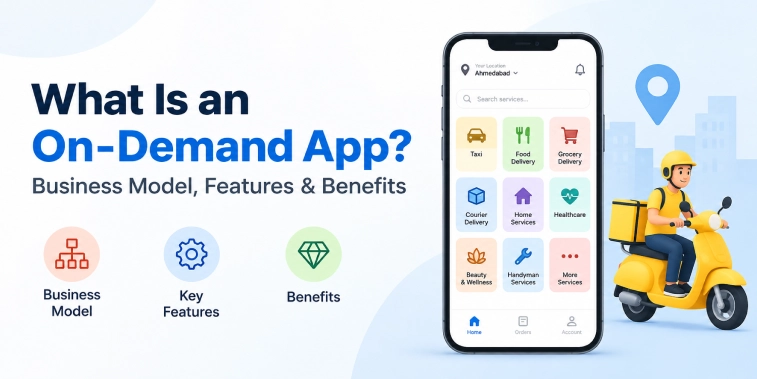
Introduction
An on-demand app is a digital platform that allows users to request products or services whenever they need them. These apps connect customers with businesses, professionals, drivers, restaurants, retailers, delivery partners, and other service providers through a convenient mobile or web platform.
Instead of calling a business, visiting a store, or waiting for manual confirmation, customers can use an on-demand app to search for a service, place an order or booking, make a payment, communicate with a provider, and track the service from one place.
On-demand platforms are now used across many industries, including transportation, food delivery, grocery delivery, home services, courier services, beauty, healthcare, and local services. A business can focus on one service or combine multiple categories into a single multi-service on-demand app.
For entrepreneurs, this model creates opportunities to build digital marketplaces that generate revenue through commissions, service fees, delivery charges, subscriptions, advertising, and other monetization methods.
With the growth of artificial intelligence, location technology, digital payments, automation, and real-time tracking, modern on-demand apps are becoming more personalized and efficient.
This guide explains what an on-demand app is, how it works, its types, business models, essential features, benefits, AI capabilities, and future potential.
What Is an On-Demand App?
An on-demand app connects customers with products or services based on their immediate or scheduled needs.
The basic process is:
Customer Request → Provider Matching → Service Delivery → Payment → Review
For example, a customer can open a ride-booking app, enter a pickup and destination, request a ride, get matched with a nearby driver, track the vehicle, complete the trip, and pay through the app.
The same concept works for other industries. A customer can order food from a nearby restaurant, request a cleaner for their home, buy groceries, schedule a courier pickup, or book a beauty service.
An on-demand app can operate as:
- A single-service platform
- A multi-service marketplace
- A delivery platform
- A service-booking platform
- A marketplace connecting customers and providers
The main purpose is to make services faster, easier, more accessible, and convenient.
How Does an On-Demand App Work?
An on-demand platform usually involves three main sides:
- Customer app
- Provider or partner app
- Admin dashboard
Each side performs a different role in the service process.
1. Customer Registers
Users create an account using supported login options such as a phone number, email address, or social authentication.
They can then manage their profile, addresses, payment methods, bookings, orders, and preferences.
2. Customer Searches for a Service
The user selects the required service or product.
Depending on the platform, they may search by:
- Service category
- Location
- Price
- Availability
- Rating
- Delivery time
- Provider
- Product
A simple search and filtering system helps customers find what they need quickly.
3. Customer Places an Order or Booking
After selecting a service, the customer provides the required information and submits a request.
For example, they may choose a delivery address, service time, product quantity, pickup location, or appointment slot.
4. Provider Matching
The platform identifies suitable providers based on factors such as location, availability, service category, rating, estimated arrival time, and other business rules.
Location-based matching is particularly important for ride-hailing, delivery, and home-service platforms.
5. Provider Accepts the Request
The provider receives the request through their application.
After accepting it, the customer receives confirmation and can follow the progress of the request.
6. Service Is Completed
The provider delivers the requested service or product.
For location-based services, customers can receive real-time updates and tracking information.
7. Payment and Review
After completion, the customer pays through the supported payment method.
The customer can then rate the provider and submit feedback.
This complete workflow allows the platform to manage the customer journey from discovery to completion.
Types of On-Demand Apps
The on-demand model can be applied to many industries.
1. Ride-Hailing Apps
Ride-hailing platforms connect passengers with drivers through a mobile application.
Services can include:
- Taxi booking
- Car booking
- Bike rides
- Premium rides
- Airport transportation
- Scheduled rides
GPS tracking, automated matching, navigation, payments, and notifications are important features for this category.
2. Food Delivery Apps
Food delivery apps connect customers with restaurants and delivery partners.
Customers can browse restaurants, view menus, place orders, pay digitally, and track deliveries.
Businesses can generate revenue through restaurant commissions, delivery fees, service charges, advertising, and promotional listings.
3. Grocery Delivery Apps
Grocery platforms allow customers to purchase products from local stores, supermarkets, or other retailers.
Common features include:
- Product search
- Categories
- Shopping cart
- Inventory management
- Delivery scheduling
- Order tracking
- Coupons
- Digital payments
4. Home Service Apps
Home-service platforms connect customers with professionals who provide services at their location.
Examples include:
- Cleaning
- Plumbing
- Electrical services
- Painting
- Carpentry
- Appliance repair
- Pest control
- Handyman services
Customers can select a service, choose a provider, schedule a time, and pay through the platform.
5. Beauty and Wellness Apps
Beauty apps connect customers with professionals offering services such as hairstyling, salon services, beauty treatments, and wellness appointments.
Users can browse professionals, check ratings, select available time slots, and make bookings.
6. Courier and Delivery Apps
Courier apps help customers and businesses arrange local package pickup and delivery.
They can support:
- Same-day delivery
- Local courier services
- Business deliveries
- Scheduled pickups
- Package tracking
7. Healthcare Apps
On-demand healthcare platforms can support services such as doctor consultations, pharmacy delivery, appointment booking, lab services, and other healthcare-related services.
These platforms require appropriate security, privacy, and regulatory considerations.
8. Multi-Service On-Demand Apps
A multi-service app combines several categories in one platform.
A Gojek-style platform, for example, can combine:
- Ride booking
- Food delivery
- Grocery delivery
- Courier services
- Home services
- Pharmacy delivery
- Wallet and payment services
This approach allows businesses to create a larger service ecosystem while giving customers access to multiple services through one application.
On-Demand App Business Model
The business model determines how an on-demand platform generates revenue.
Different industries can use different monetization strategies.
1. Commission Model
The platform takes a percentage from completed transactions.
For example, a food delivery platform may charge restaurants a commission on orders received through the application.
This model allows platform revenue to increase with transaction volume.
2. Service Fee
A platform can charge customers a service or platform fee for each transaction.
The fee may help support technology, customer service, payment processing, and platform operations.
3. Delivery Fee
Delivery platforms can charge users for delivery.
The amount can vary based on:
- Distance
- Delivery speed
- Location
- Order size
- Demand
4. Subscription Model
A subscription provides users with premium benefits in exchange for a recurring fee.
Benefits could include:
- Reduced delivery fees
- Special discounts
- Priority services
- Exclusive offers
- Premium support
5. Advertising Model
Businesses can charge providers or merchants for promotional visibility.
Advertising opportunities may include:
- Sponsored listings
- Featured businesses
- Promotional banners
- Priority placement
- Brand campaigns
6. Provider Subscription
Providers can pay a recurring fee to access premium platform features such as enhanced visibility, analytics, marketing tools, or business management features.
7. Hybrid Model
An on-demand business can combine several revenue streams.
For example:
Commission + Service Fee + Delivery Fee + Subscription + Advertising
A hybrid model can create multiple revenue opportunities and reduce dependence on a single source of income.
Essential Features of an On-Demand App
A successful on-demand platform needs features for customers, providers, businesses, and administrators.
Customer App Features
Registration and Login
Simple registration helps customers start using the platform quickly.
User Profile
Customers can manage their personal information, addresses, payment methods, bookings, and order history.
Search and Filters
Search and filtering tools help users quickly find relevant products, services, or providers.
Real-Time Tracking
GPS tracking allows customers to follow rides, deliveries, courier orders, and other location-based services.
Multiple Payment Options
Businesses can integrate suitable payment methods such as cards, wallets, bank payments, and other locally supported options.
Push Notifications
Notifications can inform customers about:
- Booking confirmation
- Order status
- Provider arrival
- Payment updates
- Promotions
- Delivery progress
Ratings and Reviews
Customers can rate providers and share feedback after completing a service.
In-App Chat
Customers and providers can communicate through the platform when additional information is required.
Customer Support
A help center, support tickets, chat support, and FAQs can help customers resolve common issues.
Provider App Features
The provider application allows drivers, professionals, merchants, and delivery partners to manage their work.
Important features include:
- Provider registration
- Profile management
- Availability status
- Booking management
- Order management
- Earnings dashboard
- Service history
- Navigation
- Notifications
- Customer communication
- Ratings and reviews
- Payout information
An easy-to-use provider application can help businesses attract and retain quality service providers.
Admin Dashboard Features
The admin panel controls the overall platform.
Administrators can manage:
- Customers
- Providers
- Merchants
- Services
- Orders
- Bookings
- Payments
- Commissions
- Promotions
- Reviews
- Support requests
Analytics can also help administrators monitor revenue, customer growth, provider activity, popular services, cancellations, and transaction trends.
A centralized admin dashboard gives business owners greater control over daily operations.
AI Features for On-Demand Apps
Artificial intelligence is becoming increasingly useful for improving on-demand platforms.
Rather than adding AI only as a trend, businesses should use it where it provides measurable value.
AI-Powered Recommendations
AI can analyze customer activity and preferences to recommend relevant services, products, restaurants, or providers.
Intelligent Provider Matching
AI can help match customers with suitable providers using factors such as location, availability, service type, ratings, and estimated arrival time.
Demand Forecasting
AI can analyze historical data to predict periods of high demand.
Businesses can use these insights to improve provider availability, delivery capacity, staffing, and promotional planning.
AI Customer Support
AI-powered assistants can answer common questions, provide order information, and guide users through routine support processes.
Complex issues can still be transferred to human support teams.
Fraud Detection
AI systems can identify unusual account or transaction patterns that may require additional review.
Personalized Promotions
AI can help identify relevant offers for different customer segments based on their activity and preferences.
Intelligent Search
AI-powered search can understand user intent and provide more relevant results, even when customers do not use exact product or service names.
These capabilities can make an on-demand platform more personalized, automated, and efficient.
Benefits of an On-Demand App for Businesses
Greater Customer Convenience
Customers can discover, order, book, pay, and track services from one platform.
This convenience can improve the overall user experience.
Wider Market Reach
A digital platform can help businesses serve customers across multiple neighborhoods, cities, or regions depending on their operating model.
Multiple Revenue Streams
Businesses can generate revenue from commissions, subscriptions, delivery fees, service charges, advertisements, and other monetization methods.
Improved Operations
A centralized platform gives businesses visibility into customers, providers, orders, bookings, payments, and service activity.
Better Customer Engagement
Push notifications, loyalty programs, personalized recommendations, promotions, and reviews can encourage customers to return to the platform.
Data-Driven Decisions
Analytics can reveal which services are popular, which locations generate demand, and how customers interact with the platform.
Easier Expansion
A scalable platform can allow businesses to add new providers, services, categories, and locations over time.
How to Start an On-Demand App Business
Building an on-demand business requires more than developing an application. Entrepreneurs should first define the market, customers, services, providers, and revenue model.
Step 1: Select a Service Category
Choose a specific market based on customer demand, competition, provider availability, and business potential.
Step 2: Define the Target Audience
Understand who will use the platform and what problem the app will solve for them.
Step 3: Choose the Business Model
Select commission, subscription, service fees, delivery charges, advertising, or a combination of models.
Step 4: Plan Core Features
Start with essential customer, provider, and admin features instead of adding unnecessary functionality.
Step 5: Select the Technology Approach
Businesses can choose between custom development and a ready-made or white-label solution.
A ready-made solution can provide a foundation that businesses customize according to their branding, service categories, workflows, and target market.
Step 6: Launch and Test
Launch the platform in a focused market, collect customer and provider feedback, and identify areas that require improvement.
Step 7: Scale the Platform
After validating the business model, expand into additional locations, services, providers, and revenue channels.
Future Trends in On-Demand Apps
The on-demand industry is evolving through technologies that improve convenience, personalization, and operational efficiency.
Key trends include:
- AI personalization for recommendations and customer experiences
- Predictive analytics for demand and resource planning
- Hyperlocal services connecting users with nearby providers
- Multi-service platforms combining multiple daily-use services
- Automated support for routine customer requests
- Smarter delivery through route optimization and real-time data
These trends are making on-demand platforms more intelligent, scalable, and customer-focused.
Conclusion
An on-demand app is a digital platform that connects customers with products and services whenever they need them. Its value comes from bringing customers, providers, merchants, payments, communication, and service management into one connected ecosystem.
From ride-hailing and food delivery to grocery, courier, home services, healthcare, and multi-service platforms, the on-demand model can be adapted to many industries.
For entrepreneurs, the opportunity extends beyond simply launching an app. A strong business needs a clear target market, reliable providers, convenient customer experiences, effective monetization, secure payments, useful analytics, and a scalable technology foundation.
AI and automation can further improve recommendations, provider matching, customer support, demand forecasting, and operational efficiency.
Businesses that want to launch a multi-service platform can also consider a Gojek-style app model, allowing several services to operate within one digital ecosystem.
With the right combination of technology, business strategy, and customer-focused services, an on-demand app can provide a strong foundation for building and expanding a modern digital marketplace.
Frequently Asked Questions (FAQs)
1. What is an on-demand app?
An on-demand app is a digital platform that connects customers with products or services when they need them. Users can search for services, place orders or bookings, make payments, receive updates, and track requests through the application.
2. How does an on-demand app make money?
An on-demand app can generate revenue through commissions, service fees, delivery charges, subscriptions, advertising, premium listings, or a combination of multiple revenue streams.
3. What are the most important features of an on-demand app?
Important features include registration, profiles, search, booking or ordering, GPS tracking, payment integration, push notifications, ratings and reviews, communication, customer support, provider management, and an admin dashboard.
4. Can I build a multi-service on-demand app?
Yes. A multi-service platform can combine services such as transportation, food delivery, grocery delivery, courier services, home services, and other categories within one application.
5. Is a Gojek-style on-demand app suitable for a startup?
A Gojek-style platform can be suitable for startups that want to offer multiple services through one application. Entrepreneurs can begin with selected services, validate demand, and gradually expand into additional categories and locations.

Parth Kulkarni
Managing Director
Parth Kulkarni is the Managing Director with strong expertise in IT and on-demand app solutions, focused on empowering startups and enterprises with scalable digital products. His strategic leadership and business insight drive innovation, ensuring consistent client success and long-term growth.
