

Introduction
The digital economy is evolving rapidly, and businesses are constantly searching for innovative ways to meet growing customer expectations. Today’s users prefer convenience, speed, and seamless digital experiences, making super apps one of the fastest-growing trends in the mobile application industry. Instead of downloading separate apps for transportation, food delivery, grocery shopping, digital payments, and home services, users increasingly prefer a single platform that provides everything they need.
This shift has created enormous opportunities for startups, enterprises, and entrepreneurs looking to enter the on-demand market. Successful platforms have demonstrated that integrating multiple services into one application not only improves customer satisfaction but also creates diverse revenue opportunities for businesses.
In 2026, super app development is no longer limited to global technology giants. Modern development frameworks, cloud infrastructure, and scalable architectures have made it possible for startups to launch feature-rich super apps with significantly lower development costs than ever before.
Whether you want to build a regional multi-service platform or launch the next generation of on-demand services, understanding the complete development process is essential. This guide explains everything you need to know, from understanding what a super app is to choosing the right technology, business model, and development strategy for long-term success.
What Is a Super App?
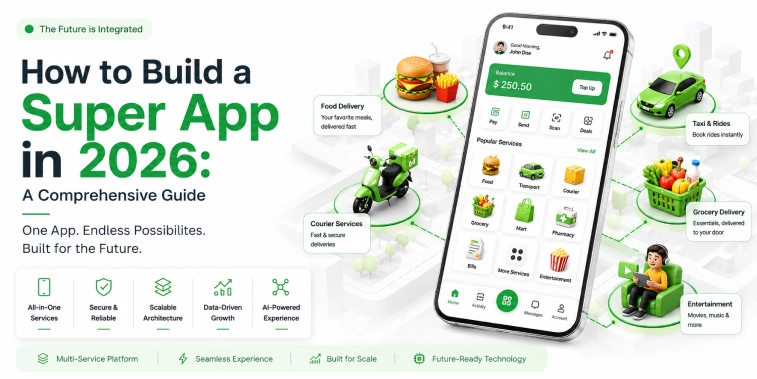
A super app is a mobile application that combines multiple digital services into a single platform, allowing users to complete various everyday activities without switching between different apps. Instead of installing separate applications for taxi booking, food delivery, grocery shopping, digital payments, and home services, users can access all these services through one convenient application.
The primary objective of a super app is to create an integrated digital ecosystem that simplifies daily life while improving user engagement. Businesses also benefit from increased customer retention, cross-selling opportunities, and multiple revenue streams.
Unlike traditional applications that focus on a single service, a super app supports several interconnected services under one account, one payment system, and one user interface.
Common Services Offered by a Super App
A modern super app may include:
- Taxi booking
- Food delivery
- Grocery delivery
- Medicine delivery
- Home services
- Parcel delivery
- Digital wallet
- Online payments
- Appointment booking
- Loyalty rewards
- Customer support
Because users can access multiple services from one application, businesses can build stronger customer relationships while increasing platform engagement.
Why Super Apps Are Growing Rapidly in 2026
Super apps continue gaining popularity because they solve one of today’s biggest consumer challenges—convenience. Modern customers want fast access to multiple services without managing numerous applications, passwords, and payment methods.
Several factors are driving the rapid growth of super apps in 2026.
Rising Demand for Convenience
Consumers increasingly expect digital platforms to simplify everyday tasks. A single application that provides transportation, shopping, food delivery, and payments creates a much smoother user experience than using multiple standalone apps.
Smartphone Adoption Continues to Increase
Affordable smartphones and faster internet connectivity have accelerated mobile-first businesses across emerging and developed markets. Millions of new users are joining digital ecosystems every year, expanding opportunities for super app businesses.
Growth of Cashless Payments
Digital wallets and online payment systems have become standard features in mobile applications. Integrated payment solutions make super apps even more convenient by allowing users to complete transactions without leaving the platform.
Businesses Want Diversified Revenue
Instead of relying on one service, companies now prefer platforms that generate income from multiple business segments. Super apps achieve this by combining different on-demand services into one scalable ecosystem.
AI and Automation
Artificial Intelligence has significantly improved customer experiences through personalized recommendations, route optimization, automated customer support, fraud detection, and predictive analytics. These innovations help businesses improve efficiency while delivering better services.
Top Benefits of Building a Super App
Developing a super app offers long-term advantages for startups, enterprises, and investors. Beyond providing multiple services, a super app creates an ecosystem that encourages users to spend more time and complete more transactions within a single platform.
Higher Customer Retention
Users who depend on one application for transportation, food delivery, shopping, and payments are less likely to switch to competitors. The more services your platform provides, the greater the chances of retaining loyal customers.
Multiple Revenue Streams
Unlike single-service applications, super apps earn revenue from multiple business channels, including:
- Commission on bookings
- Delivery charges
- Subscription plans
- Featured listings
- Vendor registration
- Advertising
- Digital payment services
Diversified income reduces business risk while improving profitability.
Increased Cross-Selling Opportunities
Customers who initially use your platform for taxi booking may later order food, schedule home services, or purchase groceries. Cross-selling increases customer lifetime value without significantly increasing acquisition costs.
Strong Brand Recognition
A super app becomes part of users’ daily routines. Frequent interaction builds trust and strengthens your brand in competitive markets.
Better User Experience
One application, one account, and one payment system provide a seamless experience. Customers appreciate convenience, which leads to higher engagement and better retention rates.
Easier Business Expansion
Many successful super apps started with a single service before expanding into multiple categories. Businesses can launch with core services and gradually introduce additional offerings based on customer demand and market trends.
Must-Have Features of a Super App
The success of any super app depends largely on the features it offers. Users expect fast performance, intuitive navigation, secure payments, and personalized experiences. Building these capabilities into your application creates a competitive advantage.
Simple User Registration
Provide multiple registration options, including email, mobile number, Google, Apple ID, and social login. A quick onboarding process reduces user drop-off and improves conversion rates.
Multi-Service Dashboard
Users should easily switch between available services without leaving the application. A well-organized dashboard improves navigation and encourages users to explore additional services.
Real-Time GPS Tracking
GPS integration is essential for ride-hailing, delivery, logistics, and home service businesses. Customers should be able to track drivers, delivery partners, and service providers in real time.
Secure Digital Wallet
An integrated wallet enables users to:
- Store funds
- Make instant payments
- Receive refunds
- Earn cashback
- Redeem loyalty rewards
This creates a seamless payment experience while increasing customer engagement.
Multiple Payment Options
Support popular payment methods such as credit cards, debit cards, digital wallets, online banking, and region-specific payment solutions. Flexible payment options improve customer satisfaction and reduce cart abandonment.
Must-Have Features of a Super App
Smart Search and Filters
As a super app grows, finding the right service quickly becomes essential. A powerful search feature with intelligent filters helps users locate restaurants, drivers, grocery stores, healthcare providers, or home services within seconds. This improves user satisfaction and encourages repeat usage.
Push Notifications
Push notifications keep users informed about important activities within the application. Businesses can send:
- Order confirmations
- Driver arrival alerts
- Promotional offers
- Payment confirmations
- Service reminders
- Personalized recommendations
Well-timed notifications increase customer engagement without overwhelming users.
Ratings and Reviews
Trust plays a major role in the success of a super app. Allowing customers to rate drivers, restaurants, delivery partners, and service providers helps maintain service quality while assisting future users in making informed decisions.
In-App Chat and Customer Support
Real-time communication between customers, service providers, and support teams improves the overall user experience. Live chat enables users to resolve issues quickly without leaving the application.
Admin Dashboard
A centralized admin panel allows business owners to manage every aspect of the platform from one place. It typically includes:
- User management
- Vendor management
- Order tracking
- Payment monitoring
- Commission management
- Reports and analytics
- Promotional campaigns
A robust admin dashboard helps improve operational efficiency and business decision-making.
Popular Super App Business Models
Choosing the right business model is crucial for long-term profitability. Most successful super apps combine multiple revenue streams to maximize earnings while providing value to customers and service providers.
Commission-Based Model
The commission model is one of the most common monetization strategies. Every completed booking or transaction generates revenue for the platform through a percentage-based commission.
Examples include:
- Taxi bookings
- Food delivery
- Grocery delivery
- Home services
- Parcel delivery
This model provides consistent recurring income as transaction volumes grow.
Subscription Model
Premium memberships offer additional benefits such as free deliveries, exclusive discounts, priority support, and cashback rewards.
Subscription plans generate predictable monthly or annual revenue while encouraging customer loyalty.
Advertising and Featured Listings
Businesses can pay to promote their services within the application through:
- Sponsored listings
- Homepage banners
- Featured restaurants
- Premium vendor placements
Advertising creates another scalable income source without affecting the user experience.
Delivery and Convenience Fees
Many super apps charge customers a convenience or delivery fee depending on order value, travel distance, and delivery speed. Dynamic pricing during peak hours also helps optimize revenue.
Technology Stack for Super App Development
Selecting the right technology stack is essential for building a fast, secure, and scalable super app. Modern frameworks and cloud technologies enable businesses to support thousands of users while maintaining high performance.
For mobile application development, Flutter and React Native are popular choices because they allow developers to build Android and iOS applications from a single codebase. Businesses that require native performance may also choose Swift for iOS and Kotlin for Android.
On the backend, technologies such as Node.js, Laravel, Django, and Spring Boot provide the scalability required to manage multiple services, APIs, and user requests simultaneously.
Reliable databases like PostgreSQL, MySQL, and MongoDB securely store customer information, orders, and payment records. Cloud platforms including AWS, Google Cloud Platform, and Microsoft Azure provide flexible infrastructure that automatically scales as user traffic increases.
To complete the ecosystem, super apps integrate secure payment gateways, GPS and mapping services, push notification systems, analytics platforms, and authentication services. Together, these technologies create a reliable foundation for delivering a seamless user experience while supporting long-term business growth.
Step-by-Step Super App Development Process
Developing a successful super app requires a structured strategy that balances technology, user experience, and business objectives.
Step 1: Conduct Market Research
Begin by studying your target audience, competitors, and industry trends. Understanding customer needs helps you identify the right services to launch and build a platform that addresses real market demands.
Step 2: Define Core Services
Select the primary services your super app will offer during the initial launch. Many businesses begin with high-demand categories such as taxi booking, food delivery, or grocery delivery before expanding into additional services.
Step 3: Design an Intuitive User Experience
Create wireframes and user interface designs that prioritize simplicity, fast navigation, and consistent branding. A clean design improves customer satisfaction and encourages long-term engagement.
Step 4: Develop and Integrate Services
Build separate applications for customers, service providers, and administrators while integrating payment gateways, GPS tracking, notifications, and secure APIs. Modular development makes future expansion easier.
Step 5: Test, Launch, and Improve
Before deployment, conduct thorough testing to ensure security, performance, and compatibility across devices. After launch, continuously monitor user feedback, release feature updates, and optimize performance to support business growth.
Challenges in Super App Development
Developing a super app involves more than combining multiple services into one platform. Businesses must overcome technical, operational, and user experience challenges to ensure long-term success. Addressing these challenges early helps build a secure, scalable, and reliable application.
Managing Multiple Services
Each service within a super app has its own workflows, APIs, and operational requirements. Integrating taxi booking, food delivery, grocery shopping, digital payments, and home services into one seamless platform requires careful planning and a scalable architecture.
Data Security and Privacy
Super apps process sensitive user information, including payment details, personal data, and location history. Implementing strong encryption, secure authentication, regular security updates, and compliance with data protection regulations is essential to maintaining user trust.
Scalability
As the user base grows, the platform must handle increasing traffic, transactions, and service requests without affecting performance. Cloud infrastructure and microservices architecture help ensure smooth scalability and high availability.
Delivering a Seamless User Experience
Providing multiple services within one application can make navigation complex. A clean interface, intuitive design, and optimized performance are crucial for delivering a consistent and user-friendly experience.
Best Examples of Super Apps
Several companies have successfully transformed individual services into complete digital ecosystems. Their growth provides valuable insights for businesses planning to build their own super app.
Gojek
Gojek started as a ride-hailing platform in Indonesia and evolved into one of the world’s leading super apps. Today, it offers services including taxi booking, food delivery, grocery delivery, courier services, digital payments, healthcare, and home services. Gojek demonstrates how integrating multiple on-demand services into one application can significantly improve customer engagement and business growth.
Grab
Grab initially focused on ride-hailing before expanding into food delivery, grocery shopping, digital payments, financial services, and travel-related offerings. Its regional expansion strategy and customer-focused ecosystem have made it one of Southeast Asia’s most successful technology platforms.
WeChat began as a messaging application but has grown into a comprehensive digital ecosystem. Users can chat, make payments, shop online, book services, access government solutions, and use thousands of mini-programs without leaving the application. It remains one of the best examples of an all-in-one digital platform.
Future of Super Apps
The future of super apps looks highly promising as businesses continue investing in digital transformation and customer convenience. Artificial Intelligence, machine learning, and automation will play a significant role in delivering personalized recommendations, intelligent customer support, and predictive analytics.
Future super apps are also expected to integrate embedded financial services, healthcare, education, entertainment, and smart mobility solutions into a single ecosystem. As customer expectations continue evolving, businesses that invest in scalable, feature-rich super apps will be well-positioned to succeed in the competitive on-demand economy.
Why Choose Our Super App Development Company
Building a successful super app requires technical expertise, industry knowledge, and a clear business strategy. Our experienced development team delivers customized super app solutions tailored to your business goals and target audience.
We offer complete end-to-end development services, including business consultation, UI/UX design, mobile app development, backend architecture, API integration, quality assurance, deployment, and ongoing maintenance. Our scalable solutions are built using modern technologies to ensure excellent performance, security, and future expansion.
Whether you’re launching a startup or expanding an existing business, we help transform your vision into a powerful multi-service platform.
Ready to build your own super app? Contact our team today to discuss your project and accelerate your digital business journey.
Conclusion
Super apps are redefining how people access digital services by combining multiple everyday solutions into one convenient platform. In 2026, businesses that embrace this model can improve customer engagement, diversify revenue streams, and build stronger brand loyalty.
Success depends on selecting the right business model, implementing essential features, choosing a scalable technology stack, and partnering with an experienced development company. With proper planning and continuous innovation, a super app can become a powerful platform that supports sustainable business growth in the rapidly evolving on-demand market.
Frequently Asked Questions (FAQs)
What is a super app?
A super app is a mobile application that integrates multiple services such as taxi booking, food delivery, grocery shopping, digital payments, and home services into one platform, providing users with a seamless experience.
What are the benefits of building a super app?
A super app increases customer retention, creates multiple revenue streams, improves user convenience, enables cross-selling opportunities, and strengthens brand recognition through an integrated ecosystem.
How much does it cost to build a super app?
The development cost depends on factors such as the number of services, application complexity, platform support, UI/UX design, third-party integrations, and ongoing maintenance. A detailed consultation helps determine the exact project scope and investment.
Which technologies are commonly used for super app development?
Popular technologies include Flutter or React Native for mobile development, Node.js or Laravel for backend development, PostgreSQL or MongoDB for databases, and cloud platforms like AWS, Google Cloud Platform, or Microsoft Azure.
Can startups build a super app?
Yes. Many startups begin with one or two core services and gradually expand into additional categories as their business grows. This phased approach minimizes investment risks while validating market demand.
Why should I choose a professional super app development company?
An experienced development company provides technical expertise, scalable architecture, secure integrations, quality assurance, and ongoing support, helping you launch a reliable super app that aligns with your business objectives and future growth plans.

Parth Kulkarni
Managing Director
Parth Kulkarni is the Managing Director with strong expertise in IT and on-demand app solutions, focused on empowering startups and enterprises with scalable digital products. His strategic leadership and business insight drive innovation, ensuring consistent client success and long-term growth.