

Introduction
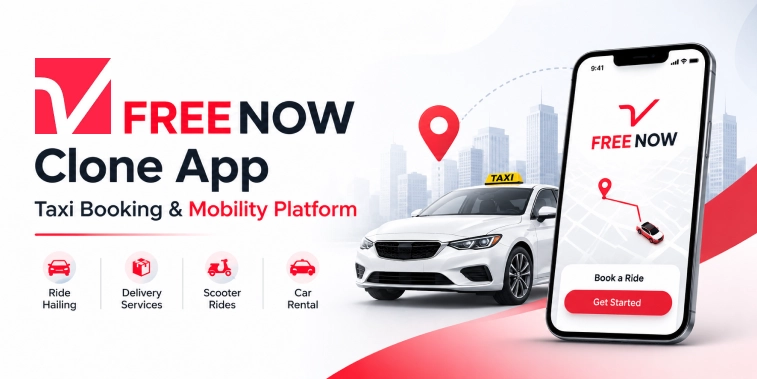
A FREE NOW Clone App is a taxi booking and mobility platform inspired by the core experience of services such as FREE NOW. It enables passengers to request rides, view nearby drivers, receive fare estimates, track vehicles in real time, make digital payments, and rate their experience. For drivers, the platform provides tools to accept trip requests, manage availability, navigate to pickup points, and monitor earnings.
The concept can support more than traditional taxi bookings. Depending on the business model, a mobility platform may include private hire vehicles, licensed taxis, airport transfers, corporate travel, rental services, scooters, bicycles, or other local transportation options. The goal is to bring different mobility services into one convenient digital ecosystem.
A clone app does not mean copying another company’s branding, content, or proprietary technology. It means developing a new platform with familiar functionality, an independent visual identity, and features adapted to the needs of a specific market. Businesses can use this model to reduce planning time, launch with proven workflows, and create a foundation for future innovation.
Why Build a Taxi Booking and Mobility Platform?
Urban transportation is becoming increasingly digital. Customers expect to book a vehicle within seconds, receive accurate pickup information, pay without cash, and communicate with drivers through a mobile application. Traditional phone-based dispatch systems often cannot match this level of speed, visibility, and convenience.
A taxi booking platform can help transportation companies reach more passengers while improving how they manage vehicles and drivers. Instead of relying only on street hails or telephone bookings, operators can create a digital channel that works throughout the day. A strong platform also gives businesses access to operational data, including booking volumes, peak demand periods, cancellation rates, driver activity, and revenue performance.
The mobility market also creates opportunities for focused services. An operator may build a platform for airport transfers, business travel, accessible transportation, intercity rides, premium cars, or environmentally friendly vehicles. By combining on-demand booking with a clear market position, a new app can compete through service quality, local expertise, and better customer support rather than trying to serve every user in the same way.
Core Components of a FREE NOW Clone App
A complete mobility platform normally includes separate applications for passengers and drivers, as well as a web-based administration panel. These components must work together through a secure backend that manages accounts, bookings, location data, pricing, payments, notifications, and reporting.
Passenger App
The passenger application should make booking a ride simple from the first screen. Users generally need to create an account, enter a pickup location, choose a destination, select a vehicle category, review the estimated fare, and confirm the request. Location search should support typed addresses, map selection, saved places, and GPS-based pickup suggestions.
After booking, passengers should see the driver’s name, profile image, vehicle details, license information, estimated arrival time, and live location. In-app calling or messaging can help users coordinate with drivers without exposing personal phone numbers. The app should also allow passengers to cancel according to defined rules, share trip details, save receipts, submit ratings, and contact support.
Driver App
The driver application should give transportation professionals control over availability and trip management. Drivers need to complete registration, upload required documents, define their working status, receive nearby booking requests, and accept or reject trips within a limited time. The interface should remain easy to use while driving, with clear notifications and minimal interaction requirements.
Important driver features include navigation support, pickup and drop-off instructions, trip status updates, earnings summaries, performance history, and payout information. The app can also include destination filters, scheduled ride alerts, incentive notifications, and a help center. Before going live, the driver account should pass document verification and any required background or vehicle checks.
Admin Panel
The administration panel is the control center of the platform. Authorized staff should be able to manage users, drivers, vehicles, bookings, service areas, pricing rules, promotions, complaints, and payment records. A dashboard with live booking activity can help dispatch teams identify delays, unassigned requests, demand spikes, and service disruptions.
Administrators should also be able to configure driver commission rates, vehicle categories, cancellation policies, surge rules, tax settings, and notification templates. Role-based access is important because support staff, finance teams, dispatchers, and senior managers may need different permissions. Detailed audit logs can show who changed a setting and when the change occurred.
Essential Features for a Competitive Platform
The most important feature is reliable booking flow. Passengers should be able to request a ride quickly, while the system identifies an appropriate driver based on distance, availability, vehicle type, service area, and other business rules. A dispatch engine should support automatic assignment while allowing administrators to intervene when necessary.
Real-time location tracking is another critical capability. GPS data helps passengers monitor the driver’s approach and enables operators to understand the status of active trips. Location updates should be frequent enough to provide useful information without consuming excessive battery power or mobile data. The system should also handle weak connectivity and temporary GPS inaccuracies gracefully.
Pricing should be transparent and configurable. The platform may calculate fares using a base charge, distance, time, minimum fare, booking fee, tolls, waiting time, and local taxes. Businesses may also need different pricing for vehicle categories, peak periods, airport routes, scheduled rides, or special events. Showing an estimate before confirmation helps users make informed decisions and reduces disputes.
A secure payment system can support credit and debit cards, mobile wallets, cash, corporate billing, and other regional payment methods. The app should generate digital receipts and maintain clear records for passengers, drivers, and administrators. Payment details should be processed through reputable providers so the platform does not store sensitive card information unnecessarily.
Other valuable features include:
– Scheduled rides for airport journeys, business travel, and important appointments.
– Multiple vehicle categories, such as economy, premium, accessible, and larger vehicles.
– Promo codes, referral campaigns, loyalty rewards, and first-trip incentives.
– In-app support with trip-specific complaint forms and help articles.
– Driver ratings and passenger feedback to monitor service quality.
– Corporate accounts with central billing, employee controls, and monthly reporting.
– Multi-language and multi-currency support for international or tourist-focused markets.
– Safety tools such as emergency contacts, trip sharing, driver verification, and ride monitoring.
Designing the User Experience
A mobility app must be convenient in stressful situations. Passengers may be standing outside an airport, carrying luggage, dealing with poor weather, or traveling in an unfamiliar city. The booking screen should therefore prioritize pickup location, destination, vehicle availability, fare information, and estimated arrival time instead of overwhelming users with unnecessary options.
The interface should communicate status clearly. Distinct stages such as searching for a driver, driver assigned, driver arriving, trip started, and trip completed can reduce confusion. Push notifications should reinforce important updates, but users should not receive excessive messages. Accessibility should be considered through readable text, strong contrast, logical navigation, and compatibility with screen readers.
The driver experience requires a different design approach. Drivers need fast access to availability controls, booking information, navigation, earnings, and support. Large touch targets, voice guidance, and limited screen complexity can reduce distraction. The app should encourage drivers to interact only when safely parked and should comply with local rules for device use while operating a vehicle.
Technology and System Architecture
A scalable platform usually combines mobile applications, backend services, databases, mapping tools, payment gateways, notification services, and an administrative web application. Native iOS and Android development can provide strong performance and deep device integration, while cross-platform frameworks may reduce development time and maintenance costs. The right choice depends on the expected market, team expertise, performance requirements, and long-term roadmap.
The backend should separate major functions into logical services. Authentication, driver onboarding, dispatch, pricing, payments, notifications, trip management, and reporting can be managed as distinct modules. This structure makes it easier to update one area without disrupting the entire system. A reliable cloud environment can provide auto-scaling, backups, monitoring, and protection against service interruptions.
Maps and routing are central to the product. The platform may use third-party mapping services for geocoding, route estimates, distance calculations, and navigation. Before launch, the business should review provider pricing, request limits, regional coverage, and licensing terms. Location data should be protected with access controls, encryption, retention rules, and clear privacy disclosures.
Performance testing is essential because booking demand may rise suddenly during rain, concerts, public events, or commuter peaks. Load testing should examine driver matching, map updates, payment processing, notifications, and administrative reporting under heavy traffic. Monitoring tools should alert the operations team to failed bookings, slow responses, payment errors, and unusual cancellation patterns.
Safety, Privacy, and Regulatory Requirements
Transportation platforms operate in a regulated environment. Requirements vary by country and city, but may include operator licensing, driver permits, vehicle inspections, insurance, tax registration, consumer protection rules, and data protection obligations. A business should obtain qualified legal advice before accepting bookings or onboarding drivers in a new region.
Driver verification should be built into the onboarding process. Depending on local requirements, the platform may need to collect identity documents, driving licenses, vehicle registration, insurance details, inspection records, and background checks. Expiry dates should be tracked automatically so administrators can restrict accounts when required documents are no longer valid.
Privacy must be addressed from the beginning rather than added after development. The service should explain what personal and location data is collected, why it is used, how long it is retained, and when it is shared. Users should have suitable controls for account access, marketing preferences, and data requests. Strong authentication, encrypted communication, secure session management, and regular access reviews can reduce security risks.
Safety features can improve trust but should not be presented as a substitute for emergency services or legal compliance. A passenger may need to share a trip with a trusted contact, contact support, or use an emergency button. These features should be tested carefully, with clear escalation procedures for support teams and local emergency partners.
Monetization Models
The most common revenue model is a commission deducted from each completed ride. The platform can charge a percentage of the fare, a fixed booking fee, or a combination of both. Commission rules may differ by vehicle type, driver category, location, or promotional campaign. Pricing should be communicated clearly so drivers understand their expected earnings.
Additional revenue can come from passenger service fees, scheduled ride charges, corporate subscriptions, premium support, advertising placements, or partnerships with hotels, airlines, event venues, and travel agencies. Businesses may also offer fleet management tools to independent operators for a monthly software fee.
Profitability depends on more than booking volume. The company must evaluate payment processing fees, driver incentives, customer acquisition costs, refunds, support expenses, mapping charges, compliance costs, and technology maintenance. A detailed unit economics model can show whether each ride contributes positively after direct operating expenses.
Development Process and Estimated Investment
Development commonly begins with market research and product definition. The business should identify its target city, customer groups, service categories, licensing requirements, competitors, and launch goals. Product designers can then map passenger, driver, and administrator journeys before preparing wireframes and visual designs.
The next stage involves building the minimum viable product. A practical first release may include account creation, driver onboarding, basic booking, dispatch, GPS tracking, fare calculation, digital payments, notifications, ratings, and administration tools. Advanced options such as corporate billing, scheduled rides, loyalty programs, and multiple mobility services can be added after the core experience is stable.
A typical delivery sequence includes:
– Product discovery, requirements, and technical planning.
– User interface and experience design for all major roles.
– Mobile app, backend, database, and admin panel development.
– Integration with maps, payments, notifications, analytics, and support tools.
– Quality assurance, security review, device testing, and performance testing.
– Pilot launch in a limited service area with selected drivers.
– Public launch, monitoring, customer support, and ongoing improvement.
Investment varies according to the number of platforms, feature depth, design quality, integrations, location coverage, and development team. A basic single-city product will cost less than a multi-country mobility ecosystem with complex dispatch, corporate accounts, multilingual support, and advanced analytics. Businesses should request a feature-based proposal instead of relying on a generic package price.
Launch Strategy for a New Mobility App
A successful launch requires supply and demand to grow together. Recruiting drivers before the public release helps ensure that passengers can receive timely service. Partnerships with local fleets, taxi associations, hotels, airports, offices, and event organizers can provide an initial source of bookings.
Passenger acquisition can combine referral programs, local search optimization, social media, paid advertising, partnerships, and targeted promotions. The first release should focus on a clearly defined service area rather than launching too broadly with unreliable coverage. Fast support and consistent ride quality are often more valuable than a large download count.
After launch, operators should monitor booking conversion, driver acceptance, average pickup time, completed rides, cancellations, repeat usage, customer ratings, support response time, and contribution margin. These metrics reveal where the experience needs improvement. For example, frequent cancellations may indicate inaccurate arrival times, insufficient driver supply, unclear pricing, or a difficult pickup process.
Building for Long-Term Growth
A strong FREE NOW Clone App should be treated as a product that evolves with customer needs and local market conditions. Future versions may add electric vehicle categories, bike and scooter rentals, public transport information, package delivery, subscription plans, or integrated travel planning. Expansion should follow validated demand rather than adding features without a clear operational purpose.
The platform should also create a reliable feedback loop. Passenger reviews, driver interviews, support tickets, analytics, and field research can identify problems that are not visible in basic usage data. Regular releases should improve reliability, accessibility, safety, and efficiency before introducing complex additions.
Ultimately, the value of a taxi booking and mobility platform comes from dependable transportation, transparent pricing, secure payments, and a smooth experience for every participant. A well-planned clone app gives businesses a practical foundation, but differentiation comes from local knowledge, strong operations, responsible technology, and consistent service quality.
Frequently Asked Questions (FAQs)
1. What is a FREE NOW Clone App?
A FREE NOW Clone App is a taxi booking and mobility platform that allows businesses to launch their own ride-hailing services in European countries. It connects passengers with drivers through dedicated applications and an admin dashboard, supporting ride booking, fare estimation, real-time tracking, online payments, and trip management.
2. How does a FREE NOW Clone App work?
A FREE NOW Clone App allows passengers to enter pickup and destination locations, select a ride option, view estimated fares, and request a taxi. The system matches the request with an available driver, who can accept the booking and navigate to the pickup location. Passengers can track their rides, complete payments, and rate their experience after the trip.
3. What are the essential features of a FREE NOW Clone App?
Essential features include passenger registration, driver registration and verification, real-time GPS tracking, ride scheduling, fare calculation, automated driver matching, multiple payment options, ride history, ratings and reviews, push notifications, and an admin dashboard. Advanced capabilities may include corporate ride management, multiple mobility options, and analytics.
4. How does a FREE NOW-like taxi booking platform generate revenue?
A taxi booking platform can generate revenue through commission on completed rides, booking fees, cancellation charges, surge pricing, corporate mobility subscriptions, and premium driver or fleet services. Businesses can combine different revenue models depending on their target market, pricing strategy, and operational structure.
5. How much does it cost to develop a FREE NOW Clone App?
The development cost depends on the number of applications, features, technology stack, third-party integrations, UI/UX design, and customization requirements. A basic taxi booking solution generally requires a smaller investment than an advanced mobility platform supporting multiple ride categories, corporate accounts, automated dispatch, and fleet management. A detailed project assessment is necessary to estimate the actual development cost.

Parth Kulkarni
Managing Director
Parth Kulkarni is the Managing Director with strong expertise in IT and on-demand app solutions, focused on empowering startups and enterprises with scalable digital products. His strategic leadership and business insight drive innovation, ensuring consistent client success and long-term growth.