


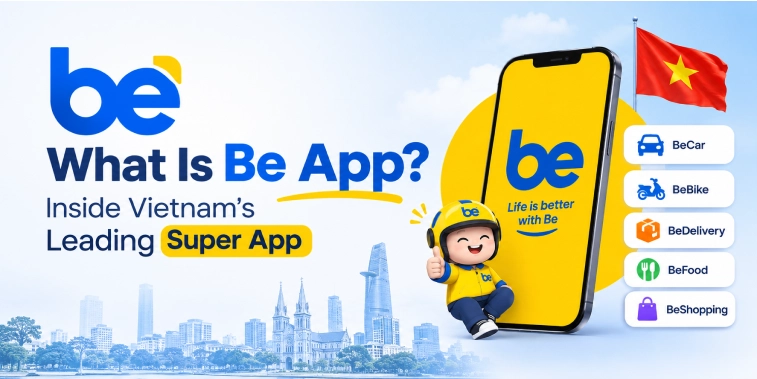
What Is Be App? Inside Vietnam’s Leading Super App
Be App is a Vietnamese digital platform that brings everyday transportation, delivery, and travel services into one mobile application. Developed by Be Group, the app was created to compete in Vietnam’s rapidly expanding ride hailing market while building a broader local alternative to international technology platforms. Instead of using separate apps for different daily needs, customers can use Be to book a motorbike or car, order meals, send packages, and arrange selected travel services.
The app is best known for ride hailing. Users can request a motorbike through beBike or a car through beCar, enter their pickup and destination details, see an estimated fare, and track the driver in real time. Depending on the city, account type, and service availability, Be also offers additional options such as delivery, food ordering, airport transfers, and intercity or ticket-related services.
Be positions itself as a distinctly Vietnamese platform. That local focus influences its service design, customer support, driver relationships, promotions, and understanding of how people travel through Vietnam’s dense urban areas. For customers searching for an alternative to global ride hailing brands, Be App offers a familiar local interface and a growing collection of services in one place.
How Be App Works
Be App works through a standard on-demand platform model. Customers create an account, provide a phone number, and use the app to request a service. For a ride, the customer selects a pickup point and destination. The platform then uses location data to identify available drivers, calculate an estimated price, and match the request with a driver who can complete the trip.
Once a driver accepts, the customer can usually see the driver’s name, vehicle details, estimated arrival time, and current location. The app also provides a way to contact the driver and follow the trip. After reaching the destination, the customer pays using an available payment method and can rate the experience. These ratings help Be monitor service quality and give customers a way to provide feedback.
The same basic process applies to other services. A customer ordering food chooses a restaurant and menu items, confirms the delivery address, and follows the order status. A customer sending a package enters pickup and recipient information, reviews the price, and tracks the delivery. The specific services and payment options may vary by location and can change as Be updates its platform.
Main Services Available on Be App
BeBike and BeCar
BeBike connects passengers with motorcycle drivers, making it suitable for short trips and busy city routes. Motorbikes are a practical transportation choice in Vietnam, where traffic congestion can make small vehicles faster and more flexible than cars. Customers can request a pickup from a precise location, review the estimated fare, and follow the trip through the app.
BeCar provides private car rides for customers who prefer more space, weather protection, or a more comfortable journey. It can be useful for family travel, business appointments, airport journeys, and trips involving luggage. Vehicle categories, pricing, and availability depend on the city and local operating conditions.
For both services, the app typically calculates fares using factors such as distance, estimated travel time, service type, and demand. Prices can change during busy periods or in locations where driver supply is limited. Customers should review the fare estimate and booking details before confirming a request.
Delivery services
Be also supports delivery services for documents, personal items, and packages. This can help individuals and small businesses arrange local deliveries without directly contacting a courier company. The customer enters the pickup and drop-off information, describes the item when required, and receives an estimated price before confirming the order.
Delivery services are particularly useful in Vietnam’s large cities, where businesses often need quick local fulfillment. Restaurants, online sellers, offices, and individual customers can use on demand delivery to move items across town. The app may provide tracking information so the sender can monitor the order from pickup through completion.
Customers should check the platform’s current rules before sending an item. Certain products may be restricted, and the sender remains responsible for packaging the item securely and providing accurate information. For valuable, fragile, or regulated goods, a specialized logistics provider may be more appropriate.
BeFood
BeFood allows customers to browse participating restaurants and order meals for delivery. The service combines restaurant discovery, menu selection, payment, and order tracking in the same application used for transportation. This makes Be more useful throughout the day, rather than only when a customer needs a ride.
The availability of restaurants and delivery coverage differs between cities and neighborhoods. Users can normally filter or browse restaurants, select dishes, review any delivery charge, and confirm the order address. Preparation times may vary because restaurants, traffic, weather, and driver availability all influence delivery speed.
Restaurant menus, promotions, minimum order requirements, and delivery fees can change. Customers should check the final order summary before payment, including item quantities, restaurant charges, applicable discounts, and the delivery address.
Travel and ticket services
Be has expanded beyond local rides by offering selected travel-related services through its platform. Depending on the market and current product lineup, these may include airport transportation, intercity travel, or ticket booking features. Such services make the app more relevant to travelers who need transportation before, during, and after a trip.
Airport rides are one of the clearest examples of how a super app can connect different parts of a journey. A passenger can arrange a car to the airport, plan a pickup after landing, and use the same account for local transportation. Ticket and travel features may be offered directly by Be or through service partners integrated into the platform.
Because travel products can change more frequently than core ride services, customers should confirm schedules, cancellation terms, luggage conditions, and payment rules at the time of booking. Availability may also depend on the departure city, destination, and travel date.
Why Be App Is Called a Super App
A super app combines multiple frequently used services under one digital account and application. It is more than a single purpose ride hailing product because it aims to become part of several everyday routines. Be follows this model by connecting transportation with delivery, food ordering, and selected travel services.
The main advantage is convenience. Customers do not need to install and manage a separate platform for every task. Saved addresses, payment details, account information, and order history can be handled in one environment. A customer may use Be for a morning ride, a lunch delivery, a package shipment, and an evening car booking without switching between several apps.
The model also creates opportunities for connected services. A ride platform already has location technology, driver networks, payment systems, customer support processes, and demand data. These capabilities can support related products such as food delivery and logistics. For customers, the result can be a more familiar experience across different types of orders.
However, the label “super app” does not mean that every service is available in every place. Features depend on local licensing, driver supply, restaurant participation, commercial partnerships, and Be’s current product strategy. Users should treat the app’s live service menu as the most accurate guide to what is available in their area.
What Makes Be Different in Vietnam
Be’s strongest point of differentiation is its local identity. The company was built for the Vietnamese market and operates in a country with distinctive transportation habits, urban layouts, payment preferences, and customer expectations. Understanding these factors can help a local platform design practical services for Vietnamese users.
Motorbike transportation is central to daily movement in many Vietnamese cities. Be’s beBike service reflects this reality, while beCar serves customers who need a private vehicle. The platform’s local approach also extends to language, promotional campaigns, driver communication, and support for domestic businesses such as restaurants and retailers.
Competition remains intense. Customers in Vietnam can choose from multiple ride hailing, food delivery, taxi, and logistics platforms. This competition gives users more choice, but it also means that service coverage, prices, promotions, and waiting times can differ from one app to another. Be’s success depends on maintaining a reliable driver network, useful service selection, competitive pricing, and consistent customer experience.
The company has also emphasized the role of Vietnamese drivers and local economic participation. As with other platform businesses, the practical experience can differ by driver, city, and service type. Customers should evaluate the app based on current performance in their own area rather than assuming that every location offers the same level of coverage.
Payments, Pricing, and Promotions
Be App may support more than one payment method, including cash and digital payment options. The choices available to a customer can depend on the service, account status, location, and current platform partnerships. Before confirming a booking, users should check which payment method is selected and whether the final charge includes all applicable fees.
Ride prices are usually estimated before the customer confirms the request. The estimate can reflect the route, vehicle type, expected travel time, and demand conditions. The final amount may differ if the destination changes, the trip takes longer than expected, waiting time is added, or other applicable conditions affect the booking.
Promotions can make Be attractive to price conscious customers. Discounts may be offered to new users, frequent users, selected payment partners, or customers in particular cities. A promotion can have limits such as a minimum spend, expiration date, service restriction, or maximum discount. Customers should read the terms instead of assuming that a code applies automatically.
Businesses may also use Be for operational needs. A company can arrange employee transportation, send documents or products, and use food delivery for workplace orders. The suitability of these services depends on billing requirements, account controls, delivery volumes, and the company’s need for reporting or centralized management.
Safety and Privacy Considerations
Like any location based service, Be App handles information needed to complete a booking. This may include a phone number, pickup and destination details, payment information, order history, and device or location data. Customers should review the app’s privacy information and grant only the permissions needed for the service they want to use.
Customers can take several practical steps to improve safety. Check the vehicle and driver details shown in the app before entering a car. For motorbike trips, wear the provided or required helmet and follow local traffic rules. Share trip information with a trusted contact when appropriate, particularly when traveling late at night or in an unfamiliar area.
It is also wise to avoid moving a conversation or payment outside the official platform without a clear reason. Do not share account passwords, verification codes, or sensitive financial information with someone claiming to represent Be. If a driver asks for an unusual additional payment or behaves inappropriately, document the details and report the issue through official support channels.
Privacy and safety features can change as the platform develops. Users should keep the app updated, use a strong account password where available, and download only the official application. In an emergency, contact local emergency services first rather than relying only on in app support.
Advantages and Limitations of Be App
Be’s main advantages are its local market knowledge, broad service direction, and convenient combination of transportation and related services. The app can be especially useful for people who want Vietnamese language support, local payment choices, motorbike rides, and access to more than one service from a single account.
The app may also be valuable to visitors who want a familiar way to arrange city transportation. However, international travelers should confirm language options, payment compatibility, phone verification requirements, and coverage before relying on it. A local SIM card or suitable data connection may be necessary for account registration and real time booking.
There are limitations as well. Service availability may be stronger in major cities than in smaller towns or rural areas. Prices and waiting times can change according to traffic and demand. Some features may be limited to particular locations, and the choice of restaurants or vehicle categories can vary significantly.
No single super app is ideal for every situation. Customers may compare Be with other ride hailing, taxi, food delivery, or courier services based on price, coverage, availability, support, and preferred payment method. The best choice often depends on the specific city and the type of service required.
Be App’s Role in Vietnam’s Digital Economy
Be App reflects the wider growth of Vietnam’s digital economy. As more consumers use smartphones for transportation, payments, shopping, and delivery, platforms are competing to become part of everyday life. A successful super app needs more than a well designed interface. It must coordinate drivers, restaurants, couriers, payment providers, customer support teams, regulators, and technology systems.
For drivers and delivery partners, platforms can provide access to demand without requiring them to find every customer independently. For restaurants and small businesses, app based ordering can create another sales channel. For customers, digital services can reduce the time and effort required to arrange routine tasks. These benefits are balanced by questions about platform fees, driver earnings, service quality, data protection, and fair competition.
Be’s continued development will depend on how effectively it balances growth with reliability. Adding more features can increase convenience, but too many disconnected products can make an app harder to use. The strongest super app experience is usually one in which the services are easy to find, payments are transparent, support is accessible, and each transaction works consistently.
Final Thoughts
Be App demonstrates how a locally developed ride-hailing application can evolve into a broader multi-service consumer platform.
By combining transportation, food delivery, parcel delivery, travel bookings, household services, and strategic partnerships, Be has created an ecosystem designed around everyday customer requirements.
Its development also highlights the importance of localization, service-provider networks, customer convenience, and multiple revenue opportunities in the super app business model.
For entrepreneurs and businesses exploring this market, Be offers a useful example of how to approach multi-service application development. The opportunity is not simply to place several services inside one application. It is to create a connected platform that makes everyday transactions easier for customers while providing sustainable opportunities for participating businesses and service providers.
As demand for digital convenience continues to develop, well-planned multi-service platforms can offer businesses an opportunity to reach new customers, expand their service portfolios, and build long-term digital ecosystems.
Frequently Asked Questions (FAQs)
1. What is Be App used for?
Be App is a Vietnamese multi-service application used for booking motorbike rides, cars, taxis, food delivery, parcel delivery, travel tickets, and selected lifestyle services. It allows customers to access multiple everyday services through one digital platform.
2. Who developed Be App?
Be App was developed by Be Group Joint Stock Company, a Vietnamese technology company established in 2018. The application officially launched its initial transportation services in December 2018.
3. How does Be App make money?
Be generates revenue through different service-related commercial arrangements. These may include transportation service fees, delivery charges, commissions from participating merchants, advertising solutions, and strategic partnerships.
4. Is Be App a super app?
Yes. Be is positioned as a multi-service consumer platform with super app characteristics. It brings together transportation, food delivery, parcel delivery, travel bookings, and additional services within one digital ecosystem.
5. Can businesses develop an app like Be?
Yes. Businesses can develop a customized multi-service application inspired by Be’s business model. Such a platform can include customer applications, driver or service-provider applications, merchant management, an admin dashboard, booking management, payment integration, and multiple on-demand service categories.

Parth Kulkarni
Managing Director
Parth Kulkarni is the Managing Director with strong expertise in IT and on-demand app solutions, focused on empowering startups and enterprises with scalable digital products. His strategic leadership and business insight drive innovation, ensuring consistent client success and long-term growth.
