

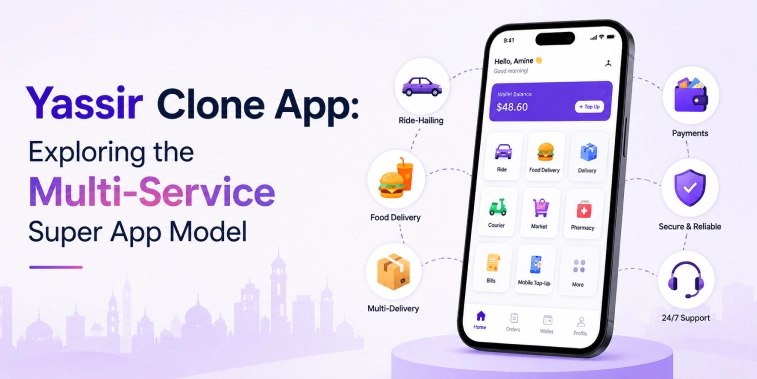
Introduction
Consumers increasingly expect everyday services to be available through simple digital platforms. Instead of using separate applications for transportation, food delivery, grocery shopping, and courier services, users can benefit from a single platform that brings multiple on-demand services together.
This model has created opportunities for startups, entrepreneurs, transportation businesses, delivery companies, and local service providers to build multi-service super apps. A Yassir Clone App provides a customizable foundation for launching such a platform under a business’s own brand.
A multi-service super app can connect customers with drivers, delivery partners, restaurants, grocery stores, retailers, and other service providers through one digital ecosystem. Customers can use one account to discover services, place bookings or orders, make payments, receive notifications, and track their activities.
The opportunity in 2026 is not simply about offering more services. A successful super app needs to make different services work together through a consistent customer experience, shared technology, reliable partner operations, and relevant personalization.
This guide explains what a Yassir Clone App is, how the multi-service super app model works, which services can be offered, and how customers and service providers interact with the platform.
What Is a Yassir Clone App?
A Yassir Clone App is a customizable, white-label platform inspired by the multi-service business model associated with Yassir. It enables businesses to launch their own branded application that can combine several on-demand services within one ecosystem.
Rather than creating completely separate applications for each service, businesses can use one platform to manage different categories such as ride-hailing, food delivery, grocery delivery, and courier services.
The platform can be customized according to the target market. Businesses can configure their branding, service categories, pricing, commissions, payment methods, operating areas, and partner requirements.
The main advantage is that customers can access multiple services through one account. A person may initially download the application to book a ride and later use the same platform to order food, purchase groceries, or send a parcel.
A complete Yassir-style platform generally consists of several connected applications and interfaces.
Customer App
The Customer App allows users to discover available services, make bookings and orders, manage their profiles, make payments, receive notifications, and track active services.
Driver App
The Driver App supports transportation partners. Drivers can manage availability, receive ride requests, accept bookings, navigate to customers, update trip status, and monitor earnings.
Delivery Partner App
Delivery partners can receive food, grocery, or courier requests, manage pickups, navigate to destinations, update delivery status, and view earnings.
Merchant Panel
Restaurants, grocery stores, retailers, and other participating businesses can manage products or menus, prices, availability, orders, and business information.
Admin Dashboard
The Admin Dashboard gives the business centralized control over customers, drivers, delivery partners, merchants, bookings, orders, payments, commissions, service areas, and analytics.
Understanding the Multi-Service Super App Model
A multi-service super app combines several everyday services within one digital ecosystem. Instead of treating each service as a separate business application, the platform provides a common customer account and shared infrastructure.
One Account, Multiple Services
Customers can access different services without repeatedly creating accounts. Their profile, addresses, payment information, notifications, and transaction history can be managed through the same platform.
Shared Technology Infrastructure
Different services can use common technology such as GPS, payments, notifications, customer support, analytics, and account management. Service-specific workflows can still operate independently where required.
Cross-Service Engagement
The super app model can encourage customers to use more than one service. Someone who joins for ride-hailing may later use food delivery or courier services.
This creates opportunities for businesses to increase customer engagement without requiring a completely separate platform for every service category.
Gradual Service Expansion
A business does not necessarily need to launch every possible service at once. It can begin with services that have strong local demand and expand the platform as its customer base and partner network grow.
The objective should be to build a relevant and useful service ecosystem, rather than simply increasing the number of categories.
Key Services Offered by a Yassir-Style Super App
The service mix can be customized according to the target market, business strategy, and operational capabilities.
Ride-Hailing & Taxi Booking
Ride-hailing can be one of the core services of a multi-service platform. Customers can enter pickup and destination locations, select a vehicle category, view applicable pricing, request a driver, and track the trip.
Drivers can receive requests, manage their availability, navigate to pickup locations, and update trip status.
Food Delivery
Customers can browse participating restaurants, explore menus, select food items, place orders, make payments, and track delivery progress.
Restaurants can manage menus, pricing, availability, and incoming orders through the merchant interface.
Grocery Delivery
A grocery service can connect customers with supermarkets, grocery stores, and retailers. Users can browse products, add items to a cart, select delivery options, and track orders.
Courier & Parcel Delivery
Customers and businesses can use courier services to send packages or documents between pickup and destination locations.
The platform can support local parcel delivery according to the business’s selected service area, vehicle network, and operational model.
On-Demand Services
Businesses can add other relevant local services when market demand and operational capacity justify expansion. New categories should complement the existing ecosystem rather than making the application unnecessarily complex.
How Does a Yassir Clone App Work?
Although every service has its own workflow, the overall platform follows a connected customer journey.
1. Customer Registration
Users create one account using the registration methods supported by the platform. After registration, they can access the services available in their location.
2. Select a Service
The customer chooses a service such as ride-hailing, food delivery, grocery delivery, or courier delivery.
3. Enter Service Details
The required information depends on the selected service. A ride requires pickup and destination locations, while food and grocery services require a merchant and product selection.
For courier services, customers can provide pickup, destination, and package details.
4. Review Pricing
The platform displays applicable pricing before confirmation where upfront pricing is supported. Prices can depend on distance, service type, delivery requirements, demand, or business-defined rules.
5. Confirm Booking or Order
The customer reviews the details and confirms the request. The platform then routes it to the appropriate driver, delivery partner, merchant, or service provider.
6. Partner Assignment
The platform can identify suitable partners based on location, availability, service category, and other operational requirements.
7. Real-Time Updates
Customers can receive notifications about important stages such as driver assignment, order preparation, pickup, delivery, or trip progress.
8. Completion and Payment
After the service is completed, the platform records the transaction and updates the status. Customers can access relevant payment information, receipts, order history, and ratings where supported.
This workflow allows multiple services to operate within one connected ecosystem while maintaining the specific processes required for each service.
Must-Have Features of a Yassir Clone App
A multi-service platform needs a simple customer experience while providing specialized tools for drivers, delivery partners, merchants, and administrators.
Customer App Features
Unified Service Dashboard:
Customers can access all available service categories from one home screen.
Profile Management:
Users can manage personal information, saved addresses, payment methods, and service history.
Ride Booking:
Customers can enter locations, select vehicle categories, view pricing, request drivers, and track rides.
Food & Grocery Ordering:
Users can browse merchants, select products, manage carts, choose delivery options, and place orders.
Courier Booking:
Customers can enter pickup and destination details, provide package information, and request delivery.
Real-Time Tracking:
GPS-based tracking can provide visibility during active rides and deliveries.
Secure Payments:
A unified payment system can support the payment options available in the target market.
Notifications:
Push notifications can provide booking, order, payment, pickup, and delivery updates.
Ratings & Reviews:
Customers can provide feedback after completed services.
Driver App Features
Driver Registration & Verification
Drivers can register and submit the required information for review before becoming active on the platform.
Availability Management
Drivers can control their online status and receive eligible requests when they are available.
Ride Request Management
Drivers can view booking information, accept suitable requests, and manage active trips.
Navigation
GPS and navigation functionality can help drivers reach pickup locations and destinations.
Earnings Management
Drivers can view completed rides, earnings, commissions, incentives, and payout information.
Delivery Partner Features
Delivery partners need tools designed specifically for food, grocery, and courier operations.
Delivery Request Management
Partners can receive available requests and view pickup and destination information.
Pickup & Delivery Status
Partners can update order status as they collect and deliver packages or orders.
Navigation
Location-based navigation can help delivery partners travel efficiently between pickup and destination points.
Earnings Tracking
Partners can monitor completed deliveries, earnings, incentives, and payouts.
Merchant Panel Features
Restaurants, grocery stores, retailers, and other merchants can manage their business through a dedicated panel.
Business Profile
Merchants can manage business information, operating hours, and service availability.
Product or Menu Management
Restaurants can manage menus, while grocery stores and retailers can manage products, categories, prices, images, and availability.
Order Management
Merchants can receive orders, confirm them, update preparation status, and manage completed orders.
Availability Management
Businesses can update product or service availability to reduce issues caused by unavailable items.
Admin Dashboard Features
The Admin Dashboard provides centralized control over the entire super app.
User & Partner Management
Administrators can manage customers, drivers, delivery partners, and their account status.
Merchant Management
The dashboard can approve merchants, manage business information, and monitor merchant activity.
Service Management
Administrators can configure available services, operating areas, pricing rules, and service-specific settings.
Booking & Order Management
The dashboard provides visibility into rides, food orders, grocery orders, courier bookings, cancellations, and completed transactions.
Payment & Commission Management
Administrators can monitor transactions, commissions, merchant settlements, partner earnings, refunds, and applicable platform fees.
Analytics
Reports can provide insights into revenue, bookings, orders, customer activity, service popularity, partner performance, and geographic demand.
Benefits of Launching a Multi-Service Super App
Multiple Services in One Platform
The biggest advantage is convenience. Customers can access several everyday services without needing separate applications.
Higher Customer Engagement
Customers who initially use one service can discover other relevant services within the same platform, creating opportunities for cross-service usage.
Multiple Revenue Opportunities
Different services can generate different revenue streams, allowing the business to reduce dependence on a single category.
Shared Technology
Accounts, payments, maps, notifications, analytics, and support systems can be shared across services, creating a connected technology ecosystem.
Scalable Expansion
Businesses can begin with selected services and gradually expand into additional categories or geographic areas based on actual customer demand.
Better Business Insights
A multi-service platform can provide broader insights into customer behavior, service demand, partner performance, and geographic activity.
Yassir Clone App Business Model & Revenue Streams
A multi-service super app can use several revenue models.
Ride Commissions
The platform can earn a commission from completed rides based on its agreement with drivers.
Delivery Commissions
Food, grocery, and courier services can generate commissions from completed transactions.
Merchant Commissions
Restaurants, grocery stores, and participating merchants can pay a commission on orders generated through the platform.
Service Fees
Applicable platform or service fees can be charged on selected bookings and orders, with charges clearly displayed before confirmation.
Delivery Charges
Delivery services can generate revenue through charges based on factors such as distance, service type, delivery speed, or business-defined pricing.
Membership Plans
A platform can offer optional membership plans with benefits such as selected discounts, reduced delivery charges, or other platform-defined advantages.
A diversified revenue model allows businesses to monetize different parts of the super app ecosystem.
Yassir Clone App Development Process
Developing a multi-service super app requires careful planning because multiple service workflows need to work together.
1. Business & Market Research
Identify the target audience, market demand, competitors, service categories, pricing approach, and initial launch area.
2. Define Service Categories
Select the services for the first version of the platform. Additional categories can be introduced as the business grows.
3. UI/UX Design
Create simple interfaces for customers, drivers, delivery partners, merchants, and administrators. The customer experience should make service discovery easy without overwhelming users.
4. Platform Development
Develop the applications and backend systems required for accounts, bookings, orders, payments, locations, notifications, and partner management.
5. Technology Integrations
Depending on requirements, integrate maps, payment gateways, notifications, analytics, communication tools, and other required technologies.
6. Testing
Test every service workflow, including booking, ordering, payment, tracking, cancellation, notifications, and partner operations.
7. Launch & Optimization
After launch, monitor customer feedback, service demand, performance, and analytics. Use these insights to improve the platform and determine which services or markets to expand into next.
Future Trends in Multi-Service Super Apps in 2026
AI-Powered Personalization
AI can analyze relevant service usage patterns and preferences to provide more personalized recommendations and improve service discovery.
Smart Service Recommendations
The platform can recommend relevant services based on factors such as location, previous activity, available services, and customer behavior.
Intelligent Driver & Delivery Matching
AI and optimization technologies can help match requests with suitable drivers and delivery partners based on location, availability, service type, and operational requirements.
Digital Payments
Digital payment solutions can make transactions faster and more convenient across different service categories.
Real-Time Tracking
Customers increasingly expect visibility during rides and deliveries. Real-time tracking can provide useful journey and delivery information.
Data-Driven Operations
Analytics can help businesses identify popular services, high-demand locations, customer behavior, partner performance, and operational bottlenecks.
These technologies can help businesses improve efficiency while creating a more convenient multi-service experience.
Conclusion
The Yassir Clone App represents a multi-service super app model that brings several on-demand services together through one digital ecosystem. Instead of building separate platforms for transportation, food, grocery, and courier services, businesses can provide multiple experiences through a unified application.
The model connects customers with drivers, delivery partners, merchants, and other service providers while giving administrators centralized control over the ecosystem.
Revenue can be generated through ride commissions, delivery commissions, merchant commissions, service fees, delivery charges, and membership plans. At the same time, AI-powered personalization, intelligent matching, real-time tracking, digital payments, and analytics can strengthen the platform in 2026.
The most effective strategy is not to add as many services as possible. Businesses should focus on relevant services, reliable operations, simple user experiences, strong partner networks, and gradual expansion based on real market demand.
Frequently Asked Questions
1. What is a Yassir Clone App?
A Yassir Clone App is a customizable multi-service platform that can connect customers with ride-hailing, food delivery, grocery delivery, courier services, and other supported on-demand services.
2. What services can a Yassir Clone App offer?
It can support ride-hailing, taxi booking, food delivery, grocery delivery, courier and parcel delivery, and other relevant services selected according to the target market.
3. How does a Yassir Clone App make money?
Revenue can come from ride commissions, delivery commissions, merchant commissions, service fees, delivery charges, and membership plans.
4. What are the main components of a Yassir Clone app?
The main components can include a customer app, driver app, delivery partner app, merchant panel, and admin dashboard.
5. Why is the multi-service super app model important in 2026?
It allows businesses to provide multiple everyday services through one platform, increase customer engagement, create multiple revenue opportunities, and expand their digital ecosystem based on market demand.

Parth Kulkarni
Managing Director
Parth Kulkarni is the Managing Director with strong expertise in IT and on-demand app solutions, focused on empowering startups and enterprises with scalable digital products. His strategic leadership and business insight drive innovation, ensuring consistent client success and long-term growth.