

Introduction
The car rental industry is changing as digital platforms make vehicle access more flexible and convenient. Traditional rental services generally depend on company-owned fleets, rental offices, and fixed booking procedures. However, peer-to-peer (P2P) car rental platforms introduce a different approach by connecting individual vehicle owners with people who need temporary transportation.
Getaround is an example of this peer-to-peer car-sharing model. It allows vehicle owners to make their cars available for rent while helping customers discover and reserve vehicles through a digital platform. This approach creates opportunities for owners to generate additional income from eligible vehicles and gives renters access to transportation without purchasing a car.
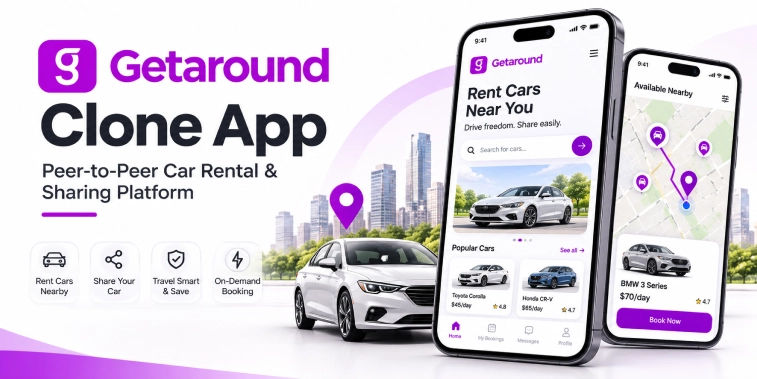
Inspired by this business model, entrepreneurs can explore Getaround clone app development to establish their own car rental and vehicle-sharing marketplaces. A Getaround clone app is a customizable digital solution that connects vehicle owners, renters, and administrators through dedicated interfaces.
With features such as vehicle listings, availability management, online bookings, digital payments, location services, and user verification, businesses can create a structured car-sharing marketplace.
This guide covers how a Getaround clone app works, its essential features, business models, development process, technology stack, cost factors, and future opportunities in the peer-to-peer car rental industry.
What Is a Getaround Clone App?
A Getaround clone app is a peer-to-peer car rental application inspired by Getaround’s vehicle-sharing business concept. It allows individual car owners and vehicle providers to list their vehicles on a digital marketplace and make them available for short-term or scheduled rentals.
Unlike traditional rental companies that primarily operate their own vehicle fleets, a peer-to-peer platform connects independent vehicle owners with renters through a centralized application.
A typical Getaround clone solution includes three main interfaces:
- Renter App: Enables customers to search for vehicles, compare rental options, check availability, make reservations, complete payments, and manage bookings.
- Vehicle Owner App: Allows car owners to register, upload vehicle information, manage availability, receive booking requests, and monitor rental earnings.
- Admin Panel: Provides business operators with tools to manage users, vehicle listings, bookings, payments, commissions, and platform activities.
Entrepreneurs can customize the application according to their target market, rental policies, vehicle categories, and business requirements.
How Does a Getaround Clone App Work?
A peer-to-peer car rental platform connects vehicle owners and renters through a digital marketplace. The process generally involves registration, vehicle listing, discovery, reservation, payment, and vehicle return.
1. User Registration and Verification
Vehicle owners and renters create accounts using their contact information. Depending on platform requirements, users may need to complete identity verification and provide relevant driving licence information.
2. Vehicle Listing
Car owners register their vehicles by submitting photographs, specifications, rental prices, availability, location, and required documentation.
After the necessary review and approval, their vehicles become available for eligible renters.
3. Vehicle Search and Discovery
Renters enter their preferred pickup location, rental dates, and vehicle requirements. The application displays matching vehicles so customers can compare available options.
4. Booking and Reservation
Customers select a suitable vehicle, review rental conditions, and submit a booking request or confirm an instant reservation, depending on the platform’s configuration.
5. Digital Payment
Renters complete payments through supported payment methods. The platform records transactions and calculates applicable rental charges, service fees, and owner earnings.
6. Vehicle Pickup and Return
Vehicle handover takes place through an agreed meeting location or an approved key-exchange process. Compatible connected-vehicle systems may also support authorized digital access.
After the rental period, the vehicle is returned according to the booking agreement.
7. Ratings and Reviews
After completing a rental, renters and vehicle owners can share feedback. Reviews help improve marketplace transparency and support better user experiences.
Key Features of a Getaround Clone App
A successful peer-to-peer car rental platform needs practical features for renters, vehicle owners, and administrators. Each interface should simplify its respective activities.
Renter App Features
1. User Registration and Profile Management
Customers can create accounts, update personal details, manage contact information, and access their booking history.
2. Vehicle Search and Filters
Users can discover available cars by applying filters such as rental price, vehicle category, transmission type, seating capacity, location, and availability.
3. Vehicle Details and Listings
Each listing displays important information, including vehicle photographs, specifications, rental pricing, location, availability, and rental conditions.
4. Real-Time Availability
An availability management system helps customers identify vehicles that can be booked for selected dates. It also helps prevent overlapping reservations.
5. Online Booking Management
Renters can select rental dates, review reservation details, confirm bookings, and manage upcoming or completed rentals.
6. Secure Digital Payments
Payment gateway integration allows users to complete transactions through supported payment methods. The system can also calculate applicable fees and taxes.
7. Booking Notifications
Push notifications, email alerts, and SMS updates can inform customers about booking confirmations, payment updates, reservation changes, and rental reminders.
8. GPS-Based Location Services
Location services help renters identify available vehicles and understand pickup locations.
9. Ratings and Reviews
Customers can provide feedback about their rental experiences, helping other users make informed booking decisions.
Vehicle Owner App Features
1. Vehicle Registration and Listing
Owners can register their vehicles by submitting photographs, specifications, and required documents.
2. Listing Management
Vehicle owners can create, edit, update, or deactivate listings according to platform policies.
3. Availability Calendar
An availability calendar allows owners to define rental dates and block periods when their vehicles are unavailable.
4. Rental Pricing Management
Owners can manage rental prices based on vehicle category, rental duration, demand, and platform pricing policies.
5. Booking Management
Owners can review incoming requests, confirm reservations where required, and monitor ongoing or completed rentals.
6. Earnings Dashboard
An earnings dashboard displays rental income, completed bookings, upcoming payments, platform commissions, and transaction history.
Admin Panel Features
1. Dashboard Management
Administrators can monitor registered users, active vehicle listings, reservations, transactions, and marketplace activity.
2. User Management
The admin can manage renter and owner accounts, review verification statuses, and handle account-related concerns.
3. Vehicle Listing Approval
Administrators can review vehicle submissions, verify required documents, and approve or reject listings according to platform requirements.
4. Booking and Payment Management
The dashboard provides access to reservation records, cancellations, transactions, applicable refunds, and commission configurations.
5. Reports and Analytics
Business operators can review user activity, booking trends, revenue information, and vehicle listing performance.
6. Promotions and Notifications
Administrators can manage discount codes, promotional campaigns, announcements, and platform notifications.
Advanced Features to Enhance a Getaround Clone App
Beyond essential marketplace functionality, businesses can introduce advanced technologies to improve the rental experience and operational efficiency.
1. AI-Based Vehicle Recommendations
Artificial intelligence can analyze customer preferences, search activity, and previous bookings to recommend relevant vehicles.
For example, users searching for family transportation may receive recommendations for vehicles with suitable seating capacity.
2. Smart Pricing Recommendations
AI-powered pricing tools can analyze booking trends, seasonal demand, vehicle categories, and local market conditions to suggest competitive rental rates.
3. Digital Identity Verification
Identity verification technology can help businesses validate user information and review submitted documents. Automated workflows may reduce manual administrative work.
4. Connected Vehicle Integration
For compatible vehicles, connected-car technology can support remote access, vehicle status information, and authorized keyless entry. These capabilities depend on manufacturer permissions and supported vehicle systems.
5. Predictive Analytics
Predictive analytics can help operators identify vehicle demand, understand booking patterns, and make informed marketplace expansion decisions.
6. Automated Customer Support
AI-powered chatbots can answer common questions about vehicle listings, bookings, payments, and account management. Complex concerns can be transferred to customer support representatives.
Benefits of Building a Getaround Clone App
A peer-to-peer car rental marketplace can create opportunities for entrepreneurs, vehicle owners, and renters.
1. Asset-Sharing Business Opportunity
The platform allows eligible vehicle owners to make their cars available for rent without requiring the marketplace operator to purchase an entire fleet.
This creates a business model based on shared vehicle availability.
2. Multiple Revenue Opportunities
Businesses can generate income through booking commissions, service fees, subscription plans, featured listings, and relevant partnerships.
3. Flexible Rental Options
Customers can explore different vehicle categories based on their transportation needs, budget, rental duration, and location.
4. Opportunities for Vehicle Owners
Car owners can participate in the marketplace and potentially earn additional income from vehicles they are willing and eligible to rent.
Actual earnings depend on demand, insurance, maintenance, and other operating expenses.
5. Digital Booking Convenience
An integrated application simplifies vehicle discovery, reservations, payment processing, and rental management.
6. Scalable Marketplace Structure
Businesses can initially launch in selected locations or vehicle categories and gradually expand as marketplace demand increases.
7. Data-Driven Business Management
Digital records and analytics help operators understand customer preferences, vehicle utilization, booking activity, and revenue performance.
Business Models and Revenue Streams of a Getaround Clone App
Selecting the right business model is essential for establishing a sustainable peer-to-peer car rental marketplace.
1. Commission-Based Model
The platform charges a percentage of each completed rental transaction. When a renter books a vehicle, the platform collects its applicable commission and transfers the remaining eligible earnings to the vehicle owner according to the payment agreement.
This model connects platform revenue directly with booking activity.
2. Subscription-Based Model
Vehicle owners or professional fleet providers can pay recurring fees to access selected marketplace services.
Subscription plans may include additional vehicle listings, analytics, promotional features, and advanced account management tools.
3. Service Fee Model
The platform can charge service fees to renters, vehicle owners, or both, depending on its pricing strategy.
All applicable fees should be communicated clearly before booking confirmation.
4. Featured Listing Model
Vehicle owners can pay for optional promotional placements to improve the visibility of their vehicles within relevant search results.
5. Partnership-Based Model
Businesses can establish partnerships with automotive service providers, vehicle maintenance companies, cleaning services, roadside assistance providers, and eligible insurance partners.
The platform can generate additional income through suitable commercial arrangements.
A balanced revenue strategy should provide value to renters and vehicle owners while covering the marketplace’s operating expenses.
Technology Stack for Getaround Clone App Development
Choosing the right technology stack helps establish a reliable, maintainable, and scalable car rental application.
The final selection depends on project requirements, development preferences, budget, and integration needs.
Frontend Development
Frontend technologies manage the user-facing application interfaces.
Possible options include:
- Flutter
- React Native
- Swift for iOS
- Kotlin for Android
- React.js for web applications
Cross-platform frameworks can help businesses develop applications for multiple operating systems using a shared codebase.
Backend Development
The backend manages application logic, authentication, vehicle listings, booking operations, payments, and database communication.
Suitable technologies include Node.js, Python, PHP, Java, and Laravel.
Database Management
Databases store user profiles, vehicle information, booking records, transaction details, and other application data.
Common options include PostgreSQL, MySQL, and MongoDB.
Maps and Location Services
Map integrations help customers discover available vehicles, view pickup locations, and access location-based services.
Businesses can evaluate Google Maps Platform and other mapping providers.
Payment Gateway Integration
Payment gateways support digital transactions, payment confirmation, and eligible refund processes.
The selected provider should support the intended countries, currencies, and transaction requirements.
Cloud Infrastructure
Cloud platforms provide infrastructure for application deployment, data storage, monitoring, and scalability. Businesses can consider AWS, Google Cloud, or Microsoft Azure.
Security Technologies
Security measures may include encrypted data transmission, secure authentication, role-based access controls, payment security, and regular vulnerability assessments.
Getaround Clone App Development Process
Developing a peer-to-peer car rental marketplace requires a structured process that connects business requirements with technical implementation.
Step 1: Market Research and Business Planning
Research the target market, customer requirements, competing platforms, and local transportation trends.
Identify the intended audience, vehicle categories, operating locations, and revenue model.
Step 2: Define Application Requirements
Prepare a feature list for renters, vehicle owners, and administrators. Include registration, verification, vehicle listings, booking management, payments, notifications, and customer support.
Step 3: UI/UX Design
Create application layouts and user journeys that make vehicle discovery, booking, listing management, and payments straightforward.
A consistent interface across all applications improves usability.
Step 4: Select the Technology Stack
Choose appropriate frontend frameworks, backend technologies, databases, cloud infrastructure, and third-party services.
Technology decisions should consider performance, security, scalability, and future maintenance.
Step 5: Application Development
Develop the renter application, owner application, administrative dashboard, and backend infrastructure.
Integrate essential features and configure the platform’s business workflows.
Step 6: Third-Party Integrations
Connect required services such as payment gateways, maps, identity verification providers, notification systems, and compatible vehicle technologies.
Step 7: Testing and Quality Assurance
Conduct functional, usability, security, compatibility, and performance testing.
Check important workflows, including registration, vehicle approval, booking confirmation, payments, and rental completion.
Step 8: Deployment and Maintenance
Deploy the application to the selected cloud environment and prepare mobile applications for their respective distribution platforms.
After launch, monitor performance, resolve technical issues, update dependencies, and introduce improvements based on customer feedback.
Cost of Getaround Clone App Development
The cost of developing a Getaround clone app depends on project scope, technology stack, application complexity, design requirements, third-party integrations, and development resources.
A basic marketplace may require fewer features, while an advanced platform with connected-car integration, AI-powered recommendations, automated verification, and detailed analytics requires additional development effort.
Important cost factors include:
1. Number of Applications: Developing renter, vehicle owner, and administrator interfaces influences the overall project scope.
2. Feature Complexity: Advanced booking workflows, payment management, identity verification, and connected-vehicle capabilities can increase development requirements.
3. UI/UX Design: Custom interfaces, interactive layouts, and multiple user journeys require dedicated design work.
4. Third-Party Integrations: Payment gateways, mapping services, verification providers, and vehicle connectivity services may involve implementation and recurring fees.
5. Technology Selection: Frameworks, infrastructure, database architecture, and development resources influence the overall budget.
6. Testing and Maintenance: Quality assurance, security updates, infrastructure monitoring, and technical support contribute to long-term expenses.
Businesses should evaluate the total cost of ownership rather than considering initial development expenses alone.
Legal, Insurance, and Operational Considerations
A peer-to-peer car rental platform involves more than application development. Businesses must understand the regulatory and operational requirements of their target markets.
Insurance Coverage
Insurance is a major consideration in peer-to-peer vehicle sharing. Businesses should work with qualified insurance providers to understand coverage requirements, rental periods, liability, vehicle eligibility, and applicable exclusions.
Relevant insurance conditions should be communicated clearly to vehicle owners and renters.
Driver and Vehicle Verification
The platform should establish procedures for checking driver eligibility, vehicle documentation, and other required information. Verification requirements may vary by location.
Rental Agreements
Rental agreements should explain booking conditions, cancellation policies, rental periods, responsibilities, payment terms, and vehicle return procedures.
Data Privacy and Security
The platform may process personal information, identity documents, payment-related information, and vehicle location data.
Businesses should follow applicable data protection laws and establish appropriate data security and retention practices.
Vehicle Maintenance and Dispute Management
Vehicle owners should meet platform safety and maintenance requirements. The business should also establish clear procedures for handling cancellations, payment disputes, vehicle concerns, and customer complaints.
Proper legal and operational planning helps establish a more dependable marketplace.
Conclusion
The peer-to-peer car rental industry presents opportunities for entrepreneurs interested in building digital vehicle-sharing marketplaces. A Getaround clone app provides a business-oriented framework for connecting individual vehicle owners with renters through an integrated platform.
With features such as vehicle listings, availability management, online reservations, digital payments, identity verification, location services, and administrative controls, businesses can establish a structured marketplace for shared vehicle access.
Advanced technologies, including artificial intelligence, connected vehicles, and predictive analytics, can further enhance platform functionality.
However, successful implementation requires more than application development. Businesses must also consider insurance arrangements, regulatory compliance, vehicle eligibility, customer trust, and long-term maintenance.
By selecting an appropriate development approach and focusing on genuine market requirements, entrepreneurs can create a customizable peer-to-peer car rental platform designed for their target audience and business objectives.
Frequently Asked Questions (FAQs)
1. What Is a Getaround Clone App?
A Getaround clone app is a peer-to-peer car rental application that connects vehicle owners with renters. It allows owners to list their cars and enables customers to search, compare, reserve, and rent available vehicles through a digital platform.
2. What Are the Essential Features of a Getaround Clone App?
Essential features include user registration, identity verification, vehicle listings, search filters, availability management, online bookings, digital payments, notifications, ratings and reviews, owner earnings management, and an administrative dashboard.
3. How Does a Peer-to-Peer Car Rental App Generate Revenue?
A peer-to-peer car rental app can generate revenue through booking commissions, renter service fees, owner subscription plans, featured vehicle listings, and partnerships with relevant automotive service providers.
4. How Much Does It Cost to Develop a Getaround Clone App?
The development cost depends on application complexity, selected features, technology stack, design requirements, third-party integrations, and development resources. Advanced functionality, such as connected-car integration and AI-powered tools, can increase the overall investment.
5. How Can Entrepreneurs Launch a Getaround Clone App?
Entrepreneurs can start by researching their target market, selecting a suitable business model, defining application requirements, choosing a development solution, integrating essential services, completing testing, and establishing the required legal, insurance, and operational procedures before launch.

Parth Kulkarni
Managing Director
Parth Kulkarni is the Managing Director with strong expertise in IT and on-demand app solutions, focused on empowering startups and enterprises with scalable digital products. His strategic leadership and business insight drive innovation, ensuring consistent client success and long-term growth.