


Introduction
The healthcare industry is becoming increasingly digital, changing the way customers discover medicines, communicate with healthcare professionals, access diagnostic services, and manage everyday healthcare needs.
Online pharmacy and telehealth platforms bring several healthcare services together through digital applications. Instead of depending entirely on physical visits to pharmacies or clinics, users can use a healthcare application to explore available services, request medicine delivery, schedule consultations, manage prescriptions, and access other supported healthcare services.
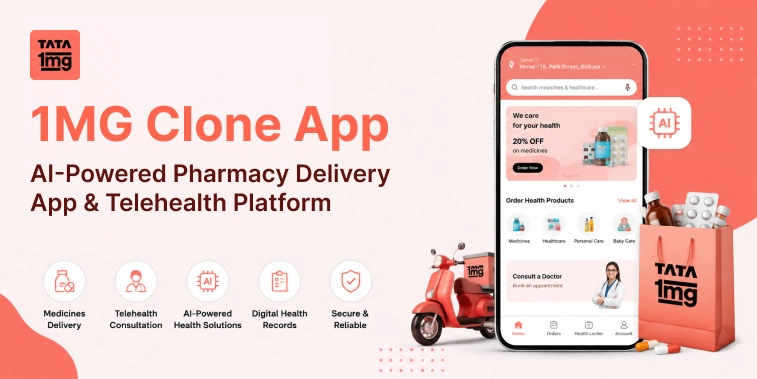
A 1MG Clone App can provide a customizable foundation for businesses planning to launch their own online pharmacy delivery and telehealth platform.
The concept can combine pharmacy delivery, doctor consultation, prescription management, healthcare services, digital payments, notifications, and AI-powered assistance within one platform.
In 2026, AI can further improve healthcare applications through intelligent search, personalized health information, appointment assistance, prescription organization, customer support, and other carefully designed features. However, AI should support qualified healthcare professionals and appropriate clinical processes rather than replace professional medical judgment.
This guide explains what a 1MG Clone App is, how an AI-powered pharmacy delivery and telehealth platform can work, its major features, business models, technology requirements, security considerations, and opportunities for healthcare businesses.
What Is a 1MG Clone App?
A 1MG Clone App is a customizable healthcare platform inspired by the type of digital experience offered by online pharmacy and healthcare marketplaces.
It can connect multiple healthcare participants through one ecosystem, including:
- Customers
- Pharmacies
- Doctors
- Diagnostic service providers
- Delivery partners
- Administrators
Depending on the business model and applicable regulations, the platform can allow customers to search for healthcare products, upload prescriptions, request eligible medicine deliveries, schedule consultations, and manage healthcare-related information.
The platform can be customized with a company’s:
- Brand name
- Logo
- Design
- Healthcare categories
- Service locations
- Pricing
- Payment options
- Business model
- Integrations
The purpose is not simply to reproduce another company’s application. Instead, businesses can use the concept as a starting point for developing their own branded healthcare marketplace.
How Does an AI-Powered Pharmacy Delivery App Work?
A digital pharmacy and telehealth platform generally involves several user types.
Customer
Customers can use the application to discover healthcare products and supported services, manage prescriptions, schedule consultations, and track eligible orders.
Doctor
Doctors can manage profiles, availability, consultation requests, appointments, and relevant consultation information through a dedicated interface.
Pharmacy
Pharmacies can manage product catalogs, prescriptions, orders, inventory information, and fulfillment workflows according to their business and regulatory requirements.
Delivery Partner
Delivery partners can receive eligible delivery assignments, access pickup and destination information, update delivery progress, and manage completed deliveries.
Admin
The administrator manages the overall ecosystem, including users, pharmacies, doctors, services, orders, consultations, payments, and reports.
This structure creates a connected healthcare platform where different participants can interact through dedicated applications or dashboards.
Why Build a 1MG Clone App in 2026?
Growing Demand for Digital Healthcare
Consumers increasingly expect convenient digital access to services that can appropriately be delivered online.
A healthcare platform can help businesses organize multiple services through a single digital experience.
Pharmacy Delivery Convenience
Customers can browse eligible products, submit required information, select delivery options, and manage orders without physically visiting multiple pharmacies.
Telehealth Accessibility
Telehealth functionality can provide a digital channel for eligible consultations, helping users connect with healthcare professionals remotely where legally permitted.
Multiple Healthcare Services
A platform can expand beyond medicine delivery by supporting additional healthcare categories.
Potential services include:
- Online pharmacy
- Doctor consultations
- Diagnostic bookings
- Health packages
- Prescription management
- Wellness products
- Healthcare reminders
The actual services offered should comply with local healthcare, pharmacy, prescription, telemedicine, and consumer-protection regulations.
Core Components of a 1MG Clone App
A complete healthcare marketplace can contain several interconnected components.
Customer App
The customer application can provide access to pharmacy products, consultations, prescriptions, orders, payments, and supported healthcare services.
Doctor App
Doctors can use a dedicated interface to manage profiles, availability, consultations, appointments, and relevant professional workflows.
Pharmacy App
Pharmacy partners can manage products, inventory information, prescriptions, orders, and fulfillment.
Delivery Partner App
Delivery partners can manage eligible medicine or healthcare-related deliveries.
Admin Dashboard
Administrators can control the platform’s users, services, transactions, providers, content, and reports.
Key Features of a 1MG Clone App
User Registration and Profile Management
Customers can create accounts and manage their basic information.
The profile system can support:
- Personal details
- Saved addresses
- Order history
- Consultation history
- Prescription records
- Payment information
- Notifications
Healthcare-related information should be handled according to applicable privacy and data-protection requirements.
Pharmacy and Medicine Search
A strong search system is important for an online pharmacy.
Customers can search for eligible products using:
- Product names
- Categories
- Brands
- Healthcare categories
- Search filters
The platform can display relevant information such as product descriptions, pricing, availability, and other information provided by authorized pharmacy partners.
For regulated medicines, the platform should implement appropriate prescription and verification workflows.
Product Categories
The platform can organize products into categories to make discovery easier.
Examples can include:
- Prescription medicines
- Over-the-counter products
- Personal care
- Wellness products
- Medical supplies
- Healthcare devices
The exact categories depend on local laws, pharmacy licenses, and the platform’s business model.
Prescription Upload
Prescription management can be an important part of a digital pharmacy platform.
Customers can upload prescriptions through supported formats, while authorized pharmacy personnel can review them according to applicable procedures.
The system can support:
- Prescription upload
- Prescription history
- Prescription status
- Pharmacy review
- Order association
- Expiration or validity information where applicable
The platform should not treat an automated system as a substitute for legally required pharmacist review or prescription validation.
Medicine Ordering and Delivery
Customers can add eligible products to a cart and proceed through the checkout process.
The workflow can include:
Product Selection → Cart → Prescription Verification Where Required → Address → Delivery Option → Payment → Order Confirmation
The exact process should be customized according to the product type and regulatory requirements.
Customers can then receive relevant order updates.
Doctor Consultation and Telehealth
Telehealth can extend the platform beyond pharmacy delivery.
A customer can browse eligible healthcare professionals and request a consultation based on available services.
Potential functionality includes:
- Doctor profiles
- Specializations
- Availability
- Appointment scheduling
- Consultation requests
- Video consultation
- Audio consultation
- Text-based communication
- Digital consultation records
- Follow-up scheduling
Telehealth features must be designed according to the regulations and professional requirements of the target market.
Doctor Profile and Availability
Doctors can create professional profiles containing relevant information such as:
- Name
- Specialty
- Professional qualifications
- Experience
- Languages
- Consultation availability
- Consultation fee, where applicable
Administrators can establish appropriate verification processes before allowing healthcare professionals to provide services through the platform.
Doctors can also manage their available consultation slots through the platform.
Appointment Scheduling
An appointment system can allow customers to select suitable consultation times.
The scheduling system can manage:
- Available slots
- Booked appointments
- Rescheduling
- Cancellations
- Consultation reminders
- Doctor availability
Automated scheduling can reduce administrative workload while making appointments easier to manage.
Digital Payments
Digital payment functionality can support pharmacy purchases and eligible healthcare services.
Depending on the target market, payment options may include:
- Credit cards
- Debit cards
- Digital wallets
- UPI
- Online banking
- Other supported payment methods
The platform can provide transaction confirmations and payment records.
Payment processing should be handled through appropriate payment providers and follow applicable financial and healthcare requirements.
Order Tracking and Notifications
Customers can receive updates about relevant orders and appointments.
Notifications can cover:
- Order confirmation
- Prescription status
- Pharmacy processing
- Delivery updates
- Payment confirmation
- Appointment reminders
- Consultation updates
- Cancellation
- Support responses
Push notifications, SMS, and email can be used according to the platform’s communication strategy.
Pharmacy Management
Pharmacy partners can receive a dedicated dashboard or application.
Features can include:
- Pharmacy profile
- Product management
- Inventory information
- Order management
- Prescription management
- Pricing
- Availability
- Earnings
- Order history
Administrators can manage pharmacy accounts and define which products or services each partner can offer.
Delivery Partner Management
For delivery-enabled services, a dedicated delivery partner application can simplify last-mile operations.
Delivery partners can:
- Manage profiles
- View assigned deliveries
- Access pickup details
- View delivery locations
- Update delivery progress
- Review completed deliveries
- Manage relevant earnings information
The delivery workflow should be designed specifically for healthcare products and should account for applicable handling requirements.
Admin Dashboard
The admin dashboard acts as the central control system.
Administrators can manage:
- Customers
- Doctors
- Pharmacies
- Delivery partners
- Products
- Orders
- Consultations
- Payments
- Reviews
- Service categories
- Notifications
- Reports
- Support requests
Analytics can help platform operators understand business performance and identify areas that need improvement.
AI Features for a Pharmacy and Telehealth Platform
AI can provide useful assistance when carefully implemented in healthcare applications.
AI-Powered Healthcare Search
AI-assisted search can help users find relevant products or platform services using natural language.
For example, users may describe what type of healthcare product they are looking for rather than knowing the exact product name.
The system can improve search relevance while keeping regulated medical decisions under appropriate professional oversight.
AI Customer Support
An AI assistant can answer common non-clinical questions about:
- Orders
- Delivery
- Appointments
- Payments
- Account management
- Platform navigation
Medical questions that require professional judgment should be directed to qualified healthcare professionals.
AI Appointment Assistance
AI can help users find available appointment slots based on selected preferences.
Prescription Organization
AI-assisted document processing can potentially help organize prescription information, but regulated prescription decisions should remain under appropriate professional review.
Personalized Recommendations
AI can help personalize product discovery or general platform navigation based on permitted information.
Healthcare recommendations should be designed carefully and should not provide unsafe or unauthorized medical advice.
Diagnostic and Healthcare Services
A broader healthcare platform can also include diagnostic services where legally and operationally supported.
Potential functionality can include:
- Diagnostic test discovery
- Test package browsing
- Appointment scheduling
- Sample collection requests
- Report access
- Diagnostic history
A business can integrate authorized diagnostic providers into the marketplace rather than operating every service itself.
Healthcare Records and Information Management
A digital healthcare platform may need to manage various forms of user information.
Depending on the business model and applicable requirements, this can include:
- Prescription records
- Consultation information
- Appointment history
- Order history
- Diagnostic reports
- Customer preferences
Sensitive healthcare information requires strong privacy controls, appropriate access management, and compliance with relevant laws.
Business Models for a 1MG Clone App
A healthcare platform can use multiple revenue models.
Pharmacy Commission
A marketplace can charge participating pharmacies a commission on eligible transactions.
Delivery Fees
Customers may pay applicable delivery charges.
Consultation Fees
The platform can facilitate payments for eligible doctor consultations and charge an agreed platform fee or commission.
Subscription Plans
Businesses can create healthcare membership plans with benefits that are legally and commercially appropriate.
Diagnostic Service Commission
The platform may earn commissions from participating diagnostic providers where permitted.
Promotional Services
Authorized healthcare businesses or brands may pay for promotional placement, subject to applicable advertising and healthcare regulations.
A combination of revenue streams can create a diversified business model.
Security and Compliance
Security is especially important for healthcare platforms because they may handle personal, payment, prescription, and health-related information.
A platform should consider:
- Secure authentication
- Role-based access
- Data encryption
- Secure payment processing
- Access controls
- Audit mechanisms
- Privacy controls
- Secure document storage
- Data retention policies
Healthcare compliance requirements vary by country and service type.
Businesses should obtain appropriate legal and compliance guidance before launching pharmacy delivery or telehealth services.
Technology alone does not make a healthcare business compliant. Operational processes, professional licensing, pharmacy requirements, data protection, consent, prescription handling, and other legal obligations also need to be addressed.
Technology and Third-Party Integrations
A scalable healthcare delivery platform may require several integrations.
Maps and Location Services
Location services can support:
- Address selection
- Pharmacy discovery
- Delivery areas
- Distance calculations
- Delivery tracking
Payment Gateways
Payment providers can facilitate secure online transactions.
Video Consultation
Video infrastructure can support eligible telehealth consultations.
Notification Services
Push notifications, SMS, and email can provide appointment and order updates.
Analytics
Analytics can help businesses monitor:
- Orders
- Customers
- Consultations
- Pharmacy activity
- Delivery performance
- Revenue
Healthcare Service Integrations
Where appropriate, third-party pharmacy, diagnostic, healthcare, or professional systems can be integrated according to technical and regulatory requirements.
Benefits of an AI-Powered Pharmacy Delivery and Telehealth Platform
For Customers
Customers can access supported healthcare services through one application.
Potential benefits include:
- Convenient pharmacy ordering
- Delivery options
- Digital consultations
- Appointment management
- Prescription organization
- Online payments
- Centralized records
For Pharmacies
Pharmacy partners can gain a digital channel for:
- Customer acquisition
- Order management
- Product discovery
- Digital payments
- Delivery fulfillment
For Doctors
Doctors can use telehealth functionality to manage eligible remote consultations and appointments.
For Healthcare Businesses
Businesses can create a connected digital healthcare ecosystem instead of operating separate applications for individual services.
How to Choose the Right 1MG Clone App Solution
Businesses should evaluate several factors before selecting a healthcare platform.
Customization
The platform should support the required branding, services, workflows, and operating model.
Pharmacy Functionality
Check whether the solution supports appropriate pharmacy and prescription workflows.
Telehealth Features
If remote consultations are required, verify the availability of appointment, communication, and consultation functionality.
AI Capabilities
AI should solve practical problems rather than simply being included as a promotional feature.
Security
Healthcare-related information requires strong security and access controls.
Scalability
The platform should be capable of supporting additional customers, pharmacies, doctors, services, and locations.
Integrations
Review required payment, maps, communication, video, analytics, and healthcare integrations.
Support and Maintenance
Ongoing updates, monitoring, maintenance, and technical support are important after launch.
Future of AI-Powered Pharmacy and Telehealth Apps
The future of digital healthcare platforms is likely to focus on making healthcare access more organized and convenient while maintaining appropriate professional oversight.
AI can contribute to this evolution through:
- Smarter healthcare search
- Appointment assistance
- Personalized platform experiences
- Administrative automation
- Prescription organization
- Customer support
- Business analytics
- Operational forecasting
The most valuable AI features will be those that solve clear problems for customers, doctors, pharmacies, and administrators.
For healthcare businesses, the priority should remain safety, privacy, regulatory compliance, professional oversight, and user trust.
Conclusion
A 1MG Clone App can provide a foundation for businesses planning to create an AI-powered pharmacy delivery and telehealth platform.
The concept can connect customers with pharmacies, doctors, diagnostic providers, delivery partners, and other supported healthcare services through one digital ecosystem.
Core functionality can include medicine discovery, prescription management, pharmacy ordering, delivery, doctor consultations, appointment scheduling, digital payments, notifications, and administrative management.
AI can further improve the platform through intelligent search, appointment assistance, customer support, personalization, prescription organization, and operational analytics. However, healthcare AI should be implemented responsibly and should not replace qualified medical professionals or legally required verification processes.
A successful healthcare platform also requires more than an attractive application. Businesses must consider pharmacy licensing, prescription rules, telehealth regulations, privacy requirements, payment security, professional verification, data protection, and other obligations applicable to their target market.
With the right combination of technology, healthcare partnerships, security, compliance, user experience, and responsible AI, a customized 1MG Clone App can become a scalable digital healthcare platform for pharmacy delivery and telehealth services.
Frequently Asked Questions (FAQs)
1. What is a 1MG Clone App?
A 1MG Clone App is a customizable digital healthcare platform designed around online pharmacy, medicine delivery, telehealth, consultations, and other supported healthcare services.
2. Can a 1MG Clone App include telehealth services?
Yes. A customized platform can include doctor profiles, appointment scheduling, video or audio consultations, communication features, and other telehealth functionality where legally permitted.
3. Can AI be integrated into a pharmacy delivery app?
Yes. AI can support intelligent search, appointment assistance, customer support, personalization, prescription organization, and operational analytics. Clinical decisions should remain under appropriate professional oversight.
4. What are the main features of a 1MG Clone App?
Key features can include medicine search, pharmacy management, prescription upload, ordering, delivery management, doctor consultations, appointment scheduling, digital payments, notifications, ratings, analytics, and an admin dashboard.
5. Is a 1MG Clone App customizable?
Yes. Businesses can customize the branding, healthcare categories, pharmacy workflows, telehealth features, payment methods, delivery areas, integrations, AI capabilities, and other platform components according to their requirements and applicable regulations.

Parth Kulkarni
Managing Director
Parth Kulkarni is the Managing Director with strong expertise in IT and on-demand app solutions, focused on empowering startups and enterprises with scalable digital products. His strategic leadership and business insight drive innovation, ensuring consistent client success and long-term growth.
