

Introduction
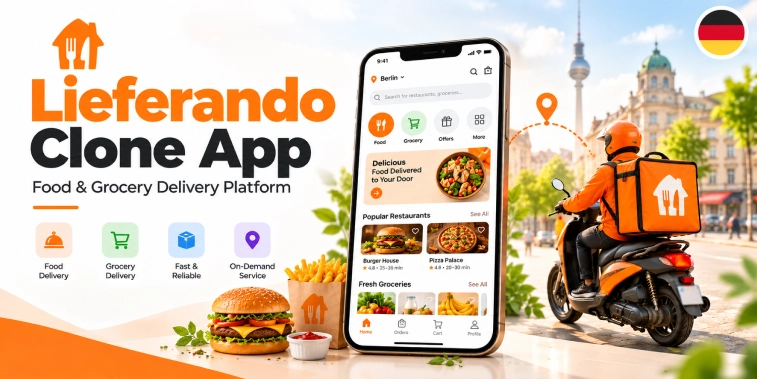
A Lieferando Clone App is a customizable food and grocery delivery platform inspired by the core features of services such as Lieferando. It connects customers, restaurants, grocery stores, delivery partners, and platform administrators through dedicated interfaces. Customers can discover nearby businesses, place orders, make payments, track deliveries, and review their experiences from one mobile or web application.
The purpose of a clone app is not to copy another company’s branding, design, or proprietary technology. Instead, it provides a proven business model and a ready framework that can be adapted to a specific market. A startup, restaurant group, grocery retailer, or delivery company can customize the platform with its own brand identity, pricing rules, service areas, payment methods, and operational workflows.
Modern delivery platforms often combine restaurant delivery with grocery delivery, pharmacy orders, convenience products, and other local commerce services. This wider model helps businesses serve customers more frequently while giving merchants additional sales channels. A well-designed Lieferando clone app can therefore become a scalable local marketplace rather than a basic food ordering application.
Why Build a Food and Grocery Delivery Platform?
Consumers increasingly expect convenient access to meals, household products, fresh food, and everyday essentials from their smartphones. They want to compare options quickly, see accurate delivery times, pay securely, and receive real-time updates without calling a store. A mobile-first delivery platform responds to these expectations while creating a direct connection between local businesses and their customers.
For entrepreneurs, the model offers several revenue opportunities. The platform can charge restaurants and stores a commission on each order, apply delivery fees, offer sponsored listings, or introduce subscription plans for frequent customers. Some businesses also use customer data and ordering trends to improve promotions, inventory decisions, and delivery coverage.
A combined food and grocery marketplace can support stronger customer retention than a single-category app. A customer may order lunch during the week, groceries on the weekend, and household supplies when needed. The more useful the platform becomes, the more opportunities it has to generate repeat orders. However, success depends on reliable logistics, transparent pricing, a strong merchant network, and a smooth user experience.
Core Users of a Lieferando Clone App
A complete delivery platform usually includes multiple applications or dashboards. Each user group needs tools that match its responsibilities. Trying to operate the entire marketplace through one generic interface can create confusion and increase administrative work.
Customers use the platform to search for restaurants and stores, browse menus or catalogs, customize products, add items to a cart, and complete checkout. They also need order history, saved addresses, payment options, delivery tracking, customer support, and ratings. A clear interface is especially important when the app serves both ready-to-eat meals and grocery products with different ordering requirements.
Restaurants and grocery merchants need a partner application or web dashboard. Through this interface, they can manage menus, product catalogs, prices, availability, preparation times, promotions, operating hours, and incoming orders. Restaurants may need options for modifiers such as toppings and portion sizes, while grocery stores may require categories, weight-based products, substitutions, and inventory updates.
Delivery partners use a driver application to accept or reject delivery requests, view pickup instructions, access navigation, update order status, and contact customers or merchants. The app should also calculate earnings, show completed deliveries, and provide useful information about delivery zones and peak periods.
Administrators manage the marketplace from a central dashboard. They can approve merchants and drivers, configure commissions, monitor orders, handle refunds, resolve disputes, manage promotions, review analytics, and control service areas. Strong administrative tools are essential because operational problems often appear after the platform begins handling a high volume of orders.
Essential Customer App Features
The customer experience should make ordering fast, predictable, and convenient. Registration can support email, phone number, social login, or guest checkout where appropriate. After signing in, users should be able to set a delivery address and immediately see businesses that serve that location.
Search and discovery are central to the value of the application. Customers should be able to search by restaurant name, cuisine, grocery category, product, dietary preference, or delivery time. Filters can include price range, distance, rating, open status, discounts, vegetarian options, vegan products, halal food, and express delivery. Personalized recommendations can be added as the platform collects more behavioral data.
Restaurant menus and grocery catalogs must present information clearly. Each product page can include photos, descriptions, ingredients, allergen information, nutrition details, prices, available options, and estimated preparation or fulfillment time. For grocery orders, the platform should support stock status and substitution preferences so customers can explain what to do if an item is unavailable.
The cart and checkout process should display an accurate cost breakdown. Customers should see item totals, taxes, delivery charges, service fees, discounts, tips, and the final amount before confirming the order. Address validation, delivery instructions, scheduled delivery, and contactless delivery preferences can reduce failed deliveries and customer complaints.
After checkout, real-time order tracking gives customers confidence. Status updates may include order received, accepted, being prepared, ready for pickup, picked up, and approaching the destination. Push notifications, SMS messages, and email updates can support users who are not actively watching the app. After delivery, ratings, reviews, reorder options, and support tools help maintain engagement.
Restaurant and Grocery Merchant Features
A merchant dashboard should help partners manage daily operations without requiring technical knowledge. Restaurants need to receive new orders, confirm them, adjust preparation times, pause ordering when busy, and mark orders as ready. Grocery stores need similar controls, along with inventory management and workflows for picking, packing, substitutions, and partial refunds.
Catalog management is a major requirement. Merchants should be able to create categories, upload product images, add descriptions, edit prices, define options, and schedule availability. Bulk upload tools can save time for stores with large inventories. Integration with point of sale systems or inventory software may be valuable for established businesses that already use digital operational tools.
Merchants also need access to performance information. Reports can show order volume, revenue, cancellation rates, customer ratings, popular products, average preparation time, and promotion performance. These insights help businesses decide which products to feature and when to add staff or adjust opening hours.
A platform can improve merchant retention by offering marketing tools. Sponsored placement, discount campaigns, loyalty rewards, promotional codes, and targeted offers can help merchants attract customers. These tools should be transparent, with clear information about costs and campaign results. When partners see measurable value, they are more likely to remain active on the marketplace.
Delivery Partner App and Logistics Management
Delivery quality has a direct effect on customer satisfaction. The driver application should show available jobs based on location, vehicle type, delivery zone, and order requirements. Drivers can receive pickup details, navigate to the merchant, confirm collection, and follow the recommended route to the customer.
The platform should support several delivery models. Orders may be assigned automatically by distance, estimated travel time, driver availability, or delivery zone. In other cases, merchants may use their own staff while the marketplace manages ordering and payments. A flexible system allows the business to work with independent couriers, logistics companies, and in-house delivery teams.
Geolocation and mapping services make it possible to calculate delivery distances, estimate arrival times, and monitor courier movement. The system can use geofencing to confirm that a driver has reached a pickup or drop-off location. Proof of delivery may include a photo, signature, one-time code, or customer confirmation, depending on the order type and local requirements.
Fair and understandable earnings can help attract reliable delivery partners. The app should show base pay, distance payments, tips, bonuses, and adjustments in a clear format. Administrators can use delivery analytics to identify bottlenecks, improve delivery zones, and adjust courier incentives during busy periods.
Payments, Pricing, and Revenue Models
A delivery platform needs secure payment processing that supports the preferences of its target market. Common options include credit and debit cards, digital wallets, bank transfers, local payment methods, and cash on delivery where operationally practical. Payment authorization, refunds, partial refunds, failed transactions, and merchant payouts should be handled through a reliable payment infrastructure.
Pricing must be transparent. Customers should understand which charges are paid to the merchant, which fees support the platform, and which amount is paid for delivery. Hidden charges can damage trust and increase cart abandonment. The application should also support different rules for restaurants, grocery stores, scheduled orders, large baskets, and high-demand periods.
Common revenue models include a commission on each completed order, a fixed delivery fee, a service fee, and paid promotional placement. The platform may also offer a subscription program that provides reduced delivery fees or member-only discounts. For grocery partners, the business can consider fulfillment fees, catalog management services, or business-to-business ordering features.
The best model depends on local competition, customer price sensitivity, merchant margins, and delivery costs. A platform should test pricing carefully rather than applying high fees immediately. Sustainable economics require a balance between customer affordability, merchant profitability, courier earnings, and platform operating costs.
Technology Architecture and Integrations
A scalable clone app commonly uses separate interfaces for customers, merchants, delivery partners, and administrators, supported by a shared backend. The backend manages accounts, catalogs, orders, payments, notifications, delivery assignments, promotions, and reporting. A modular architecture makes it easier to add services without rebuilding the entire application.
Mobile apps can be developed for Android and iOS using native or cross-platform technologies. A responsive web application can support customers who prefer browser ordering and merchants who use desktop computers. Cloud hosting provides flexible capacity, while caching, database optimization, monitoring, and automated backups help maintain performance as order volume grows.
Important third-party integrations may include payment gateways, mapping and navigation services, SMS providers, push notification systems, analytics tools, customer support software, identity verification services, and point of sale systems. The selection should reflect the country where the platform will operate. Payment availability, tax rules, data regulations, and mapping coverage vary significantly between markets.
Application programming interfaces should be documented and protected with authentication, authorization, rate limits, and audit logs. A clean integration strategy reduces the risk that one external provider will disrupt the entire platform. It also allows the business to replace services when pricing, coverage, or technical requirements change.
Security, Privacy, and Compliance
Food and grocery delivery platforms handle personal information, location data, payment details, order history, and communication records. Security must therefore be part of the product design from the beginning. Sensitive information should be encrypted in transit and at rest, and access should be limited according to each user’s role.
The platform should use secure authentication, strong password policies, session management, device monitoring, and multi-factor authentication for administrators and merchants. Payment card information should be processed through compliant providers rather than stored unnecessarily on the platform’s own servers. Regular vulnerability assessments and security testing can identify weaknesses before they become serious incidents.
Privacy requirements depend on the operating region. The platform may need clear consent notices, a data retention policy, user data access and deletion tools, cookie controls, and agreements with vendors that process personal information. Terms of service should explain delivery responsibilities, cancellations, refunds, reviews, and acceptable use.
Operational compliance is also important. The business may need appropriate licenses, tax registration, insurance, food handling procedures, age verification for restricted products, and rules for delivery partners. Consulting legal and compliance specialists before launch can prevent costly changes later.
How to Develop a Lieferando Clone App
The first stage is market research and business planning. The company should define its service area, customer segments, merchant categories, delivery model, pricing structure, and competitive advantage. It is useful to interview restaurants, grocery stores, couriers, and prospective customers before finalizing features. This research can reveal whether the market needs faster delivery, better product variety, lower fees, scheduled orders, or stronger merchant tools.
The next stage is product definition. The business should separate essential launch features from later enhancements. A practical minimum viable product may include customer registration, location-based discovery, merchant catalogs, cart and checkout, online payment, order management, courier assignment, tracking, notifications, ratings, and administrator controls. Advanced loyalty programs, predictive recommendations, and complex subscription plans can be introduced after the core workflow is stable.
Design and development should focus on the complete order journey. Teams need to map what happens when a merchant rejects an order, a product is unavailable, a payment fails, a driver is delayed, or a customer enters an incorrect address. Testing these exceptions is as important as testing successful orders.
Before launch, the platform should be tested for usability, security, performance, payment reliability, location accuracy, and compatibility across devices. A pilot launch in a limited geographic area can expose operational problems with a manageable number of users. After the pilot, the business can improve workflows, train merchants, recruit more delivery partners, and expand coverage gradually.
Marketing and Customer Acquisition
A new delivery marketplace must attract customers and supply at the same time. Customers will not stay if there are too few restaurants or stores, while merchants may leave if order volume is low. Launch planning should therefore prioritize a focused service area with enough demand and a strong selection of local businesses.
Merchant acquisition can begin with direct sales, local partnerships, introductory commission rates, onboarding support, and professional catalog setup. Restaurants and stores should understand how the platform can increase reach without creating excessive administrative work. Training materials and responsive partner support can make onboarding faster and reduce early frustration.
Customer acquisition may include local search optimization, social media, referral campaigns, app install promotions, email marketing, influencer partnerships, and neighborhood advertising. Offers should be designed to encourage a second and third order, not only a one-time download. Loyalty points, personalized promotions, free delivery thresholds, and reliable service can contribute to long-term retention.
Search engine optimization is valuable for building sustainable visibility. Location pages, cuisine pages, grocery category pages, merchant profiles, helpful ordering guides, and comparison content can attract users with high intent. Content should provide genuine value and include accurate information about delivery areas, ordering processes, fees, and available services.
Common Challenges and Practical Solutions
One major challenge is managing inconsistent availability. Restaurants may close early, stores may run out of products, or drivers may become unavailable during peak periods. Real-time status controls, inventory synchronization, preparation time updates, and automated customer notifications can reduce disappointment.
Another challenge is maintaining delivery profitability. Long distances, failed deliveries, traffic, low order values, and excessive discounts can quickly increase costs. Businesses should analyze delivery density, set sensible service zones, establish minimum order values where appropriate, and use batching or scheduled delivery for suitable grocery orders.
Customer support is also essential. Users need fast help with missing items, late orders, incorrect charges, refunds, and account issues. In-app support, searchable help content, automated status explanations, and trained human agents can resolve problems efficiently. Clear merchant and courier policies help support teams make consistent decisions.
Competition is unavoidable in local delivery markets. A clone app needs a specific advantage, such as stronger grocery selection, better service in smaller cities, transparent fees, faster merchant onboarding, superior customer support, or specialized delivery options. Competing only through discounts can create unsustainable costs, so the long-term strategy should emphasize convenience and service quality.
Future Opportunities for Delivery Platforms
The future of food and grocery delivery will likely involve more personalization and automation. Recommendation systems can suggest meals and products based on dietary preferences, previous orders, budgets, and seasonal demand. Predictive analytics can help merchants prepare popular products and help platforms position drivers before busy periods.
Quick commerce, scheduled grocery delivery, meal subscriptions, corporate ordering, and local product marketplaces can expand the platform’s revenue base. Some businesses may also add pharmacy, pet care, flowers, or convenience categories, provided they can meet relevant regulatory and fulfillment requirements.
Artificial intelligence can support customer service, demand forecasting, fraud detection, catalog enrichment, and delivery route optimization. These tools should improve operations without removing transparency or human support. Customers should still understand prices, delivery estimates, substitutions, and refund decisions.
Sustainability is another important opportunity. Platforms can support bicycle and electric vehicle delivery, optimized routes, reusable packaging programs, grouped deliveries, and accurate demand planning. These measures can reduce environmental impact while potentially lowering operating costs in dense urban areas.
Conclusion
A Lieferando Clone App: Food & Grocery Delivery Platform offers a practical foundation for launching a branded local commerce marketplace. Its value comes from connecting customers, merchants, couriers, and administrators through coordinated digital workflows. The strongest platforms go beyond menu browsing by providing reliable payments, accurate catalogs, transparent pricing, real-time tracking, effective support, and useful business analytics.
Success depends on more than replicating visible app features. Entrepreneurs must validate local demand, recruit quality merchants and delivery partners, design sustainable economics, protect user data, and test operational edge cases. A focused launch, followed by continuous improvement and market-specific customization, can turn a clone app into a competitive and scalable delivery business.
Frequently Asked Questions (FAQs)
1. What Is a Lieferando Clone App?
A Lieferando Clone App is a customizable food and grocery delivery platform that connects customers with restaurants, grocery stores, delivery partners, and administrators through a single digital marketplace.
2. How Does a Lieferando Clone App Work?
Customers can browse restaurants and grocery stores, select products, add items to their cart, place orders, make payments, and track deliveries. Restaurants and stores manage orders, while delivery partners handle pickups and deliveries.
3. What Are the Key Features of a Lieferando Clone App?
Key features can include restaurant and grocery discovery, search and filters, menus and product catalogs, shopping carts, online payments, order tracking, notifications, ratings and reviews, delivery management, merchant dashboards, and an admin panel.
4. How Does a Lieferando Clone App Generate Revenue?
A food and grocery delivery platform can generate revenue through restaurant or merchant commissions, delivery fees, service charges, subscriptions, featured listings, advertising, and promotional partnerships.
5. How Much Does It Cost to Develop a Lieferando Clone App?
The development cost depends on factors such as the number of features, customer and delivery applications, merchant functionality, UI/UX customization, payment and map integrations, technology requirements, security, and ongoing maintenance. A detailed feature scope is required for an accurate estimate.

Parth Kulkarni
Managing Director
Parth Kulkarni is the Managing Director with strong expertise in IT and on-demand app solutions, focused on empowering startups and enterprises with scalable digital products. His strategic leadership and business insight drive innovation, ensuring consistent client success and long-term growth.