


Introduction
The ride-hailing industry has transformed how people travel in cities by making transportation faster, more convenient, and accessible through mobile apps. Instead of waiting for traditional taxis or searching for available transportation, users can book a ride, track their driver, make digital payments, and share trip details directly from their smartphones.
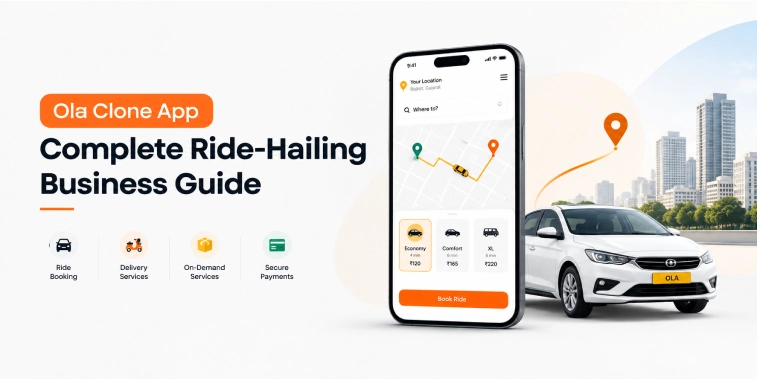
An Ola Clone App provides businesses with a ready-to-customize solution for launching a ride-hailing platform similar to popular taxi-booking applications. It can connect passengers with drivers, manage bookings, process payments, support real-time tracking, and provide an administrative system for managing the entire platform.
For entrepreneurs planning to enter the transportation market, an Ola Clone App can provide a practical foundation for building a scalable ride-hailing business. The platform can also be customized with different vehicle categories, pricing models, service areas, payment options, and revenue strategies.
This guide explains what an Ola Clone App is, how it works, its essential features, business models, revenue opportunities, development considerations, and how businesses can use it to build a competitive ride-hailing platform.
What Is an Ola Clone App?
An Ola Clone App is a customizable ride-hailing application designed to provide functionality similar to established taxi-booking platforms such as Ola. It allows customers to request rides through a mobile app while drivers can accept and complete bookings through a separate driver application.
A complete ride-hailing platform generally includes three major components:
- Customer app
- Driver app
- Admin dashboard
The customer application handles ride booking, driver tracking, payments, ratings, and trip management. The driver application allows drivers to manage availability, accept ride requests, navigate to pickup locations, and track earnings. The admin dashboard gives business owners control over users, drivers, bookings, payments, pricing, reports, and platform operations.
An Ola Clone App does not have to be an exact copy of another company’s application. Businesses can customize the platform according to their target market, service category, branding, and business model.
How Does an Ola Clone App Work?
A ride-hailing app follows a straightforward process that connects customers and drivers in real time.
1. Customer Registers
Customers create an account using their phone number, email address, or supported social login options. They can then add profile information and preferred payment methods.
2. Customer Enters Pickup and Destination
The customer enters the pickup location and destination. The application can use GPS and mapping technology to identify locations and estimate the route.
3. Ride Options Are Displayed
The platform can display available vehicle categories such as economy cars, premium cars, SUVs, bikes, or other transportation options.
Customers can select the vehicle type that best matches their needs.
4. Fare Is Estimated
The system calculates an estimated fare based on factors such as distance, estimated travel time, vehicle category, pricing rules, and applicable fees.
5. Driver Matching
The platform searches for available drivers near the pickup location. A matching system can consider distance, driver availability, vehicle type, and other business rules.
6. Driver Accepts the Request
The selected driver receives the ride request and can accept or reject it based on platform rules.
Once accepted, the customer receives driver information and ride details.
7. Real-Time Tracking
Customers can track the driver’s location through an interactive map. Drivers can also use navigation tools to reach the pickup and destination locations.
8. Ride Completion
After reaching the destination, the driver completes the trip through the driver app. The final fare can then be calculated according to the platform’s pricing rules.
9. Payment and Rating
Customers pay using the selected payment method and can rate the driver after completing the ride.
This process creates a connected ecosystem between customers, drivers, and the platform administrator.
Key Features of an Ola Clone App
The success of a ride-hailing platform depends heavily on its features. A well-designed Ola Clone App should provide useful functionality for customers, drivers, and administrators.
Customer App Features
Registration and Login
Customers should be able to create accounts quickly using phone numbers, email addresses, or other supported authentication methods.
Ride Booking
The core feature allows users to enter pickup and destination locations and request a ride.
Multiple Vehicle Categories
Businesses can offer different vehicle options based on their target market. Examples include:
- Economy cars
- Premium cars
- SUVs
- Bikes
- Electric vehicles
- Shared rides
Fare Estimation
Customers can view estimated ride costs before confirming a booking. Transparent pricing can improve customer confidence.
Real-Time Driver Tracking
GPS-based tracking allows customers to monitor the driver’s location and estimated arrival time.
Multiple Payment Options
A ride-hailing platform can support multiple payment methods, including:
- Credit and debit cards
- Digital wallets
- UPI
- Net banking
- Other locally supported payment methods
Ride History
Customers can access previous trips, payment information, invoices, and booking details.
Ratings and Reviews
After completing a ride, customers can rate drivers and provide feedback. This can help businesses monitor service quality.
Push Notifications
Notifications can inform customers about booking confirmation, driver arrival, ride status, payment updates, and promotions.
In-App Chat or Calling
Customers and drivers can communicate regarding pickup details through supported in-app communication features.
Customer Support
A support system can help customers report issues, ask questions, or request assistance with bookings and payments.
Driver App Features
Drivers need a dedicated interface for managing rides and earnings.
Driver Registration
Drivers can submit their profile information and required documents for verification according to local laws and platform policies.
Driver Verification
The admin can review driver information before approving drivers to use the platform.
Online and Offline Status
Drivers can control their availability by switching between online and offline modes.
Ride Request Management
Drivers can receive nearby ride requests and accept or reject them according to platform rules.
Navigation
Integrated maps and navigation can help drivers reach pickup and destination locations efficiently.
Earnings Dashboard
Drivers can view completed rides, earnings, commissions, incentives, and payment information.
Trip History
Drivers can review previous trips and their associated earnings.
Ratings and Reviews
Drivers can view customer ratings and feedback where appropriate.
Notifications
Drivers receive updates about new ride requests, booking changes, payments, incentives, and other important information.
Admin Dashboard Features
The admin panel gives business owners centralized control over the platform.
Important features can include:
- Customer management
- Driver management
- Driver verification
- Ride management
- Vehicle management
- Pricing management
- Commission management
- Payment management
- Promotions
- Reports and analytics
- Complaint management
- Content management
- Notification management
- Service-area management
A strong admin dashboard can help businesses monitor daily operations and make data-driven decisions.
Advanced Features for an Ola Clone App
Beyond basic ride booking, businesses can add advanced functionality to improve the customer and driver experience.
Scheduled Rides
Customers can schedule rides for a future date and time. This can be useful for airport transfers, business travel, appointments, and planned journeys.
Multiple Stops
Customers can add multiple destinations to a single booking when supported by the business model.
Ride Sharing
Businesses can introduce shared rides where multiple passengers travel along compatible routes.
Corporate Transportation
A dedicated corporate feature can allow businesses to manage employee transportation, billing, ride limits, and account administration.
Emergency Assistance
A safety feature can provide quick access to emergency support and predefined safety workflows.
Trip Sharing
Customers can share ride information with trusted contacts for additional convenience and safety.
Promo Codes
Businesses can create promotional campaigns and discount codes to attract new customers and encourage repeat bookings.
Driver Incentives
The platform can support incentive programs based on completed rides, working periods, service areas, or promotional campaigns.
AI Features for a Modern Ride-Hailing App
Artificial intelligence can improve several aspects of a ride-hailing platform when implemented responsibly.
AI-Based Driver Matching
AI-assisted matching can evaluate factors such as driver location, availability, trip requirements, and historical operational data to help identify suitable drivers.
Demand Forecasting
Predictive analytics can help businesses estimate demand by location and time. This information can support driver allocation and operational planning.
Intelligent Pricing
Data-driven pricing systems can help businesses adjust pricing according to demand, availability, distance, and other defined factors.
AI Customer Support
AI-powered support tools can answer common customer questions and assist with routine support requests.
Fraud Detection
Machine learning systems can help identify unusual transaction or booking patterns for further review.
Personalized Recommendations
The platform can use customer activity and preferences to provide relevant service suggestions or promotions.
AI should be used to improve efficiency and customer experience rather than simply adding technology for marketing purposes.
Ola Clone App Business Model
A ride-hailing business needs a clear business model before launching. Different markets may require different approaches.
Commission Model
The platform takes a percentage of the fare from each completed ride.
For example, if a ride generates $20 and the platform charges a 20% commission, the platform receives $4 while the remaining amount goes to the driver, subject to applicable fees and agreements.
Subscription Model
Drivers can pay a recurring subscription fee to access the platform or specific services.
Service Fee Model
The business can charge customers a service or platform fee in addition to the ride fare.
Corporate Account Model
Businesses can provide transportation services to corporate customers through dedicated accounts and negotiated pricing.
Advertising Model
The platform can generate additional income by offering advertising opportunities to relevant businesses.
Hybrid Revenue Model
Many platforms can combine multiple revenue streams, such as commissions, service fees, subscriptions, corporate accounts, and advertising.
A hybrid approach can provide greater flexibility as the business grows.
Benefits of Launching an Ola Clone App
Faster Market Entry
A ready-made or customizable ride-hailing solution can provide a foundation for launching a business without developing every component from scratch.
Customizable Branding
Businesses can customize the application’s logo, colors, interface, service categories, pricing rules, and other elements according to their brand.
Multiple Revenue Opportunities
A ride-hailing platform can support different monetization strategies rather than depending on a single revenue source.
Scalable Business Model
Businesses can begin with one city or service category and expand into additional locations and vehicle categories over time.
Better Customer Convenience
Customers can book rides, track drivers, make payments, and manage trips from one platform.
Improved Driver Management
A dedicated driver application can simplify ride requests, availability, navigation, earnings, and communication.
Centralized Operations
The admin dashboard provides business owners with centralized control over important platform operations.
How to Start an Ola Clone App Business
Launching a ride-hailing platform requires more than simply deploying an application. Businesses should plan their market, operations, technology, and revenue model carefully.
1. Choose Your Target Market
Decide whether the platform will operate in one city, multiple cities, a specific region, or a larger market.
Research local transportation demand, competitors, regulations, and customer expectations.
2. Select Vehicle Categories
Determine which transportation options your platform will support.
You may start with a limited number of categories and add more as demand grows.
3. Define Your Revenue Model
Choose whether your platform will use commissions, service fees, subscriptions, corporate accounts, advertising, or a hybrid model.
4. Plan Essential Features
Start with core features such as registration, ride booking, GPS tracking, payments, driver management, notifications, ratings, and customer support.
Advanced features can be added as the platform grows.
5. Choose the Technology Approach
Businesses can choose between building a platform from scratch or using a customizable clone solution.
The right choice depends on budget, timeline, customization requirements, technical resources, and long-term goals.
6. Build the Customer and Driver Experience
Both applications should be easy to navigate. Customers should be able to book rides quickly, while drivers should be able to manage requests without unnecessary complexity.
7. Test the Platform
Before launch, test important workflows such as:
- Registration
- Driver verification
- Ride booking
- Driver matching
- GPS tracking
- Fare calculation
- Payments
- Notifications
- Ride cancellation
- Ratings
- Customer support
8. Launch in a Focused Market
Instead of immediately expanding everywhere, businesses can start in a specific service area and measure demand, customer acquisition, driver availability, and operational performance.
9. Optimize and Scale
Use analytics and customer feedback to identify areas for improvement. Once the business model proves effective, expand to additional locations and services.
Ola Clone App Development: What Should You Consider?
Before choosing an Ola Clone App solution, businesses should evaluate several important factors.
Customization
The platform should allow businesses to customize branding, features, pricing, vehicle categories, service areas, and workflows.
Scalability
The solution should be capable of supporting increasing numbers of customers, drivers, bookings, and locations.
Security
User information, authentication, payment processing, and administrative access should be protected using appropriate security practices.
Performance
Fast loading times and reliable booking workflows are important for a ride-hailing application.
Maps and Location Services
Reliable GPS and mapping functionality is essential for pickup, routing, tracking, and distance calculations.
Payment Integration
The platform should support payment methods relevant to the target market and comply with applicable payment and financial requirements.
Analytics
Business owners need access to useful data about bookings, revenue, drivers, customers, service areas, and operational performance.
Future of Ride-Hailing Apps
The ride-hailing industry is expected to continue evolving as businesses adopt better technology and customers demand faster and more convenient transportation services.
Important areas of development include:
- AI-assisted driver matching
- Predictive demand analytics
- Electric vehicle integration
- Connected mobility services
- Smarter route planning
- Digital payments
- Automated customer support
- Corporate mobility platforms
- Multi-service transportation apps
Businesses that combine technology with a strong understanding of local transportation needs can create more useful and competitive mobility platforms.
Conclusion
An Ola Clone App can provide a strong foundation for entrepreneurs who want to enter the ride-hailing and transportation market. With customer and driver applications, an admin dashboard, real-time tracking, digital payments, booking management, ratings, and analytics, the platform can support the core requirements of a modern ride-hailing business.
However, technology alone does not guarantee business success. Entrepreneurs should carefully research their target market, understand local transportation requirements, choose an appropriate revenue model, provide reliable driver and customer experiences, and continuously improve the platform based on real-world data.
With the right strategy and customization, an Ola Clone App can be developed into a branded ride-hailing platform designed around specific customer needs and business goals.
Frequently Asked Questions (FAQs)
1. What is an Ola Clone App?
An Ola Clone App is a customizable ride-hailing platform that provides features such as ride booking, driver matching, GPS tracking, digital payments, ratings, notifications, and trip management. Businesses can customize the platform according to their brand and target market.
2. How does an Ola Clone App make money?
An Ola Clone App can generate revenue through ride commissions, service fees, booking charges, subscriptions, corporate transportation plans, advertising, premium services, and other suitable monetization methods.
3. What are the main features of an Ola Clone App?
Key features include customer registration, ride booking, fare estimation, driver matching, real-time tracking, multiple payment options, ratings and reviews, notifications, driver management, earnings tracking, and an admin dashboard.
4. Can an Ola Clone App support multiple vehicle types?
Yes. A customizable ride-hailing platform can support multiple vehicle categories such as cars, premium vehicles, SUVs, bikes, electric vehicles, or other transportation options depending on the business model and local requirements.
5. Is an Ola Clone App suitable for starting a ride-hailing business?
Yes. An Ola Clone App can provide a customizable foundation for launching a ride-hailing business. Entrepreneurs can start with essential features and a focused service area, then expand the platform as customer demand and operations grow.

Parth Kulkarni
Managing Director
Parth Kulkarni is the Managing Director with strong expertise in IT and on-demand app solutions, focused on empowering startups and enterprises with scalable digital products. His strategic leadership and business insight drive innovation, ensuring consistent client success and long-term growth.
