

Introduction
Online pharmacy services have changed how customers search for medicines, upload prescriptions, compare products, place orders, and receive healthcare products at home. As digital healthcare adoption continues to grow, pharmacy businesses are looking for software solutions that can simplify online ordering while helping pharmacies manage products, prescriptions, customers, payments, and deliveries.
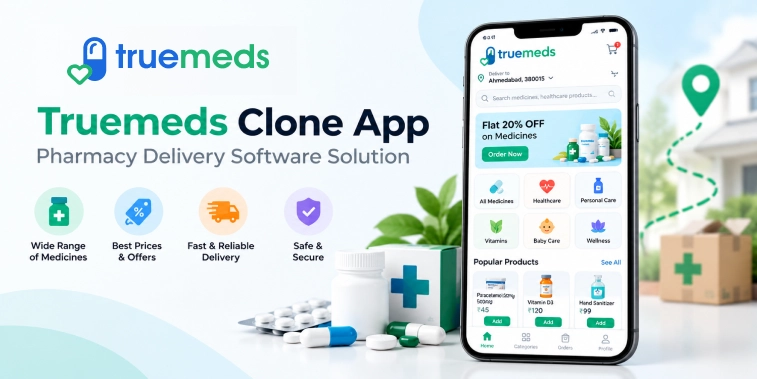
A Truemeds Clone App is a customizable pharmacy delivery software solution inspired by the digital pharmacy marketplace model associated with Truemeds. It can provide a foundation for businesses that want to launch their own branded online pharmacy platform with features for customers, pharmacies, delivery partners, and administrators.
A modern pharmacy delivery platform can support medicine discovery, prescription management, product information, cart and checkout, digital payments, order tracking, notifications, pharmacist-related workflows, and administrative management.
The exact features and workflows should be customized according to the target market, pharmacy operations, applicable healthcare regulations, and business model.
This guide explains what a Truemeds Clone App is, how it works, its key features, AI-powered functionality, pharmacy and delivery management tools, revenue opportunities, technology integrations, security requirements, and important considerations for launching a pharmacy delivery software solution.
What Is a Truemeds Clone App?
A Truemeds Clone App is a ready-to-customize online pharmacy platform designed around the core functionality of a digital medicine ordering and delivery marketplace.
A clone solution does not have to be an exact copy of an existing company. Instead, it can provide common pharmacy marketplace functionality that a business can customize with its own:
- Brand identity
- Pharmacy network
- Product catalog
- Service areas
- Pricing structure
- Delivery model
- Payment methods
- Customer workflows
- Business rules
The platform can connect several participants within one ecosystem.
Customers
Customers can search for medicines and healthcare products, review product information, upload prescriptions where required, place orders, make payments, and manage delivery details.
Pharmacies
Pharmacy partners can manage product catalogs, inventory, prescriptions, orders, pricing, and fulfillment.
Delivery Partners
Delivery personnel can receive eligible delivery assignments, access pickup and delivery details, navigate to locations, and update delivery status.
Administrators
Administrators can manage customers, pharmacies, products, orders, payments, delivery partners, promotions, reports, and platform settings.
This multi-sided structure allows a business to operate a connected digital pharmacy marketplace.
How Does a Truemeds Clone App Work?
A pharmacy delivery application generally follows a structured customer-to-pharmacy-to-delivery workflow.
Customer Registration
Customers create accounts using supported authentication methods such as phone numbers, email addresses, or other available options.
Product Discovery
Users can search for medicines and healthcare products by product name, category, or other relevant attributes.
Product Information
The application can display information such as:
- Product name
- Product category
- Price
- Available quantity
- Manufacturer information
- Basic product details
- Prescription requirements where applicable
Healthcare information should be presented carefully and should not replace professional medical advice.
Prescription Upload
For products requiring prescriptions, the platform can provide a mechanism for customers to submit the required prescription information for appropriate review.
Cart and Checkout
Customers can add eligible products to a cart, review quantities, select a delivery address, and proceed through checkout.
Order Processing
The pharmacy receives the order and processes the items according to the platform’s workflow and applicable requirements.
Delivery Assignment
When an order is ready for delivery, an eligible delivery partner can be assigned.
Delivery Tracking
Customers can receive relevant updates about their order and delivery.
Order Completion
After delivery, the order can be marked as completed and the customer can access order history and support options.
The exact workflow should be configured according to the pharmacy’s operational processes and applicable regulations.
Key Features of a Truemeds Clone App
A pharmacy delivery software solution needs features that support customers, pharmacy partners, delivery operations, and administrators.
Customer App Features
User Registration and Profile Management
Customers can create and manage their accounts.
A profile may include:
- Name
- Contact information
- Saved addresses
- Order history
- Prescription records where appropriate
- Payment preferences
- Notification settings
The platform should collect only information that is necessary for the relevant services and handle it securely.
Medicine Search
Search is one of the most important features of an online pharmacy application.
Users can search by:
- Medicine name
- Brand
- Generic name where supported
- Product category
- Healthcare product type
Search functionality should be designed to help users find products without creating confusion between similar product names.
Categories and Product Discovery
The platform can organize products into categories such as:
- Prescription medicines
- Over-the-counter products where permitted
- Personal care
- Wellness products
- Medical devices
- Healthcare essentials
Categories should reflect the products and services legally offered through the platform.
Product Details
A product page can provide relevant information such as product name, manufacturer, price, availability, pack size, and other permitted details.
Where professional or regulatory information is required, businesses should use verified product information from appropriate sources.
Prescription Management
Prescription functionality can allow customers to submit prescriptions through supported workflows.
The system may provide tools for:
- Prescription upload
- Prescription review
- Prescription status
- Prescription-related communication
- Order association
Prescription handling should be designed around applicable healthcare and privacy requirements.
Cart Management
Customers can review products, change quantities, remove items, and check applicable pricing before proceeding to checkout.
Checkout
The checkout process can include:
- Delivery address
- Product summary
- Applicable fees
- Discounts where eligible
- Payment method
- Order confirmation
The final amount should be clearly displayed before the transaction is completed.
Digital Payments
The application can integrate supported payment methods.
Depending on the market, these may include cards, bank-based payments, digital wallets, or other supported payment services.
Payment processing should use appropriate security practices and compliant payment providers.
Order Tracking
Customers can receive relevant updates regarding their pharmacy order.
Tracking information may include order processing, pharmacy fulfillment, dispatch, and delivery progress.
Order History
Customers can view previous orders and relevant transaction details.
For recurring purchases where appropriate, previous orders can help customers locate products more easily.
Notifications
Notifications can provide important updates about:
- Order confirmation
- Prescription review
- Payment
- Order processing
- Dispatch
- Delivery
- Refunds
- Account activity
Notifications should be relevant and not misleading.
Customer Support
The platform can provide support through chat, tickets, phone assistance, or other supported channels.
Common issues can include delivery questions, order problems, payment issues, and account-related requests.
Pharmacy Partner Features
Pharmacy partners require dedicated software to manage their participation in the marketplace.
Pharmacy Profile
A pharmacy profile can include:
- Pharmacy name
- Address
- Contact information
- Operating hours
- Service area
- Business information
- Verification status where applicable
Product Management
Pharmacies can manage their available products, pricing, quantities, and product information.
Inventory Management
Inventory functionality can help pharmacies track product availability.
The platform can provide information about low-stock items and unavailable products, depending on the system’s capabilities.
Prescription Management
Authorized pharmacy staff can access prescriptions submitted through the platform according to the applicable workflow.
Prescription review should be handled by appropriately authorized personnel.
Order Management
Pharmacy staff can view incoming orders, process eligible orders, update order status, and prepare products for fulfillment.
Availability Management
Pharmacies can control product availability and service hours.
Pharmacy Analytics
The platform can provide reports covering:
- Orders
- Revenue
- Product activity
- Customer activity
- Fulfillment performance
- Popular products
These analytics can help pharmacy partners understand marketplace performance.
Delivery Partner Features
A dedicated delivery application can help coordinate medicine and healthcare product deliveries.
Delivery Partner Registration
Delivery personnel can register and submit required information for verification.
Availability Management
Partners can indicate when they are available to receive eligible delivery requests.
Delivery Assignments
The platform can provide delivery assignments based on the business’s dispatch workflow.
Pickup Details
Delivery partners can receive relevant pharmacy pickup information.
Navigation
Map integration can help delivery personnel navigate to pickup and customer locations.
Delivery Updates
Partners can update relevant delivery information through the application.
Earnings and History
The application can provide access to eligible earnings and completed delivery information.
Notifications
Delivery partners can receive alerts for new assignments, changes, and important delivery information.
Admin Dashboard
The admin dashboard provides centralized control over the pharmacy delivery platform.
Administrators can manage:
- Customers
- Pharmacies
- Products
- Prescriptions
- Orders
- Delivery partners
- Payments
- Promotions
- Support requests
- Reports
Customer Management
Admins can manage customer accounts and support requests.
Pharmacy Management
The platform can support pharmacy onboarding, verification, profiles, service areas, and operational settings.
Product Management
Admins can manage product categories, product information, and marketplace-level settings.
Prescription Workflow Management
Administrators can monitor prescription-related workflows while ensuring access is limited to authorized personnel.
Order Management
A centralized order dashboard can provide visibility into pharmacy orders and fulfillment.
Delivery Management
Admins can monitor delivery operations and manage delivery partner settings.
Commission Management
Where the business model uses commissions, administrators can configure relevant commission rules.
Promotions
The platform can support eligible coupons, discounts, promotional campaigns, and banners.
Analytics and Reports
The admin dashboard can provide reports about:
- Orders
- Revenue
- Customers
- Pharmacy performance
- Delivery performance
- Product demand
- Platform activity
AI Features for a Modern Pharmacy Delivery Platform
AI can support pharmacy platforms in areas such as search, customer support, personalization, and operational analytics. Because healthcare is a sensitive area, AI functionality should be designed carefully and should not replace qualified medical professionals or authorized pharmacy processes.
AI-Powered Product Search
AI can help users find relevant products when search terms are incomplete or expressed differently from the product catalog.
Personalized Product Discovery
Where legally and ethically appropriate, AI can personalize general shopping experiences based on relevant user activity.
Personalization should not make unsupported medical recommendations.
AI Customer Support
An AI assistant can answer general platform questions about:
- Orders
- Delivery
- Account settings
- Payment status
- General platform navigation
Medical questions should be directed to appropriate healthcare professionals rather than handled as automated diagnosis or treatment advice.
Demand Forecasting
AI-based analytics can help businesses identify product demand patterns and support inventory planning.
Inventory Insights
Predictive analytics can help identify potential stock requirements based on historical demand and operational data.
Fraud and Anomaly Detection
AI can help identify unusual transaction or account patterns for further review.
Business Model and Revenue Opportunities
A pharmacy delivery software solution can support different revenue models depending on the operating structure.
Pharmacy Commission
A marketplace may charge participating pharmacies a commission on eligible transactions.
Delivery Fees
Customers may pay applicable delivery fees based on service conditions, distance, order value, or promotional rules.
Subscription Plans
Businesses can offer eligible membership plans with defined benefits.
Sponsored Promotions
Pharmacy partners or permitted brands may participate in promotional placements subject to applicable laws and platform policies.
Service Fees
The platform may apply clearly disclosed service or platform fees where appropriate.
Partner Programs
A business may develop partnerships with relevant healthcare or wellness organizations where legally permitted.
Revenue models should always be designed around applicable healthcare, advertising, consumer-protection, and payment regulations.
Technology and Third-Party Integrations
A modern pharmacy delivery platform requires a combination of application technology, backend infrastructure, and third-party services.
Payment Gateway Integration
Payment gateways support online transaction processing.
Maps and Location APIs
Maps can support pharmacy discovery, address selection, delivery coordination, and navigation.
Push Notifications
Push notification services can provide timely order and delivery updates.
SMS and Email Services
These services can support authentication, transactional communication, reminders, and support notifications.
Analytics Platforms
Analytics tools can provide insights into customer activity, orders, conversions, and operational performance.
AI Services
AI services can support intelligent search, customer support, demand forecasting, and operational analytics.
Cloud Infrastructure
Cloud services can support application hosting, databases, storage, monitoring, backups, and scalability.
Security and Privacy
Pharmacy platforms can process sensitive customer information, prescription information, addresses, payment information, and healthcare-related data.
Security and privacy should therefore be considered core requirements rather than optional features.
Important measures can include:
- Secure authentication
- Encryption
- Role-based access control
- Secure APIs
- Data access restrictions
- Payment security
- Audit logging
- Monitoring
- Backup and recovery
- Regular security testing
Access to prescription and other sensitive information should be limited to authorized personnel.
Businesses should also comply with applicable healthcare, privacy, pharmacy, payment, and data-protection requirements in each market where the platform operates.
Prescription and Compliance Considerations
Pharmacy applications have additional responsibilities compared with ordinary ecommerce platforms.
Businesses should establish appropriate processes for:
- Prescription verification
- Authorized pharmacy review
- Product eligibility
- Customer identity where required
- Record handling
- Data protection
- Order documentation
- Restricted products
- Delivery requirements
The exact requirements vary by country and jurisdiction.
A software platform should support compliance workflows, but businesses should obtain appropriate legal and regulatory guidance before launching pharmacy services.
Benefits of a Truemeds Clone App
A customizable pharmacy delivery platform can provide several potential benefits.
Centralized Digital Ordering
Customers can discover products, submit eligible prescriptions, place orders, and manage deliveries through one application.
Wider Pharmacy Reach
A marketplace can connect customers with participating pharmacies within supported service areas.
Convenient Customer Experience
Search, ordering, digital payments, notifications, and tracking can simplify the purchasing process.
Multiple Revenue Opportunities
Businesses can combine commissions, delivery fees, subscriptions, and other permitted revenue models.
Scalable Marketplace
Additional pharmacies and service areas can potentially be added as the platform grows.
Data-Driven Operations
Analytics can help businesses understand product demand, orders, customer activity, and fulfillment performance.
How to Make a Truemeds Clone App Stand Out
A pharmacy platform should focus on trust, convenience, accuracy, and responsible healthcare workflows.
Improve Product Discovery
Fast search, useful categories, accurate product information, and clear availability can make the platform easier to use.
Simplify Prescription Workflows
Customers should have a clear process for submitting and tracking prescriptions where required.
Provide Transparent Pricing
The platform should clearly display product prices, applicable discounts, delivery fees, and other charges.
Build Pharmacy Trust
Verified pharmacy information, transparent policies, and accessible support can help create customer confidence.
Improve Delivery Visibility
Clear order and delivery updates can reduce uncertainty for customers.
Use AI Responsibly
AI should support search, support, and operational efficiency without replacing qualified healthcare professionals or making unsupported medical claims.
Pharmacy Delivery App Development Process
Building a pharmacy delivery platform requires planning across technology, healthcare operations, compliance, and user experience.
Market Research
Identify target customers, pharmacy partners, service areas, competitors, and applicable regulations.
Business Model Planning
Define commissions, delivery charges, memberships, promotions, and other permitted revenue models.
Feature Planning
Define customer, pharmacy, delivery, and admin requirements.
UI/UX Design
Create interfaces that make medicine discovery, prescription submission, checkout, and order tracking clear and easy to understand.
Technology Architecture
Plan the mobile applications, backend, APIs, database, cloud infrastructure, integrations, and security architecture.
Development
Develop the customer app, pharmacy dashboard, delivery application, admin panel, and backend services.
Integration
Connect payment, maps, notifications, analytics, and other required services.
Testing
Test functionality, performance, security, payments, prescription workflows, notifications, and different user roles.
Compliance Review
Review the platform’s workflows and policies against applicable pharmacy, healthcare, privacy, and payment requirements.
Launch and Monitoring
Launch in the selected market and continuously monitor performance, user feedback, security, and operational issues.
Cost Factors in Pharmacy Delivery App Development
The cost of developing a Truemeds-style pharmacy delivery platform varies according to project requirements.
Major factors include:
- Number of applications
- Feature complexity
- UI/UX requirements
- Pharmacy management functionality
- Prescription workflows
- Delivery management
- Payment integrations
- Maps and location services
- AI functionality
- Admin dashboard
- Security requirements
- Compliance requirements
- Testing
- Development team location
- Maintenance and support
A basic pharmacy marketplace may require fewer resources than a larger platform supporting multiple pharmacies, advanced inventory management, AI functionality, sophisticated analytics, complex prescription workflows, and multiple geographic markets.
Businesses should consider both initial development expenses and ongoing costs such as cloud infrastructure, maintenance, security updates, support, compliance, and product improvements.
Conclusion
A Truemeds Clone App can provide a customizable foundation for businesses looking to launch a pharmacy delivery software solution. It can connect customers, pharmacies, delivery partners, and administrators through dedicated digital interfaces.
A complete platform can include medicine search, product discovery, prescription workflows, cart and checkout, digital payments, order tracking, notifications, pharmacy management, delivery management, analytics, and administrative controls.
AI can add useful capabilities through intelligent search, general customer support, demand forecasting, inventory insights, and anomaly detection. However, pharmacy platforms require additional care because they can involve prescriptions, sensitive information, regulated products, and healthcare-related workflows.
Businesses should therefore focus not only on features but also on security, privacy, pharmacy operations, compliance, user experience, and responsible technology use.
A successful pharmacy delivery platform should be customized for its target market rather than treated as a simple copy of an existing application. With appropriate pharmacy partnerships, scalable technology, secure data handling, clear workflows, and a customer-focused experience, a Truemeds-style platform can provide a strong foundation for a digital pharmacy marketplace.
Frequently Asked Questions (FAQs)
1. What is a Truemeds Clone App?
A Truemeds Clone App is a customizable pharmacy delivery software solution inspired by the digital pharmacy marketplace concept associated with Truemeds. It can connect customers, pharmacies, delivery partners, and administrators through a centralized platform.
2. How does a Truemeds Clone App work?
Customers can search for eligible medicines and healthcare products, submit prescriptions where required, add products to a cart, make payments, place orders, and receive delivery updates. Pharmacies process orders, delivery partners manage eligible deliveries, and administrators manage the overall platform.
3. What features should a Truemeds Clone App include?
Important features can include medicine search, product categories, product details, prescription management, cart and checkout, payments, order tracking, notifications, pharmacy management, delivery management, customer support, analytics, and an admin dashboard.
4. Can AI be integrated into a Truemeds Clone App?
Yes. AI can support intelligent product search, general customer support, demand forecasting, inventory insights, personalization of non-clinical shopping experiences, and anomaly detection. AI should not replace qualified healthcare professionals or provide unsupported medical advice.
5. How does a Truemeds Clone App generate revenue?
Depending on the business model and applicable regulations, revenue may come from pharmacy commissions, delivery fees, subscriptions, service fees, permitted promotional placements, and relevant partnerships.

Parth Kulkarni
Managing Director
Parth Kulkarni is the Managing Director with strong expertise in IT and on-demand app solutions, focused on empowering startups and enterprises with scalable digital products. His strategic leadership and business insight drive innovation, ensuring consistent client success and long-term growth.