


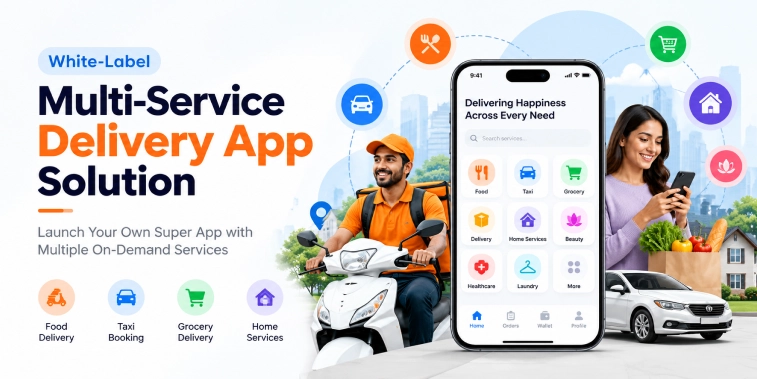
Introduction
The on-demand delivery market has expanded rapidly as customers increasingly expect convenient ways to order food, groceries, medicines, parcels, household products, and other everyday essentials through mobile applications. Businesses entering this market need more than a basic delivery application. They require a scalable digital platform that can manage customers, merchants, delivery partners, orders, payments, and real-time delivery operations from a centralized system.
A White-Label Multi-Service Delivery App Solution provides businesses with a customizable foundation for launching a branded delivery platform without developing every core function from the ground up. The solution can be customized with a company’s branding, service categories, business rules, payment options, delivery workflows, and operational requirements.
Unlike a single-purpose delivery application, a multi-service platform can support several delivery categories within one ecosystem. Depending on the business model, it may include food delivery, grocery delivery, pharmacy delivery, courier services, retail delivery, and other local on-demand services.
For entrepreneurs and established businesses, a white-label solution can reduce development complexity and provide a structured starting point for launching a delivery marketplace. However, choosing the right solution requires careful evaluation of customization options, scalability, functionality, security, integrations, and long-term business requirements.
This guide explains what a white-label multi-service delivery app solution is, how it works, its essential features, business benefits, revenue opportunities, development considerations, and the steps involved in launching a successful platform.
What Is a White-Label Multi-Service Delivery App Solution?
A White-Label Multi-Service Delivery App Solution is a customizable delivery platform that businesses can brand and configure according to their own requirements. Instead of creating a delivery ecosystem entirely from scratch, a business can use an existing software foundation and adapt its interface, features, workflows, and service categories.
The term white-label means that the platform can be presented under the purchasing company’s own brand. Businesses can typically customize elements such as the logo, colors, application interface, service categories, and other brand-specific components.
The multi-service aspect allows the platform to support multiple types of delivery services through one application. For example, a business may provide grocery delivery alongside food, pharmacy, parcel, or retail delivery.
A typical ecosystem can include several connected participants:
- Customers who place orders
- Merchants who provide products or services
- Delivery partners who fulfill deliveries
- Administrators who manage the complete platform
Each participant can have a dedicated interface or dashboard based on their responsibilities.
A white-label solution does not mean copying another company’s protected branding, content, or proprietary technology. It provides a customizable software foundation that businesses can adapt with their own branding, design, service model, and operational processes.
How Does a White-Label Multi-Service Delivery App Work?
A multi-service delivery platform connects customers, merchants, delivery partners, and administrators through a centralized system. Although workflows can differ between businesses, the general process follows several stages.
Service Selection
Customers open the application and select the service they require. Depending on the business model, available categories may include restaurants, grocery stores, pharmacies, retail stores, courier services, or other local businesses.
A clear service dashboard helps customers find the appropriate category quickly.
Product or Service Discovery
After selecting a category, customers can browse participating merchants and available products. Search, filters, categories, product details, prices, and availability can help customers make purchasing decisions.
Order Placement
Customers select their products, add them to a cart, provide delivery details, choose an available delivery option, and confirm the order.
The platform then sends the order information to the appropriate merchant.
Merchant Processing
Merchants receive incoming orders through their dedicated panel. They can review the order, confirm availability, prepare the items, and update the order status.
The platform can communicate status changes to customers automatically.
Delivery Assignment
After the order is ready, a delivery partner can be assigned based on availability, location, service area, vehicle type, or other business rules.
The delivery partner receives the pickup information and uses navigation tools to reach the merchant.
Delivery Tracking
Customers can receive real-time updates about their order and delivery progress. GPS-based tracking can provide visibility into the delivery partner’s location and estimated arrival.
Order Completion
The delivery partner completes the delivery and updates the status. The platform records the transaction, payment, delivery information, and other relevant details.
Customers may then provide ratings or feedback about the merchant and delivery experience.
Key Features of a White-Label Multi-Service Delivery App
A successful multi-service delivery platform requires features that support customers, merchants, delivery partners, and administrators.
Customer Registration and Profile Management
Customers can create accounts, manage personal information, save delivery addresses, review order history, and manage available payment preferences.
A well-designed profile system makes repeat ordering faster and more convenient.
Multi-Service Marketplace
The platform can display several service categories within one application. Customers may be able to switch between food, grocery, pharmacy, parcel, and other delivery services without installing separate applications.
Businesses can activate or deactivate service categories according to their operating model and market requirements.
Product Search and Filtering
Search and filtering functionality helps customers find products and merchants quickly. Categories, keywords, price ranges, availability, and other filters can make product discovery easier.
Shopping Cart and Checkout
Customers can add multiple products to a cart, review prices, apply available promotions, select delivery preferences, and complete checkout.
A simple checkout process can reduce unnecessary steps and make ordering more convenient.
Multiple Payment Options
The platform can integrate supported payment methods such as cards, digital wallets, bank-based options, or other payment providers.
Payment integration should be selected according to the target market and applicable requirements.
Real-Time Order Tracking
Customers can monitor order status from confirmation through delivery. GPS integration can provide additional visibility once an order is assigned to a delivery partner.
Tracking can improve transparency and reduce uncertainty around delivery times.
Delivery Partner Management
Delivery partners can receive available delivery requests, view pickup and drop-off details, use navigation, update delivery status, and monitor their earnings.
The platform can also support partner verification and performance management.
Merchant Management
Merchants can manage product catalogs, prices, inventory, incoming orders, order status, promotions, and business information.
A dedicated merchant panel allows businesses to manage their operations without relying entirely on the platform administrator.
Push Notifications
Notifications can keep customers, merchants, and delivery partners informed about important events such as order confirmation, order acceptance, pickup, delivery updates, cancellations, and completed transactions.
Ratings and Reviews
Customers can provide ratings and reviews after receiving an order. Feedback can help businesses monitor service quality and identify areas that need improvement.
Admin Dashboard
The administrator dashboard provides centralized control over users, merchants, delivery partners, services, orders, payments, commissions, promotions, and reports.
Role-based access can help restrict sensitive functions to authorized administrators.
Business Benefits of a White-Label Delivery Solution
A white-label multi-service delivery platform can offer several advantages to businesses entering or expanding within the on-demand delivery market.
Faster Market Entry
Using a ready-made platform can reduce the time required to establish essential delivery functionality. Businesses can focus on branding, market research, provider onboarding, and customer acquisition while using an existing software foundation.
Customizable Branding
Businesses can present the application under their own brand identity. Branding can include the company name, logo, colors, interface elements, and other visual components.
This allows businesses to build a recognizable digital presence rather than directing customers to a third-party marketplace.
Multiple Service Opportunities
A multi-service model allows businesses to operate across several delivery categories. A company can begin with one service and expand into additional categories as customer demand grows.
For example, a business may start with grocery delivery and later introduce pharmacy, food, parcel, or retail delivery.
Centralized Management
Multiple services can be managed through connected administrative tools. This gives businesses greater visibility into customers, merchants, delivery partners, orders, transactions, and overall operations.
Centralization can also make it easier to monitor performance across different service categories.
Scalability
A modular platform can support expansion as the business grows. Additional merchants, delivery partners, service areas, and categories can be introduced without necessarily replacing the entire system.
Improved Customer Convenience
Customers can access multiple services through one application. A single account, saved addresses, order history, and familiar checkout process can make repeat purchases more convenient.
White-Label Delivery App Revenue Model
A multi-service delivery platform can generate revenue through several methods. Businesses should select revenue streams based on their target market, operating costs, and service categories.
Commission From Merchants
The platform can charge merchants a percentage of completed orders. Commission rates may vary according to category, agreement, or business strategy.
Delivery Fees
Customers can pay delivery charges based on distance, order type, service category, location, or other pricing factors.
Transparent pricing is important so customers understand applicable charges before confirming an order.
Service Charges
A platform can apply a service or platform fee to eligible transactions. The amount and structure can be customized according to the business model.
Subscription Plans
Businesses can introduce customer subscription programs that provide benefits such as reduced delivery charges, special offers, or other platform advantages.
Subscriptions can create recurring revenue while encouraging repeat usage.
Merchant Subscription Plans
Merchants may also be offered premium plans that provide additional tools, enhanced visibility, analytics, or other business services.
Advertising and Sponsored Listings
Participating merchants can pay for promotional placements or increased visibility within relevant sections of the application.
Promotional content should remain relevant and clearly presented to maintain customer trust.
Essential Panels in a Multi-Service Delivery Platform
A multi-service delivery ecosystem usually requires separate interfaces for its main participants.
Customer App
The customer application allows users to browse services, search for products, place orders, make payments, track deliveries, view order history, and submit feedback.
The interface should remain easy to navigate even when several services are available.
Merchant Panel
Merchants can manage products, prices, inventory, orders, promotions, and business information. They can also receive and process incoming orders.
Delivery Partner App
Delivery partners can view assigned requests, accept available jobs, access pickup and drop-off information, navigate to locations, update delivery status, and track earnings.
Admin Panel
Administrators can manage the complete platform, including customers, merchants, delivery partners, service categories, transactions, commissions, promotions, and reports.
How Much Does a White-Label Multi-Service Delivery App Cost?
The cost of a white-label multi-service delivery app depends on the level of customization, number of services, supported platforms, required features, integrations, design requirements, and development or deployment arrangements.
A basic solution supporting one or two delivery categories generally requires less investment than a highly customized platform supporting multiple services, advanced analytics, automated workflows, several payment methods, and large-scale operations.
Important cost factors include:
- UI/UX customization
- Customer application
- Merchant dashboard
- Delivery partner application
- Admin panel
- Backend infrastructure
- Payment gateway integration
- GPS and mapping services
- Notification systems
- Third-party integrations
- Testing and quality assurance
- Cloud hosting
- Maintenance and updates
Businesses should identify the features required for the initial launch before requesting development estimates. A phased approach can help separate essential MVP functionality from future enhancements.
Recurring expenses such as hosting, payment processing, third-party APIs, technical support, maintenance, and updates should also be included in the overall budget.
Steps to Launch a White-Label Multi-Service Delivery App
1. Identify the Target Market
Research customer expectations, competitor offerings, service gaps, pricing, and local delivery requirements. This information can help determine which services should be included in the initial platform.
2. Select the Initial Services
Choose services that have clear customer demand and can be operated efficiently. Starting with a focused set of services can make the initial launch easier to manage.
3. Define the Business Model
Determine whether revenue will come from merchant commissions, delivery fees, subscriptions, advertising, service charges, or a combination of these methods.
4. Customize the Platform
Configure the platform according to the company’s branding, service categories, pricing rules, delivery areas, payment methods, and operational requirements.
5. Onboard Merchants and Delivery Partners
Recruit suitable merchants and delivery partners before launch. Establish clear onboarding procedures, service standards, and operational policies.
6. Test the Core Workflows
Test registration, product discovery, ordering, payments, merchant processing, delivery assignment, tracking, cancellations, notifications, and refunds where applicable.
Testing should cover different user roles and realistic operating scenarios.
7. Launch in a Focused Area
Begin with a selected city, region, or service area. A focused launch allows the business to monitor delivery quality, customer feedback, provider performance, and operational challenges.
8. Monitor and Expand
After launch, analyze orders, customer retention, delivery performance, cancellations, provider activity, and support requests. Use these insights to improve the platform and expand into additional service categories or locations.
Challenges to Consider
Operating a multi-service delivery platform involves several challenges. Managing different service categories can create different operational requirements, pricing models, provider relationships, and customer expectations.
Merchant and delivery partner onboarding also requires consistent verification, communication, and support. As the platform grows, maintaining delivery quality and timely order fulfillment becomes increasingly important.
Another challenge is keeping the customer experience simple. Too many service categories or complicated navigation can make the application difficult to use.
Businesses should also consider local regulations, taxes, payment requirements, consumer protection rules, data privacy obligations, and other legal requirements applicable to their target market.
A strong operating strategy, reliable technology, responsive customer support, and continuous platform monitoring can help businesses manage these challenges more effectively.
Conclusion
A White-Label Multi-Service Delivery App Solution can provide businesses with a customizable foundation for entering the growing on-demand delivery market. By bringing multiple services such as food, grocery, pharmacy, retail, and courier delivery into one platform, businesses can create a broader digital ecosystem for customers and service providers.
The main advantages of a white-label approach include faster market entry, customizable branding, centralized operations, multiple revenue opportunities, and the ability to expand into additional service categories.
However, technology alone does not guarantee business success. Entrepreneurs need to understand their target market, select the right service categories, establish a sustainable revenue model, recruit reliable merchants and delivery partners, and continuously improve the customer experience.
A focused launch with essential functionality can provide a practical starting point. As customer demand and operational capabilities grow, businesses can add new services, expand geographically, and introduce advanced functionality.
Frequently Asked Questions (FAQs)
1. What Is a White-Label Multi-Service Delivery App Solution?
A White-Label Multi-Service Delivery App Solution is a customizable delivery platform that businesses can launch under their own brand. It can support multiple services such as food, grocery, pharmacy, retail, and courier delivery while connecting customers, merchants, delivery partners, and administrators through one centralized system.
2. What Features Should a White-Label Multi-Service Delivery App Include?
Important features can include customer registration, service discovery, product search, shopping cart, checkout, multiple payment options, order tracking, GPS integration, merchant management, delivery partner management, push notifications, ratings and reviews, promotions, and an admin dashboard. Businesses can customize the features according to their specific service model.
3. How Does a White-Label Multi-Service Delivery App Generate Revenue?
A platform can generate revenue through merchant commissions, delivery fees, service charges, customer subscriptions, merchant subscription plans, advertising, and sponsored listings. Businesses can combine different revenue streams based on their target market and operating strategy.
4. What Are the Benefits of Using a White-Label Multi-Service Delivery App?
A white-label solution can help businesses enter the market faster, launch under their own brand, manage multiple delivery services through one platform, and customize workflows according to their business requirements. It can also provide opportunities to expand services and revenue streams as the business grows.
5. How Can a Business Launch a White-Label Multi-Service Delivery App Successfully?
A business can start by researching its target market, selecting suitable delivery categories, defining the revenue model, customizing the platform, onboarding merchants and delivery partners, testing the core workflows, and launching in a focused service area. Monitoring customer feedback and operational performance can then help improve the platform and support future expansion.

Parth Kulkarni
Managing Director
Parth Kulkarni is the Managing Director with strong expertise in IT and on-demand app solutions, focused on empowering startups and enterprises with scalable digital products. His strategic leadership and business insight drive innovation, ensuring consistent client success and long-term growth.
