


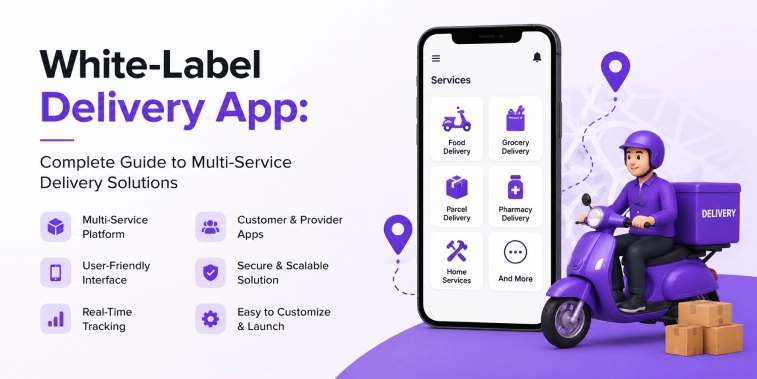
Introduction
The on-demand delivery industry has expanded beyond food delivery. Customers now expect convenient delivery services for groceries, medicines, parcels, retail products, meals, and other everyday needs through digital platforms.
For businesses, building separate applications for every delivery category can require significant time, resources, and ongoing maintenance. A White-Label Delivery App provides another approach by offering a customizable delivery platform that can be adapted to a company’s own brand, services, operating locations, and business model.
A multi-service delivery platform can connect customers, vendors, delivery partners, and administrators through one digital ecosystem. Depending on the business model, the same platform can support food delivery, grocery delivery, pharmacy delivery, courier services, retail delivery, and other on-demand services.
In 2026, businesses can also enhance these platforms with AI-assisted recommendations, intelligent delivery management, digital payments, real-time notifications, analytics, and automated customer support.
This guide explains what a white-label delivery app is, how a multi-service delivery platform works, its major features, business benefits, revenue opportunities, technology requirements, and important considerations when launching a delivery business.
What Is a White-Label Delivery App?
A white-label delivery app is a pre-built or customizable delivery platform that businesses can launch under their own brand.
Instead of developing an entire delivery ecosystem from the beginning, a business can customize the platform with its:
- Brand name
- Logo
- Colors
- Service categories
- Delivery areas
- Pricing structure
- Payment methods
- Business rules
- Third-party integrations
The platform can be adapted to different delivery models.
For example, a business could launch a platform offering:
- Food delivery
- Grocery delivery
- Pharmacy delivery
- Parcel delivery
- Retail delivery
- Flower delivery
- Local store delivery
The exact services depend on the company’s target market and operating model.
A white-label solution is particularly useful for businesses that want to enter the delivery market with a customizable technology foundation rather than creating every component from scratch.
How Does a Multi-Service Delivery App Work?
A multi-service delivery platform typically connects several types of users.
Customer
Customers browse available services, place orders or delivery requests, make payments, track deliveries, and provide feedback.
Vendor or Business
Vendors can add products or services, manage orders, update availability, and receive customer requests.
Delivery Partner
Delivery partners can receive assigned tasks, manage deliveries, view relevant order information, and update delivery progress.
Admin
Administrators manage the entire platform, including customers, vendors, delivery partners, orders, payments, services, promotions, and reports.
The platform brings these participants together through a centralized system.
Why Choose a White-Label Delivery App?
Faster Market Entry
A customizable delivery solution can reduce the amount of time required to establish the basic technology infrastructure.
Businesses can focus more on launching services, acquiring customers, developing partnerships, and expanding their delivery network.
Brand Customization
A white-label platform can be adapted to reflect the company’s identity.
Customization can include:
- Logo
- App name
- Color scheme
- User interface
- Service categories
- Notifications
- Website and app branding
This allows the delivery platform to operate as a business’s own digital product.
Multi-Service Expansion
One platform can support several delivery categories.
A business that starts with food delivery could potentially expand into groceries, pharmacy products, retail items, or courier services.
Centralized Management
Administrators can manage multiple service categories from a centralized dashboard.
This can simplify:
- Order management
- User management
- Vendor management
- Delivery management
- Payments
- Reports
Scalability
A properly designed platform can be expanded as the business grows.
Businesses can add new:
- Cities
- Vendors
- Delivery partners
- Service categories
- Payment methods
- Features
Key Features of a White-Label Delivery App
Customer App
The customer application is the primary interface for users ordering products or requesting deliveries.
Important features can include:
- Registration and login
- Profile management
- Service categories
- Search
- Product browsing
- Cart
- Order placement
- Delivery address management
- Payment
- Order tracking
- Notifications
- Reviews and ratings
- Order history
- Customer support
A simple and organized customer interface can make it easier to discover services and complete orders.
Multi-Service Category Management
A major advantage of a multi-service platform is the ability to manage multiple delivery categories.
For example:
Food Delivery
Customers can discover restaurants, browse menus, place orders, and request delivery.
Grocery Delivery
Customers can order groceries and household products from participating stores.
Pharmacy Delivery
Eligible pharmacy products can be ordered for delivery according to applicable regulations and pharmacy requirements.
Parcel Delivery
Customers can request local pickup and delivery services for permitted parcels.
Retail Delivery
Local businesses can use the platform to deliver products directly to customers.
This category structure can be customized according to the business’s target market.
Vendor and Merchant Management
For marketplace-based delivery businesses, vendor management is essential.
Vendors can have dedicated dashboards or applications where they can:
- Create business profiles
- Add products
- Manage pricing
- Update inventory
- Accept orders
- Reject unavailable orders
- Manage operating hours
- View earnings
- Review order history
Administrators can control vendor accounts and manage marketplace participation.
A flexible vendor system makes it easier to expand the platform by onboarding businesses across multiple service categories.
Delivery Partner App
The delivery partner application provides tools for managing delivery tasks.
Delivery partners can:
- Register
- Complete required verification
- Manage profiles
- Set availability
- Receive delivery requests
- Accept delivery tasks
- View pickup information
- Access delivery addresses
- Update delivery progress
- View earnings
- Review completed deliveries
The exact workflow can vary depending on the delivery service.
For example, food, grocery, and parcel delivery may require different pickup and delivery information.
Admin Dashboard
The admin dashboard provides centralized control over the entire platform.
Administrators can manage:
- Customers
- Vendors
- Delivery partners
- Services
- Products
- Orders
- Payments
- Promotions
- Reviews
- Locations
- Support requests
- Reports
Analytics can help administrators understand platform performance and identify popular services.
A multi-service dashboard should also allow administrators to manage individual service categories without losing centralized control.
Order and Delivery Management
Order management connects customers, vendors, and delivery partners.
The platform can provide tools for:
- Order creation
- Order confirmation
- Vendor processing
- Delivery assignment
- Delivery tracking
- Payment management
- Order history
- Cancellation management
The exact order workflow should be customized for each service category.
A grocery order may require inventory confirmation, while a courier request may focus more on pickup and destination details.
Real-Time Delivery Tracking
Customers increasingly expect visibility into their deliveries.
A delivery platform can use location services to provide relevant delivery information.
Tracking functionality can support:
- Delivery partner location
- Estimated delivery information
- Pickup location
- Destination
- Delivery progress
- Map-based tracking
Real-time tracking can improve transparency and reduce customer uncertainty.
Digital Payments
Digital payments are an important part of modern delivery platforms.
Depending on the target market, businesses can integrate:
- Credit cards
- Debit cards
- Digital wallets
- UPI
- Online banking
- Other supported payment methods
The platform can provide payment confirmation and transaction records.
For marketplace businesses, payment management may also include vendor settlements and delivery partner earnings.
Payment processing should use appropriate providers and follow applicable financial and regulatory requirements.
Ratings and Reviews
Ratings and reviews can help customers evaluate vendors and delivery services.
Customers can provide feedback after completing an order or delivery.
The platform can display:
- Vendor ratings
- Product reviews
- Delivery feedback
- Service ratings
Administrators can establish review policies and moderate inappropriate content where necessary.
A transparent review system can help build trust within a multi-service marketplace.
Notifications and Communication
Notifications can keep users informed about important events.
Customers may receive notifications about:
- Order confirmation
- Payment status
- Order updates
- Delivery progress
- Promotions
- Cancellations
Vendors can receive notifications about:
- New orders
- Order changes
- Payments
- Customer requests
Delivery partners can receive alerts about new delivery tasks and relevant updates.
In-app communication can also help customers, vendors, and delivery partners coordinate when necessary.
Business Models for a White-Label Delivery App
A multi-service delivery platform can use different monetization models.
Commission Model
The platform can charge vendors a commission on eligible orders.
This is common for marketplace-based delivery platforms.
Delivery Fees
Customers can pay a delivery charge based on factors such as distance, service category, location, or order conditions.
Subscription Plans
Businesses can offer subscription plans that provide benefits such as reduced delivery fees or other platform benefits.
Vendor Subscription
Vendors can pay a recurring fee to participate in the marketplace or access premium features.
Advertising and Promotions
Vendors can pay for promotional placement or marketing opportunities within the platform.
A business can use one model or combine multiple revenue streams according to its marketplace strategy.
Revenue Opportunities
A multi-service delivery platform can create several potential revenue channels.
For example:
Vendor Commission + Delivery Fees + Subscriptions + Advertising + Premium Services
Revenue strategies should be designed around customer expectations, vendor economics, competition, and operating costs.
Businesses should also consider delivery partner compensation, payment processing costs, customer acquisition, technology expenses, refunds, and support costs when developing their financial model.
Technology and Third-Party Integrations
A scalable delivery platform may require multiple technical integrations.
Maps and Location Services
Location services can support:
- Address selection
- Distance calculations
- Delivery tracking
- Route planning
- Service-area management
Payment Gateways
Payment integrations support online transactions and payment records.
Push Notifications
Notification services can deliver real-time updates to customers, vendors, and delivery partners.
Analytics
Analytics tools can provide insights into:
- Orders
- Customers
- Vendors
- Deliveries
- Revenue
- Popular services
Communication Services
SMS, email, or in-app messaging can support account verification and platform communication.
The specific integrations should be selected based on the target market and platform requirements.
Security and Data Protection
Security is important for any platform that handles customer accounts, addresses, payments, and business information.
A delivery platform can implement:
- Secure authentication
- Role-based access
- Data protection
- Secure payment processing
- Account management
- Administrative controls
- Appropriate monitoring
Businesses should also review applicable privacy, payment, consumer-protection, and data-security requirements in each market where they operate.
AI and 2026 Delivery App Trends
AI can introduce new capabilities into multi-service delivery platforms.
AI-Powered Recommendations
AI can analyze relevant platform activity to recommend products, vendors, or services that may be useful to customers.
Intelligent Delivery Assignment
AI-assisted systems can help identify suitable delivery partners based on factors such as location, availability, and delivery requirements.
Demand Forecasting
Businesses can use data and AI-assisted analytics to identify demand patterns and plan resources.
Automated Customer Support
AI assistants can handle common questions related to orders, payments, and platform functionality, while complex cases can be escalated to human support.
Personalized Promotions
Businesses can use customer activity and preferences to create more relevant promotional experiences.
AI should be implemented responsibly and should complement rather than replace appropriate human oversight.
Benefits of a Multi-Service Delivery Platform
For Customers
Customers can access multiple services through one application.
Benefits can include:
- Convenience
- Multiple service options
- Digital payments
- Delivery tracking
- Centralized order history
- Reviews and ratings
For Vendors
Vendors can:
- Reach new customers
- Accept digital orders
- Manage products
- Receive payments
- Track marketplace performance
For Delivery Partners
Delivery partners can access delivery opportunities and manage relevant tasks through a dedicated application.
For Businesses
Platform owners can build a scalable marketplace with multiple service categories and potential revenue streams.
How to Choose a White-Label Delivery App Solution
Before selecting a platform, businesses should evaluate several factors.
Customization
The solution should support the company’s branding and business model.
Multi-Service Support
Businesses should verify that the platform can support the delivery categories they plan to offer.
Scalability
The technology should be capable of supporting future growth.
Integrations
Required payment, maps, notification, analytics, and communication integrations should be considered.
User Experience
The customer, vendor, delivery partner, and admin interfaces should be easy to use.
Security
Businesses should review the platform’s security architecture and data-handling practices.
Support and Maintenance
Ongoing technical support and updates can be important after launch.
Conclusion
A White-Label Delivery App can provide businesses with a flexible foundation for launching a multi-service delivery platform in 2026.
Instead of building separate systems for every delivery category, businesses can create one connected ecosystem that supports customers, vendors, delivery partners, and administrators.
The platform can support food delivery, grocery delivery, pharmacy delivery, retail delivery, parcel services, and other local delivery categories, depending on the business model and applicable regulations.
Core features such as customer applications, vendor management, delivery partner tools, order management, digital payments, real-time tracking, reviews, notifications, and analytics can create a complete delivery experience.
Businesses can also explore revenue models such as commissions, delivery fees, subscriptions, vendor plans, and promotional services.
Looking toward 2026, AI-assisted recommendations, intelligent delivery assignment, conversational search, demand forecasting, and automated customer support can further improve multi-service delivery platforms.
The most important consideration is to build a solution around customer convenience, vendor usability, delivery efficiency, scalability, security, and sustainable business economics.
A properly customized White-Label Delivery App can therefore help businesses establish their own branded delivery ecosystem while providing the flexibility to expand into new services and locations over time.
Frequently Asked Questions (FAQs)
1. What is a white-label delivery app?
A white-label delivery app is a customizable delivery platform that businesses can launch under their own brand. It can support customers, vendors, delivery partners, orders, payments, tracking, and multiple delivery services.
2. What services can a multi-service delivery app support?
Depending on the business model, it can support food, grocery, pharmacy, retail, parcel, flower, and other local delivery services.
3. Can a white-label delivery app be customized?
Yes. Businesses can customize branding, service categories, delivery areas, pricing models, payment methods, workflows, integrations, and other platform features.
4. How does a multi-service delivery platform make money?
Potential revenue models include vendor commissions, delivery fees, subscriptions, vendor plans, advertising, and premium services. The appropriate model depends on the platform’s target market and business strategy.
5. Can AI be integrated into a white-label delivery app in 2026?
Yes. AI can support features such as recommendations, delivery assignment, demand forecasting, conversational search, personalized promotions, and automated customer support.

Parth Kulkarni
Managing Director
Parth Kulkarni is the Managing Director with strong expertise in IT and on-demand app solutions, focused on empowering startups and enterprises with scalable digital products. His strategic leadership and business insight drive innovation, ensuring consistent client success and long-term growth.
