

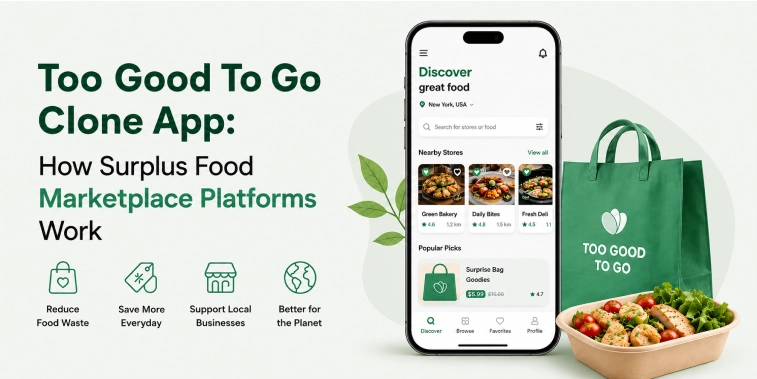
Introduction
Food waste is becoming an important challenge for restaurants, bakeries, cafés, grocery stores, supermarkets, and other food businesses. Every day, businesses may have unsold food that is still suitable for consumption but cannot be sold through their normal channels. At the same time, consumers are increasingly interested in affordable food options and more sustainable purchasing choices.
This has created an opportunity for surplus food marketplace platforms that connect businesses with customers who want to purchase available surplus food at reduced prices.
A Too Good To Go Clone App provides a customizable platform for businesses that want to build their own surplus food marketplace. Instead of allowing suitable surplus food to go to waste, businesses can list available items through a digital platform and allow nearby customers to discover, reserve, and collect them.
The model creates value for multiple participants. Businesses can potentially recover revenue from surplus inventory, customers can discover discounted food, and the platform can facilitate a more efficient connection between supply and demand.
In 2026, this marketplace model can be strengthened by location-based discovery, real-time availability, digital payments, notifications, merchant dashboards, customer ratings, and data-driven inventory management.
This guide explains what a Too Good To Go Clone App is, how surplus food marketplace platforms work, which features they require, how businesses can monetize them, and which trends can shape this model in 2026.
What Is a Too Good To Go Clone App?
A Too Good To Go Clone App is a customizable marketplace platform designed around the surplus food business model. It connects food businesses that have suitable unsold food with customers who want to purchase available items, often at discounted prices.
The platform can be customized with a business’s own branding, service areas, marketplace rules, payment methods, commission structure, and merchant requirements.
Unlike a traditional food delivery application, the primary purpose of a surplus food marketplace is not to let customers order freshly prepared meals from a standard menu. Instead, participating businesses can list available surplus food or surprise-style food selections based on what remains available.
For example, a bakery may have unsold pastries near closing time. Rather than leaving those products unused, the bakery can create a surplus listing through the platform. Nearby customers can discover the listing, reserve it, pay through the application, and collect it during the specified pickup period.
A complete platform can include several components.
Customer App
Customers can discover nearby surplus food listings, view availability, reserve items, make payments, receive notifications, and access reservation history.
Merchant Panel
Restaurants, bakeries, cafés, supermarkets, and other food businesses can create listings, set quantities, define pickup windows, manage reservations, and monitor their marketplace activity.
Admin Dashboard
Administrators can manage customers, merchants, listings, payments, commissions, locations, complaints, promotions, and analytics.
Optional Delivery Management
If the business model supports delivery, delivery partners can be integrated into the platform. However, a pickup-focused model can remain the core workflow because surplus food marketplaces often depend on customers collecting their reserved food from participating businesses.
How Does a Surplus Food Marketplace Work?
A surplus food marketplace connects available food supply with nearby customer demand through a digital platform.
The basic process is
- Merchant lists surplus food
- Customer discovers listing
- Customer reserves
- Payment
- Pickup
- Reservation completion
This model differs from conventional food delivery because availability can change quickly.
A restaurant or bakery may not know exactly how much surplus food will remain until later in the day. Therefore, the platform needs to make it easy for merchants to update availability and for customers to discover time-sensitive listings.
Real-Time Availability
Merchants can add available surplus items or packages when they become known.
The listing can include:
- Food category
- Quantity
- Pickup location
- Pickup time
- Price
- Basic description
- Availability status
Limited Pickup Windows
Surplus food often has a specific collection period. Customers can therefore see when an item is available and plan their pickup accordingly.
Reservation-Based Marketplace
Instead of guaranteeing a traditional menu selection, businesses can offer a defined surplus package or available selection.
Customers reserve the available offering and collect it during the specified time.
This helps simplify inventory management for merchants while creating an attractive marketplace experience for customers.
Types of Businesses That Can Use a Surplus Food Marketplace
A Too Good To Go-style platform can support several types of food businesses.
Bakeries
Bakeries may have unsold bread, pastries, cakes, sandwiches, and other products toward the end of the day.
A surplus marketplace can help them offer suitable remaining products to nearby customers.
Restaurants & Cafés
Restaurants and cafés can create surplus listings based on suitable prepared food or products that remain available.
Supermarkets & Grocery Stores
Supermarkets can potentially list suitable surplus bakery products, prepared foods, packaged products, and other eligible inventory according to their operating policies.
Hotels
Hotels with suitable surplus food offerings can potentially participate in a marketplace model where applicable.
Food Retailers
Specialty food stores and other food retailers can use the platform to connect available surplus products with nearby customers.
The exact food categories and business requirements should be determined according to local regulations, food safety practices, and the platform’s operating model.
How Customers Use a Too Good To Go Clone App
The customer journey should be simple because surplus listings can be time-sensitive.
1. Create an Account
Customers register and create a profile. They can manage their details, saved locations, payment methods, and reservation history.
2. Discover Nearby Listings
Location-based discovery allows customers to see participating businesses and available surplus food near them.
Users can browse listings based on distance, pickup time, category, or other marketplace filters.
3. View Listing Details
Customers can see important information such as the business name, pickup location, collection window, price, and description of the available surplus offering.
4. Reserve a Listing
After selecting an available listing, the customer confirms the reservation.
5. Complete Payment
The customer can pay through the supported payment method and receive a reservation confirmation.
6. Collect the Food
Customers visit the participating business during the specified pickup period and collect their reserved food.
7. Confirm & Review
After collection, the platform can mark the reservation as completed and allow customers to rate or review the experience.
This simple workflow helps connect surplus supply with nearby demand without requiring merchants to maintain a large traditional delivery menu.
Must-Have Features of a Too Good To Go Clone App
A successful surplus food marketplace needs features designed around time-sensitive inventory, location-based discovery, reservations, and merchant management.
Customer App Features
Nearby Surplus Discovery
Customers can discover available listings based on their current or selected location.
Search & Filters
Users can filter listings by food category, distance, pickup time, price, or other available criteria.
Listing Details
Each listing can display the merchant, price, pickup window, location, availability, and relevant description.
Reservation Management
Customers can view active reservations, upcoming pickup times, and completed reservations.
Digital Payments
The platform can support available payment methods for online reservation payments.
Notifications
Push notifications can remind customers about reservation confirmation, pickup times, availability changes, or other important updates.
Maps & Navigation
Location and map integration can help customers find participating businesses and reach pickup locations.
Ratings & Reviews
Customers can provide feedback after completing a pickup.
Merchant Panel Features
The Merchant Panel is particularly important because surplus availability can change throughout the day.
Merchant Registration
Businesses can create profiles and provide the information required for platform approval.
Surplus Listing Creation
Merchants can create listings with available quantities, pricing, pickup windows, and descriptions.
Availability Management
Businesses can update quantities or deactivate listings when the available surplus has been reserved.
Reservation Management
Merchants can view reservations and prepare the required surplus packages for customer collection.
Pickup Management
Businesses can verify reservations and mark pickups as completed according to the platform workflow.
Sales & Performance Insights
Merchants can monitor reservations, revenue, popular pickup periods, and other available marketplace metrics.
Admin Dashboard Features
The Admin Dashboard provides centralized management of the marketplace.
Customer Management
Administrators can manage customer accounts, activity, support requests, and account status.
Merchant Management
The platform can review merchant registrations, approve businesses, manage profiles, and monitor marketplace activity.
Listing Management
Administrators can monitor active listings, categories, pricing, availability, and marketplace activity.
Payment & Commission Management
The dashboard can manage transactions, commissions, refunds, settlements, and other financial records.
Service Area Management
Administrators can define supported locations and monitor marketplace activity across different areas.
Analytics & Reports
Reports can provide insights into reservations, revenue, merchant performance, customer activity, popular locations, and listing demand.
Benefits of a Surplus Food Marketplace Platform
Helps Businesses Monetize Suitable Surplus
Businesses can potentially recover some revenue from suitable surplus food instead of leaving all unsold inventory unused.
Creates Affordable Options for Customers
Customers can discover food offerings at prices that may be lower than regular retail pricing.
Improves Inventory Utilization
A marketplace can help businesses create another sales channel for available surplus inventory.
Builds Customer Engagement
Customers may return regularly to discover new listings from nearby businesses.
Supports Local Food Businesses
The platform can help smaller restaurants, bakeries, cafés, and food retailers reach additional nearby customers.
Creates a Scalable Marketplace Model
Entrepreneurs can expand the platform by adding more merchants, customers, categories, and geographic areas.
Too Good To Go Clone App Business Model & Revenue Streams
A surplus food marketplace can generate revenue through multiple approaches.
Merchant Commission
The platform can charge participating merchants a commission on completed reservations.
Customer Service Fee
A platform can apply a service fee to selected transactions where appropriate.
Featured Listings
Merchants may be offered optional promotional placement to increase the visibility of their listings.
Subscription Plans
The platform can introduce merchant subscription plans that provide selected marketplace tools or promotional benefits.
Promotional Partnerships
Businesses can create marketplace campaigns or promotional arrangements to increase customer discovery and engagement.
The best revenue model depends on the target market, merchant economics, customer expectations, and operating costs.
Too Good To Go Clone App Development Process
Building a surplus food marketplace requires a development strategy focused on marketplace operations and real-time availability.
1. Market Research
Identify the target customers, participating food businesses, local demand, competitors, food categories, and operating areas.
2. Define the Marketplace Model
Determine whether the platform will focus on customer pickup, delivery, or a combination of both.
Also define how merchants will list surplus food and how reservations will be handled.
3. UI/UX Design
Design simple interfaces for customers, merchants, and administrators. The customer experience should make nearby listings easy to discover.
4. Platform Development
Develop the customer application, merchant panel, admin dashboard, and backend systems required for listings, reservations, payments, notifications, and location services.
5. Integrations
Depending on requirements, integrate maps, payment gateways, notifications, analytics, and other necessary technologies.
6. Testing
Test listing creation, reservation availability, payments, pickup verification, notifications, cancellations, and marketplace workflows.
7. Launch & Optimization
Launch in a defined geographic area, monitor customer and merchant feedback, analyze marketplace activity, and expand gradually.
Future Trends for Surplus Food Marketplace Platforms in 2026
AI-Powered Demand Prediction
AI can help businesses analyze historical marketplace activity and identify patterns in surplus availability, customer demand, and pickup periods.
Personalized Food Recommendations
A platform can use relevant customer behavior to recommend nearby listings that match previous interests or preferences.
Smarter Inventory Management
Data-driven tools can help merchants understand which products, categories, and time periods generate stronger marketplace demand.
Real-Time Availability
Improved real-time listing management can help customers see more accurate availability while reducing outdated listings.
Location-Based Personalization
Platforms can use location information to prioritize nearby listings and make discovery more relevant.
Data-Driven Marketplace Growth
Analytics can help platform operators identify high-demand areas, successful merchant categories, customer retention patterns, and opportunities for geographic expansion.
These trends can make surplus food marketplaces more efficient and personalized while helping businesses manage changing inventory.
Conclusion
A Too Good To Go Clone App can provide the foundation for a digital surplus food marketplace that connects food businesses with customers looking for convenient and affordable food options.
The model is different from a traditional food delivery application because the platform focuses on available surplus inventory, time-sensitive listings, reservations, and customer pickup or delivery rather than a fixed menu.
For merchants, the platform can create an additional sales channel for suitable surplus food. Customers can discover nearby offerings through a simple mobile experience, while the platform operator can generate revenue through merchant commissions, service fees, featured listings, subscriptions, and other marketplace models.
The most important elements of the platform are real-time availability, location-based discovery, simple reservations, merchant tools, secure payments, notifications, and reliable marketplace management.
In 2026, AI-powered demand prediction, personalization, smarter inventory insights, real-time availability, and data-driven expansion can further improve the surplus food marketplace experience.
Businesses entering this market should focus on building a reliable local marketplace first, developing strong merchant relationships, maintaining a simple customer experience, and expanding based on actual demand.
Frequently Asked Questions (FAQs)
1. What is a Too Good To Go Clone App?
A Too Good To Go Clone App is a customizable surplus food marketplace platform that connects food businesses with customers interested in purchasing available surplus food through reservations.
2. How does a surplus food marketplace work?
Businesses list suitable surplus food with availability, pricing, and pickup information. Customers discover nearby listings, reserve and pay for them, and collect the food during the specified pickup period.
3. Which businesses can use a surplus food marketplace?
Bakeries, restaurants, cafés, supermarkets, hotels, grocery businesses, and other suitable food retailers can potentially participate, depending on the platform model and applicable food safety requirements.
4. How does a surplus food marketplace make money?
Common revenue options include merchant commissions, customer service fees, featured listings, subscription plans, and promotional partnerships.
5. What features are important in a Too Good To Go Clone App?
Important features include location-based discovery, surplus listing management, real-time availability, reservations, digital payments, pickup windows, notifications, maps, merchant management, and analytics.

Parth Kulkarni
Managing Director
Parth Kulkarni is the Managing Director with strong expertise in IT and on-demand app solutions, focused on empowering startups and enterprises with scalable digital products. His strategic leadership and business insight drive innovation, ensuring consistent client success and long-term growth.