

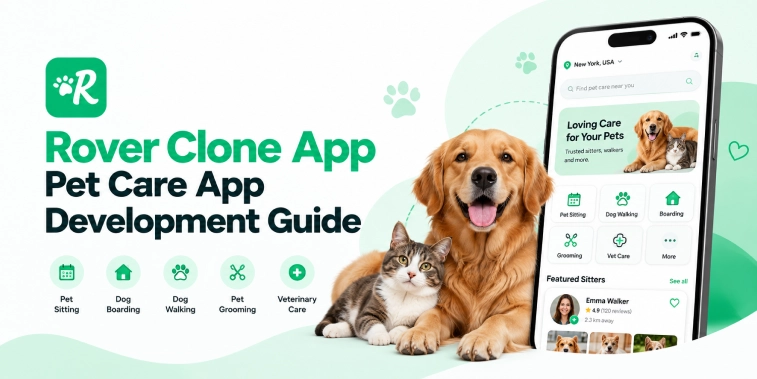
Introduction
Pet owners increasingly use digital platforms to find convenient and reliable services for their pets. From dog walking and pet sitting to grooming, boarding, training, and other care services, mobile applications have made it easier to discover providers, compare services, schedule appointments, and manage bookings.
A Rover Clone App is a customizable pet care platform designed around the core concept of connecting pet owners with independent pet care providers through a mobile and web-based ecosystem. Businesses can customize the platform to create their own branded pet care marketplace while adapting its features, service categories, pricing, and business model to their target market.
A modern pet care app can connect several participants, including pet owners, pet sitters, dog walkers, groomers, trainers, administrators, and other service providers. The platform can provide tools for profiles, service discovery, availability, booking, payments, messaging, reviews, notifications, and provider management.
This guide explains what a Rover Clone App is, how it works, its key features, AI-powered functionality, provider tools, business models, technology integrations, security considerations, and important aspects of pet care app development.
What Is a Rover Clone App?
A Rover Clone App is a ready-to-customize pet care marketplace solution inspired by the service marketplace model associated with Rover.
The purpose is not necessarily to create an identical copy of another company’s application. Instead, a clone solution can provide a foundation containing common pet care marketplace functionality that a business can customize according to its own brand and requirements.
A typical platform can connect:
- Pet owners
- Pet sitters
- Dog walkers
- Groomers
- Trainers
- Boarding providers
- Pet care businesses
- Administrators
Pet owners can use the application to discover nearby providers, view profiles, compare services, check availability, make bookings, communicate with providers, and complete payments.
Service providers can create profiles, list services, manage availability, accept bookings, communicate with customers, and monitor earnings.
Administrators can manage users, providers, bookings, payments, reviews, commissions, promotions, and other platform operations.
How Does a Rover Clone App Work?
A pet care marketplace generally follows a service discovery and booking workflow.
Step 1: User Registration
Pet owners create an account using supported authentication options.
They can provide basic information and create pet profiles containing relevant details.
Step 2: Pet Profile Creation
Users can add information about their pets, such as:
- Pet name
- Pet type
- Breed
- Age
- Size
- Special requirements
- Care instructions
- Behavioral information
This information can help providers understand the pet before accepting a service.
Step 3: Service Discovery
Pet owners search for services such as:
- Dog walking
- Pet sitting
- Boarding
- Grooming
- Training
- Drop-in visits
- Other pet care services
Step 4: Search and Filtering
Users can filter providers according to factors such as location, service type, availability, pricing, ratings, and other relevant criteria.
Step 5: Provider Profile Review
Customers can view provider profiles, services, prices, availability, ratings, reviews, and other information.
Step 6: Booking
The pet owner selects a service, date, time, pet, and other booking details before submitting the request.
Step 7: Payment
The customer completes payment using a supported payment method.
Step 8: Service Delivery
The provider performs the requested service according to the booking.
Step 9: Communication and Updates
Customers and providers can communicate through supported messaging and receive relevant notifications.
Step 10: Review
After the service, customers can provide ratings and reviews.
This workflow creates a structured marketplace connecting pet owners with care providers.
Why Build a Pet Care App?
The pet care industry includes many recurring services, which creates opportunities for digital marketplaces.
A dedicated application can make it easier for customers to find providers and manage recurring or one-time services.
Growing Digital Pet Care Demand
Pet owners increasingly use online tools to search for services, compare providers, and manage appointments.
Convenient Service Discovery
A marketplace can bring multiple pet care services into one application.
Local Marketplace Opportunities
Pet care services are often location-dependent. A platform can connect local pet owners with nearby providers.
Recurring Bookings
Dog walking, pet sitting, grooming, and similar services can generate repeat bookings.
Provider Flexibility
Independent pet care providers can use the marketplace to showcase their services and reach potential customers.
Key Features of a Rover Clone App
A complete pet care marketplace should include functionality for pet owners, providers, administrators, and platform operations.
Pet Owner Features
User Registration and Login
Users can create accounts using phone numbers, email addresses, social login, or other supported methods.
Secure authentication helps protect account information.
Pet Profiles
Pet profiles are especially important for a pet care marketplace.
A profile can include:
- Name
- Breed
- Age
- Size
- Medical or care notes where appropriate
- Feeding instructions
- Walking preferences
- Behavioral information
- Emergency contact information
- Special instructions
The amount and type of information collected should be appropriate to the service and handled securely.
Service Search
Users can search for pet care providers based on their requirements.
Search categories can include:
- Dog walking
- Pet sitting
- Boarding
- Grooming
- Training
- Drop-in care
- Daycare
Filters
Filters can make provider discovery easier.
Possible filters include:
- Service type
- Location
- Price
- Availability
- Rating
- Pet type
- Pet size
- Service duration
Provider Profiles
A provider profile can display:
- Profile photo
- Introduction
- Experience
- Services
- Pricing
- Availability
- Service area
- Ratings
- Reviews
- Certifications where applicable
Availability Calendar
Providers can manage available dates and times through a calendar.
Customers can see available slots before submitting a booking request.
Booking Management
Customers can create, view, modify, or cancel eligible bookings according to platform policies.
The application can provide booking details such as service type, provider, pet, date, time, location, and price.
Digital Payments
The platform can integrate supported payment methods.
Customers should be able to see pricing and applicable fees clearly before confirming a transaction.
Messaging
An in-app communication system can allow pet owners and providers to discuss booking-related information.
Messaging can be particularly useful for sharing care instructions or clarifying service details.
Notifications
Notifications can provide relevant updates about:
- Booking requests
- Booking confirmations
- Reminders
- Provider messages
- Payment activity
- Service updates
- Cancellations
Ratings and Reviews
After a completed service, customers can rate providers and leave reviews.
Reviews can help other customers evaluate providers while giving providers feedback about their services.
Favorites
Users can save preferred providers for future bookings.
This can simplify repeat service discovery.
Pet Care Provider Features
Providers need dedicated tools to manage their marketplace presence and bookings.
Provider Registration
Service providers can create profiles and submit required information for verification.
Depending on the business model and market, verification may include identity, experience, qualifications, background checks, or other relevant documentation.
Service Listing
Providers can list the services they offer.
They can define:
- Service categories
- Pricing
- Service duration
- Service area
- Availability
- Pet types accepted
- Other service conditions
Schedule Management
Providers can manage their calendars and prevent customers from booking unavailable time slots.
Booking Requests
Providers can receive new booking requests and accept or decline them according to platform rules.
Earnings Dashboard
Providers can view relevant earnings information, completed services, pending amounts, and transaction history.
Customer Communication
Providers can communicate with customers through in-app messaging where supported.
Reviews Management
Providers can view customer feedback and monitor their service ratings.
Admin Dashboard
The admin dashboard is the central control system for the marketplace.
Administrators can manage different aspects of the platform from one interface.
User Management
Admins can manage pet owner accounts, provider accounts, support requests, and account activity.
Provider Management
The dashboard can support provider approval, verification, profile management, service categories, and account controls.
Booking Management
Administrators can monitor bookings, cancellations, disputes, and other operational events.
Payment Management
The platform can track transactions, commissions, refunds, and other payment-related activity.
Commission Management
The business can define commission structures for eligible provider transactions.
Review Management
Administrators can monitor reviews and handle content that violates platform policies.
Promotions
Admins can create promotional campaigns, coupons, referral programs, and other customer offers.
Analytics and Reports
Reports can provide information about:
- Bookings
- Revenue
- Active users
- Provider performance
- Popular services
- Customer retention
- Cancellations
AI Features for a Modern Pet Care App
Artificial intelligence can add useful capabilities to a pet care marketplace when implemented responsibly.
AI-Powered Provider Recommendations
AI can analyze relevant user preferences and service requirements to recommend potentially suitable providers.
Recommendations should be presented as suggestions rather than guarantees about provider quality.
Intelligent Search
AI can help interpret natural-language searches.
For example, a user could search for a provider who offers evening dog walking in a particular area, and the platform can identify relevant search criteria.
Personalized Service Discovery
AI can use relevant booking patterns and preferences to personalize service suggestions.
AI Customer Support
An AI assistant can answer common questions about:
- Bookings
- Payments
- Cancellations
- Provider availability
- Account settings
- General platform usage
More complex issues can be transferred to human support.
Demand Forecasting
AI-based analytics can help businesses identify demand patterns for pet care services.
This can help with provider acquisition, promotional planning, and service availability.
Fraud and Anomaly Detection
AI can assist in identifying unusual account or transaction activity.
This should be part of a broader security and risk-management system.
Business Model and Revenue Opportunities
A Rover Clone App can support different monetization strategies.
Commission-Based Revenue
The platform can charge a commission on eligible bookings made through the marketplace.
Service Fees
Customers may be charged applicable platform or service fees, which should be clearly disclosed.
Provider Subscription Plans
Providers may be offered subscription plans with additional marketplace or business tools.
Featured Listings
Providers may pay for eligible promotional visibility within the platform.
Advertising
Pet-related brands can potentially advertise relevant products or services to customers, subject to platform policies.
Premium Customer Memberships
A platform can offer optional membership programs with eligible benefits.
Partner Revenue
The marketplace can create partnerships with pet product companies, veterinary services, grooming businesses, trainers, or other relevant providers.
The exact revenue structure should be designed around customer value, provider economics, and local market conditions.
Technology and Third-Party Integrations
A pet care marketplace requires several technical components and external integrations.
Payment Gateway Integration
Payment providers can process supported online transactions.
Maps and Location APIs
Maps support provider discovery, service areas, locations, and navigation.
Push Notification Services
Push notifications provide timely updates to customers and providers.
SMS and Email Services
These services can support authentication, reminders, transactional messages, and customer communication.
Calendar Integration
Calendar functionality can help providers and customers manage appointments and availability.
Analytics Tools
Analytics systems can provide insights into user behavior, bookings, conversion activity, and provider performance.
AI Services
AI integrations can support recommendations, search, customer support, forecasting, and other intelligent features.
Cloud Infrastructure
Cloud infrastructure can support hosting, databases, file storage, monitoring, backups, and scalable application services.
Security and Privacy
A pet care platform can process personal information, addresses, pet information, payment-related information, provider information, and communication data.
Security should therefore be treated as a core platform requirement.
Important measures can include:
- Secure authentication
- Encryption
- Role-based access control
- Secure APIs
- Payment security
- Data access controls
- Activity monitoring
- Backup systems
- Recovery procedures
- Regular security testing
Businesses should also comply with applicable privacy and data protection requirements in the regions where they operate.
Because pet care can involve access to a customer’s home or personal location, the platform should also provide appropriate privacy controls and transparent policies around location and personal information.
How to Make a Rover Clone App Stand Out
The pet care marketplace can become more competitive as more businesses offer digital booking services. A platform can differentiate itself by focusing on customer trust and service quality.
Build Strong Provider Profiles
Detailed and transparent provider profiles can help customers make informed decisions.
Make Booking Simple
Customers should be able to search, compare, select, and book services without unnecessary steps.
Support Repeat Bookings
Easy rebooking can help customers schedule recurring pet care services.
Improve Communication
Messaging, reminders, and clear booking information can reduce misunderstandings between customers and providers.
Focus on Local Services
Strong local search and service-area management can help connect customers with relevant providers.
Use AI Carefully
AI should solve useful problems rather than simply being added as a marketing feature.
Prioritize Trust
Verification, reviews, clear policies, customer support, and secure payment handling can contribute to a stronger marketplace experience.
Pet Care App Development Process
Developing a pet care marketplace requires planning across product, technology, operations, and business strategy.
Market Research
Identify the target audience, service categories, local competitors, provider supply, and customer needs.
Feature Planning
Define the functionality required for customers, providers, administrators, and other participants.
UI/UX Design
Create simple interfaces that make service discovery, booking, communication, and management easy.
Technology Planning
Choose an architecture that supports mobile applications, web dashboards, APIs, databases, integrations, security, and scalability.
Development
Develop the customer application, provider application, admin dashboard, backend services, and required integrations.
Testing
Test functionality, usability, security, performance, payments, notifications, location services, and booking workflows.
Launch
Release the platform in a focused market and monitor customer and provider feedback.
Continuous Improvement
Use analytics and feedback to improve features, user experience, marketplace operations, and platform reliability.
Cost Factors in Pet Care App Development
The cost of developing a Rover-style pet care platform can vary significantly depending on the project scope.
Important factors include:
- Number of applications
- Feature complexity
- UI/UX requirements
- Customization level
- AI functionality
- Payment integrations
- Maps and location features
- Third-party services
- Admin dashboard complexity
- Security requirements
- Development team location
- Testing requirements
- Maintenance and support
A basic marketplace may require fewer resources than a large multi-service platform with advanced AI, complex provider verification, sophisticated analytics, and multiple integrations.
Instead of focusing only on initial development cost, businesses should also consider infrastructure, maintenance, customer support, marketing, provider acquisition, and ongoing product improvements.
Conclusion
A Rover Clone App can provide a customizable foundation for launching a digital pet care marketplace. It can connect pet owners with dog walkers, sitters, groomers, trainers, boarding providers, and other pet care professionals through one platform.
A complete solution can include pet profiles, service discovery, provider profiles, search and filters, availability calendars, bookings, payments, messaging, notifications, ratings, reviews, location features, provider management, and an administrative dashboard.
AI can add further capabilities through personalized recommendations, intelligent search, customer support, demand forecasting, and anomaly detection. Technology integrations for payments, maps, calendars, notifications, analytics, and cloud infrastructure can support the technical operation of the platform.
However, a successful pet care marketplace requires more than software. Trust, provider quality, customer support, transparent policies, convenient booking, and reliable service operations are equally important.
Businesses should customize the platform according to their target market, service categories, provider network, revenue model, and regulatory requirements. With a clear strategy and a scalable technology foundation, a Rover-style platform can provide a structured way to bring pet owners and care providers together through a convenient digital marketplace.
Frequently Asked Questions (FAQs)
1. What is a Rover Clone App?
A Rover Clone App is a customizable pet care marketplace solution inspired by the service marketplace model associated with Rover. It can connect pet owners with providers offering services such as dog walking, pet sitting, boarding, grooming, and training.
2. How does a Rover Clone App work?
Pet owners create accounts and pet profiles, search for suitable providers, check services and availability, make bookings, complete payments, communicate with providers, and review services. Providers manage their profiles, schedules, bookings, and earnings through a dedicated interface.
3. What features should a Rover Clone App include?
Important features can include pet profiles, provider profiles, service discovery, search and filters, availability calendars, booking management, payments, messaging, notifications, ratings and reviews, location services, provider management, analytics, and an admin dashboard.
4. Can AI be integrated into a Rover Clone App?
Yes. AI can support provider recommendations, intelligent search, personalized service discovery, customer support, demand forecasting, and anomaly detection.
5. How can a Rover Clone App generate revenue?
Potential revenue models include booking commissions, service fees, provider subscriptions, featured listings, advertising, premium customer memberships, and relevant business partnerships. The appropriate model depends on the platform’s target market and operating strategy.

Parth Kulkarni
Managing Director
Parth Kulkarni is the Managing Director with strong expertise in IT and on-demand app solutions, focused on empowering startups and enterprises with scalable digital products. His strategic leadership and business insight drive innovation, ensuring consistent client success and long-term growth.