


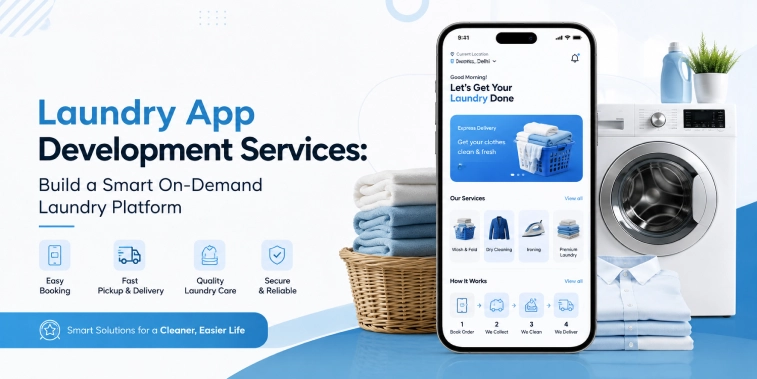
Introduction
Laundry is a recurring household and business requirement, but traditional laundry and dry-cleaning services can still depend heavily on phone calls, manual order management, uncertain pickup times, and limited visibility into order status. As customers become more comfortable booking everyday services through mobile applications, laundry businesses have an opportunity to move their operations to a digital platform.
Laundry app development services help businesses build on-demand laundry platforms that connect customers with laundries, dry cleaners, pickup and delivery partners, and administrators through a centralized system.
A smart laundry platform can allow customers to schedule pickups, select laundry services, choose convenient time slots, view pricing, track orders, make digital payments, and receive notifications. At the same time, laundry businesses can manage incoming orders, pricing, service categories, processing stages, and customer information through a dedicated management system.
The opportunity is not limited to traditional washing services. A modern platform can support wash-and-fold, dry cleaning, ironing, stain treatment, specialty garment care, scheduled laundry, and pickup-and-delivery services, depending on the business model.
In 2026, businesses can further improve laundry operations through real-time tracking, automated notifications, digital payments, route optimization, customer preferences, analytics, and AI-supported operational insights.
This guide explains how laundry app development services can help businesses build a smart on-demand laundry platform, what services and features such a platform can support, how the workflow operates, and which factors matter when developing a scalable laundry marketplace.
What Are Laundry App Development Services?
Laundry app development services involve designing and developing a digital platform that allows customers to book laundry or dry-cleaning services while enabling laundry businesses and delivery partners to manage the complete order lifecycle.
The platform can be developed as a standalone application for one laundry business or as a multi-vendor marketplace that connects customers with multiple laundry and dry-cleaning providers.
The exact structure depends on the business model.
A single laundry business may use the application to digitize its own pickup, processing, payment, and delivery operations. A marketplace model can bring several laundry providers together and allow customers to choose among available services.
A complete smart laundry platform can include several components.
Customer App
The Customer App allows users to browse laundry services, select garments or service categories, schedule pickups, choose time slots, view prices, make payments, track orders, and manage their profiles.
Laundry Partner Panel
Laundry businesses can use a dedicated panel to receive orders, manage service categories, update order status, configure pricing, manage processing stages, and monitor business activity.
Delivery Partner App
Pickup and delivery partners can manage assigned jobs, view customer locations, navigate between locations, update pickup and delivery status, and monitor their earnings.
Admin Dashboard
The Admin Dashboard provides centralized control over customers, laundry partners, delivery partners, orders, payments, commissions, service areas, promotions, and analytics.
Together, these components create a connected platform for managing the laundry service journey from booking through final delivery.
Services Supported by an On-Demand Laundry Platform
A smart laundry application can support multiple service categories depending on the target market.
Wash & Fold
Customers can schedule everyday clothing and fabric washing services. The laundry provider collects the items, processes them, folds them, and prepares them for delivery.
Dry Cleaning
Dry-cleaning services can support garments that require specialized cleaning processes rather than standard washing.
Customers can select the service while providing relevant garment information through the platform.
Ironing & Pressing
Customers can request ironing or pressing services for clothing that requires professional finishing.
This can be offered as an independent service or combined with washing and dry cleaning.
Stain Treatment
Specialized stain-treatment services can be included for garments requiring additional cleaning attention.
Household Laundry
The platform can support larger household laundry requirements such as bedding, curtains, towels, blankets, and other suitable items.
Commercial Laundry
Laundry businesses can also serve hotels, restaurants, salons, gyms, offices, healthcare organizations, and other businesses that require recurring laundry services.
Commercial customers may need scheduled pickups, recurring orders, bulk processing, and centralized billing.
Pickup & Delivery
Pickup and delivery form an important part of an on-demand laundry platform. Customers can choose a convenient time slot, while delivery partners collect and return the processed laundry.
The exact services should be selected according to customer demand, business capabilities, local regulations, and available laundry infrastructure.
How Does an On-Demand Laundry App Work?
A smart laundry platform connects customers, laundry providers, and delivery partners through a structured digital workflow.
The typical process is:
- Customer selects a laundry service
- Customer schedules pickup
- Laundry partner receives the order
- Pickup partner collects the laundry
- Laundry is processed
- Order status is updated
- Clean laundry is prepared for delivery
- Delivery partner returns the order
- Customer receives the completed laundry
This workflow gives customers visibility into their order while helping businesses coordinate laundry processing and transportation.
1. Customer Registration
Customers create an account and provide basic information such as their name, contact details, and preferred addresses.
They can also save multiple pickup and delivery addresses for future bookings.
2. Select Services
Customers browse available laundry services such as wash-and-fold, dry cleaning, ironing, stain treatment, or household laundry.
3. Choose Pickup Time
The customer selects an available pickup date and time slot based on the service provider’s operating schedule.
4. Add Order Details
Depending on the platform design, customers can specify garment categories, approximate quantities, service requirements, special instructions, or other relevant information.
5. Confirm Pricing
The platform displays applicable pricing based on the selected services, quantity, weight, garment category, delivery charges, or other configured pricing rules.
6. Confirm Booking
After reviewing the order details, the customer confirms the booking.
The request is then assigned to the relevant laundry provider or delivery partner.
7. Pickup
A delivery partner or laundry representative reaches the customer’s location and collects the laundry.
The platform can update the order status to indicate that the pickup has been completed.
8. Processing
The laundry provider processes the order according to the selected services.
Status updates can show stages such as received, processing, ready for delivery, and out for delivery.
9. Delivery
Once processing is complete, the order is assigned for delivery. Customers can receive notifications and, where supported, track the delivery.
10. Completion & Review
The customer receives the processed laundry and the order is marked as completed. The customer can then rate the service and provide feedback.
This structured workflow reduces manual coordination and creates a more transparent experience for customers and service providers.
Must-Have Features of a Smart Laundry Platform
A modern laundry application should combine customer convenience with strong operational tools for laundry and delivery partners.
Customer App Features
Easy Registration & Profile Management
Customers can create accounts, manage personal information, save addresses, and view previous orders.
Service Selection
Users can browse laundry categories and select the services they need.
Pickup Scheduling
Customers can select convenient pickup dates and available time slots.
Order Management
The application can display active, upcoming, and completed laundry orders.
Pricing & Order Summary
Customers can review service charges, pickup or delivery fees, discounts, and the total order amount before confirmation.
Real-Time Order Tracking
Customers can monitor order progress from pickup through processing and final delivery.
Digital Payments
The platform can support available payment methods so customers can pay conveniently through the application.
Notifications
Push notifications can provide updates about pickup confirmation, laundry processing, order readiness, delivery, payment, and completion.
Ratings & Reviews
Customers can provide feedback after receiving their laundry.
Customer Support
A support feature can help users report issues, ask questions, or request assistance with their orders.
Laundry Partner Features
Laundry providers need tools to manage their daily operations.
Order Management
Partners can view new orders, confirm requests, update processing status, and manage completed orders.
Service & Pricing Management
Laundry businesses can configure available services, prices, garment categories, and additional charges.
Processing Status
Partners can update order stages such as received, sorting, washing, dry cleaning, ironing, quality checking, and ready for delivery where applicable.
Business Hours
Laundry providers can manage operating hours and service availability.
Earnings & Reports
Partners can monitor orders, revenue, settlements, and other available business performance information.
Delivery Partner Features
Pickup and delivery partners can use a dedicated application to manage transportation tasks.
Job Assignment
Partners can receive pickup and delivery assignments with relevant customer and order information.
Navigation
GPS and navigation tools can help partners reach pickup and delivery locations.
Pickup Confirmation
Partners can confirm when laundry has been collected.
Delivery Status
Partners can update delivery progress and mark completed orders.
Earnings Tracking
Partners can view completed jobs and relevant earnings information.
Admin Dashboard Features
The Admin Dashboard provides centralized management of the laundry platform.
Customer Management
Administrators can manage customer accounts, order history, support requests, and account status.
Laundry Partner Management
The platform can manage laundry provider registrations, service areas, pricing information, and account status.
Delivery Partner Management
Administrators can manage delivery partners, assignments, availability, performance, and payouts.
Order Management
The dashboard provides visibility into pickup requests, active laundry orders, processing stages, deliveries, cancellations, and completed orders.
Commission & Payment Management
For marketplace models, administrators can manage commissions, settlements, customer payments, refunds, and delivery charges.
Analytics & Reports
Reports can provide insights into order volume, revenue, popular services, customer activity, delivery performance, and geographic demand.
Benefits of Developing a Smart On-Demand Laundry Platform
Convenient Customer Experience
Customers can schedule laundry pickup and delivery without calling a laundry business or visiting the store.
Better Order Visibility
Digital status updates can give customers clearer information about where their laundry is within the service process.
Improved Business Efficiency
Laundry businesses can manage bookings, processing stages, customer information, and delivery coordination from a centralized system.
Wider Customer Reach
A digital platform can help laundry businesses reach customers beyond their existing walk-in clientele.
Multiple Service Opportunities
Businesses can offer washing, dry cleaning, ironing, stain treatment, household laundry, and commercial services through one platform.
Recurring Customer Relationships
Laundry is often a repeat requirement. Features such as saved addresses, order history, recurring bookings, and notifications can encourage repeat usage.
Scalable Operations
Businesses can expand into new service areas, add laundry partners, increase delivery capacity, or introduce additional services as demand grows.
Laundry App Business Model & Revenue Streams
A smart laundry platform can generate revenue through several models.
Service Commissions
A marketplace can charge laundry partners a commission on completed orders.
Delivery Charges
The platform can generate revenue from pickup and delivery charges based on distance, order size, service area, or other pricing rules.
Platform Fees
A service or platform fee can be applied to selected transactions where appropriate.
Subscription Plans
The platform can offer recurring plans for customers who regularly use laundry services. Benefits can include selected discounts, delivery benefits, or other platform-defined advantages.
Commercial Accounts
Businesses such as hotels, restaurants, gyms, salons, and offices can become recurring customers and generate revenue through scheduled or bulk laundry services.
Featured Listings
In a multi-vendor marketplace, laundry providers may be offered optional promotional placements to increase visibility.
A business can combine multiple revenue streams depending on its target customers and marketplace structure.
Laundry App Development Process
Building a smart laundry platform requires more than simply creating a booking application. The development process should consider customer experience, laundry operations, pickup and delivery, payments, and scalability.
1. Market Research
Identify the target customers, local competitors, laundry service demand, pricing expectations, service areas, and business opportunities.
2. Define the Business Model
Decide whether the platform will support one laundry business, multiple laundry partners, commercial customers, or a combination of these models.
3. Plan Services & Workflows
Define the laundry services, pricing structure, pickup process, processing stages, delivery workflow, cancellation rules, and customer support procedures.
4. UI/UX Design
Create intuitive interfaces for customers, laundry partners, delivery partners, and administrators. The customer interface should make service selection and scheduling simple.
5. App & Backend Development
Develop the applications and backend infrastructure required for accounts, orders, payments, scheduling, notifications, locations, partner management, and analytics.
6. Integrations
Depending on requirements, integrate maps, payment gateways, notifications, analytics, communication tools, and other required services.
7. Testing
Test booking, scheduling, pickup, order processing, payment, status updates, delivery, cancellation, and notification workflows.
8. Launch & Optimization
Launch within a defined market, collect customer and partner feedback, monitor analytics, and continuously improve the platform.
Future Trends in Laundry App Development in 2026
AI-Powered Demand Forecasting
AI can help businesses analyze order history and identify demand patterns. This can support better staffing, pickup planning, and operational preparation.
Smart Pickup & Delivery Routing
Location and optimization technologies can help businesses plan efficient pickup and delivery routes, particularly when multiple orders need to be collected or returned within similar time windows.
Personalized Service Recommendations
Platforms can use relevant customer preferences and order history to recommend services, recurring schedules, or suitable laundry options.
Automated Notifications
Smart notification systems can keep customers informed throughout the order lifecycle and reduce the need for manual communication.
Recurring Laundry Scheduling
Because laundry is a repeat requirement, platforms can provide recurring booking options for customers and commercial clients.
Data-Driven Operations
Analytics can help businesses identify popular services, high-demand areas, customer retention patterns, order volumes, and delivery performance.
Digital Payments & Cashless Operations
More digital transactions can make payments easier to manage while providing businesses with clearer financial records.
These technologies can help laundry businesses improve operational efficiency while providing customers with a more convenient digital experience.
Conclusion
Laundry app development services provide businesses with the technology needed to build smart on-demand laundry platforms that connect customers, laundry providers, and pickup and delivery partners.
A well-designed platform can support services such as wash-and-fold, dry cleaning, ironing, stain treatment, household laundry, commercial laundry, and pickup and delivery. Customers can select services, schedule pickups, monitor order progress, make payments, and receive their processed laundry without relying on manual booking processes.
For businesses, a digital platform can improve order management, expand customer reach, support recurring services, and create multiple revenue opportunities through commissions, delivery charges, platform fees, subscriptions, commercial accounts, and promotional listings.
In 2026, AI-powered demand forecasting, smarter routing, personalized recommendations, recurring scheduling, automated notifications, and data-driven operations can further improve laundry platforms.
The strongest strategy is to build around simple booking, reliable pickup and delivery, transparent pricing, accurate order tracking, efficient laundry operations, and a consistent customer experience. Businesses can then expand services and locations based on actual demand.
Frequently Asked Questions (FAQs)
1. What are laundry app development services?
Laundry app development services involve creating digital platforms that allow customers to book laundry and dry-cleaning services while helping laundry businesses and delivery partners manage orders, pickups, processing, payments, and deliveries.
2. What services can an on-demand laundry app offer?
An on-demand laundry platform can support wash-and-fold, dry cleaning, ironing, stain treatment, household laundry, commercial laundry, and pickup and delivery services.
3. How does a laundry app make money?
A laundry platform can generate revenue through service commissions, delivery charges, platform fees, subscription plans, commercial accounts, and featured listings.
4. What features are important in a smart laundry platform?
Important features include service selection, pickup scheduling, order tracking, digital payments, notifications, customer support, laundry partner management, delivery management, and an admin dashboard.
5. Why develop a laundry app in 2026?
A digital laundry platform can simplify booking and pickup, improve order visibility, help businesses manage operations, support recurring customers, and provide opportunities to expand laundry services through technology and data-driven operations.

Parth Kulkarni
Managing Director
Parth Kulkarni is the Managing Director with strong expertise in IT and on-demand app solutions, focused on empowering startups and enterprises with scalable digital products. His strategic leadership and business insight drive innovation, ensuring consistent client success and long-term growth.
